
Search myodfw.com
Showing 281 - 300 of 509 results

NE BIG GAME HUNTING April 23, 2026 Currently open Controlled Spring Bear, Cougar ( check current harvest numbers), Coyote Announcements and resources Here's the local scoop for your hunt area in the 2026 Spring Bear Forecast. Submit your applications for 2026 controlled hunts by May 15. Big game harvest statistics - You'll find links to population, harvest and point summary reports that can help you decide what hunts to apply for this season. Please report elk with hoof disease - If you see elk showing signs of elk hoof disease, including lame or limping elk or elk with damaged, injured…
Updated December 31, 2025 Subscribe for updates Starting Jan. 1, 2026, an Ocean Endorsement is needed for most recreational anglers fishing in the ocean. Check the Ocean Endorsement page for more information. Ocean Endorsement
Oregon's owls are mostly nocturnal, hunting for insects, fish, frogs, birds, mice and other small mammals in the night. Their hoots, screeches and calls can be heard after dark or early in the morning. Owls don't build nests, but instead use tree cavities, nests created by other species, naturally occurring structures or human-made nest platforms. The Western burrowing owl nests underground in abandoned dens dug by squirrels, prairie dogs and badgers. Learn more about Oregon's owls.

Features: Largemouth bass are greenish on the back and sides with a white belly and usually a dark horizontal stripe along the side. They are distinguished from their close cousin, the smallmouth, by a large mouth with the upper jaw extending behind the eye. Largemouth bass in Oregon can exceed 25 inches in length and a weight of 12 pounds. Habitats: Their preferred habitats are shallow ponds and lakes, or the backwater sloughs of rivers where aquatic plants or submerged logs and brush provide abundant cover. Largemouth bass begin life feeding on zooplankton (tiny crustaceans), but soon switch to insects…

CORVALLIS, Ore. – The shotgun range at E.E. Wilson Wildlife Area near Corvallis will be closed for renovation from July 14 through the end of October. Renovations on the range will include expanding the shooting bays and implementing ADA complaint access to the site. ODFW expects work to be complete…
Cassin's auklet uses a few offshore lands for breeding in Oregon. It forages in the marine environment and nests in a chamber under rocks or digs its own burrow, two to six feet long, in the soil. This species spends its day at sea and only comes to the burrow at night, perhaps to reduce discovery by predacious Western gulls. Although few Cassin's auklets nest in Oregon, nesting sites are found along the entire coast where offshore rocks provide appropriate habitat. During the non-breeding season this is the most abundant alcid seen at sea in Oregon. They are present offshore…

This active and often unwary woodpecker, the smallest in North America, is generally the most often seen black and white woodpecker in human-settled areas. A preference is shown for decayed wood for nesting, though sound wood is also utilized. Nest sites are usually 10 to 12 feet off of the ground. It is found mostly at low to moderate elevations in deciduous and mixed deciduous-coniferous forests throughout much of the state, and less often in coniferous forests. Hear the call of the Downy woodpecker Photo by ©Keith Kohl, ODFW

For many, the rich, melodious song of the Black-headed grosbeak is the music of springtime in Oregon. The handsome males, with their bold pattern of cinnamon, black, and white, are among our most striking songbirds, and area familiar site in parks and gardens as well as in almost every forest type in the state. The buffy, streaked females are less conspicuous, but are also accomplished singers. The Black-headed grosbeak is a common to fairly common breeder and common migrant in forested regions throughout the state. Hear the song of the Black-headed grosbeak Photo by David Bronson

SALEM, Ore. – A Chinese mitten crab, a prohibited species in Oregon, was found in the Willamette River near the Sellwood Bridge and reported to ODFW on Nov. 17. The crab was spotted in shallow water and captured by hand. It was alive and not released back into the river…

Gnat Creek Hatchery was constructed in 1960 as part of the Columbia River Fisheries Development Program (Mitchell Act)—a program to enhance declining fish runs in the Columbia River Basin. The facility is used for egg incubation and rearing of spring Chinook and winter steelhead. Most of the production is released off-station. The hatchery is an easy drive toward Oregon’s coast on Highway 30 and a visitor-friendly place for the entire family. With lots to do, located on beautiful Gnat Creek and tucked away amid the rainforest, this is a worthwhile stop on the way to the coast.
Upon taking an adult salmon, steelhead, legal-size sturgeon or Pacific halibut, the angler must immediately enter the codes for the species caught, ocean port or stream, and the month and day of catch. The information from these tags helps ODFW manage the fisheries and estimate total harvest. Currently nearly 40 percent of anglers use e-tagging. Want to switch from paper to electronic? Login to your account and look under your profile to switch.
This northern grouse reaches Oregon only in the forests of the Wallowa Mountains in the northeastern part of the state. It is dusky and slightly smaller than the ruffed grouse. Sexes are different in coloration; males have a black breast with white spotting on the sides, white spots at the base of a black tail, and a red comb above the eye. Females are heavily barred with dark brown and white and have a dark tail. Hear the call of the spruce grouse Spruce grouse observation form Photo by Dave Budeau, ODFW

ASTORIA, Ore. – Clatsop beaches reopen for razor clam harvesting Oct. 1 following the annual conservation closure that began July 15. Before harvesting razor clams or any shellfish, always call the Shellfish Safety Hotline at 1-800-448-2474 or visit the ODA Recreational Shellfish Biotoxin Webpage. During the closure, Oregon Department of…
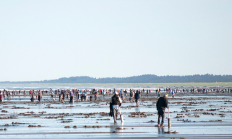
Features: Green sunfish have more of a bass-shaped body and a larger mouth than the other sunfishes, other than the warmouth. Also, unlike other sunfish except the warmouth, the pectoral fin is rounded, rather than pointed. Green sunfish are olive green on the back and sides with a yellowish-copper or brassy hue on the lower sides of the belly. Dusky, vertical bars are often present. Turquoise mottling, often in the form of bars, radiates backward from the snout and eye. They have a dark spot at the base of the rear lobe of the dorsal fin. Habitat: Green sunfish are…

This seabird, the most abundant in Oregon, has recently suffered severe declines or significant population shift in the eastern North Pacific. Similar in shape to thin, long-winged gulls, sooty shearwaters are dark sooty gray with limited amounts of white on the underwing coverts. They glide on wind currents along wave troughs on stiff wings. Gregarious, they form huge loose flocks in migration, often passing for hours within site of land-based observers. In Oregon, it is an abundant summer visitor and transient offshore on the inner shelf and is most numerous three to six miles offshore. Hear the call of the…


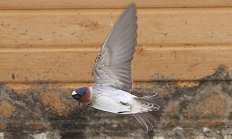
This chunky swallow is readily recognized by its square tail and orangish rump patch. It nests colonially and has taken to human-made structures so well that it has greatly expanded its range into many areas otherwise not suitable for it. It does not do well in urban settings, however, and quickly disappears when areas become densely settled. The unique gourd-shaped mud nest is often usurped by other species for nesting and is often used for protective roosting sites by rosy-finches and other wintering species. It is a locally common to abundant breeding bird near water throughout most of Oregon. Its…
Worldwide, frogs and toads are in trouble because of habitat loss, pollution, pesticides, climate change, diseases, the pet trade and competition from invasive species. Many of Oregon's 12 native species of frogs and toads are listed as Oregon Conservation Strategy Species of concern. Frogs and toads belong to the same animal group but are very different. Toads have dry, rough and bumpy skin covering a wide body while frogs are slender with smooth, moist skin. Frog eyes are higher on the head than toads and are rounder and bulging. And there's a reason we play "leap frog" - frogs take…
