
Search myodfw.com
Showing 301 - 320 of 484 results
WESTERN OREGON September 10, 2026 Current season: Mourning dove, ruffed and blue grouse, Rooster pheasant and Quail (Western Oregon), Turkey (Select WMU's) Announcements, resources 2026-27 Game Bird Regulations online and available at ODFW licensed agents and vendors. Buy your 2026-27 bird stamp(s) and validations - Available for purchase now: upland and waterfowl validations, federal duck stamp and don't skip the HIP survey. Redeem your sports-pac vouchers before entering the field to hunt. Don't miss the Youth Upland Game Bird Hunts register now. Plan this season's hunts with prior year game bird harvest summaries. ODFW's Hunt by Reservation Program connects bird hunters with private landowners…

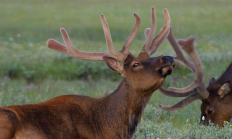
Sporting the form of a curlew, this medium-sized marsh wader is almost always found in flocks, flying in formation and quacking like ducks. Their long, down-curved bill complements their long neck and legs. Although their feathers appear black, a closer look will reveal an iridescence of bronze, purple, maroon, and green. They are named for their "white face" which appears in alternate plumage as a narrow border of white feathers along the edge of their reddish-purple facial skin, delineating a mask around the red eye. The White-faced ibis has extended its breeding grounds in Oregon to wetlands in Harney, Lake…
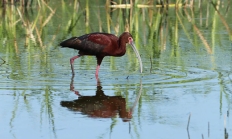
The Sharp-shinned hawk is North America's smallest and most migratory accipiter. As a hunter of songbirds (and sometimes young chickens) it historically endured harsh reproach, and was often depicted as a blood-thirsty villain, even by some ornithologists. Across the U.S., many thousands were shot in the first half of the 20th century. But prevailing attitudes have changed, and today a glimpse of this slender, secretive hawk darting through the treetops is more likely to elicit admiration than malice. Adult plumage, nearly identical to the slightly larger Cooper's hawk, consists of slate gray back and wings, breast and sides barred with…
Features: Bullheads present in Oregon (brown, yellow and black) are distinguished from channel catfish by their square or rounded tails and lack of spotting. They seldom exceed two pounds and 18-inches long. Black bullheads have a square tail with a light vertical bar at its base and chin barbels that are all dark. Habitat: Bullheads are found on the bottom in the shallows of mud-bottomed ponds, lakes, reservoirs and backwaters of rivers. The black bullhead is primarily in reservoirs and streams tributary to the Snake River. Bullheads feed on almost any type of plant or animal material; insect larvae and…

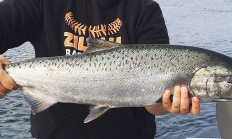
Features: While in the ocean, Chinook salmon often have a purple hue to their backs with silvery sides and bellies, large oblong black spots on the back, and round black spots on both lobes of the tail (note that tail spotting may be obscured in ocean fish by “silver” in the tail). Upon returning to freshwater to spawn, Chinook darken in color and develop red on their bellies and fins. A key identifier is the black gum line on the lower jaw with dark colors both inside and outside of the gum line. Spawning generally occurs from August to early…
Features: When in the ocean coho salmon can look very similar to Chinook salmon . However, coho will have a white gum line on the lower jaw with darker color both inside and outside of the gum line, and will only have spots on the upper lobe of their tails. When coho return to freshwater they become red on their sides and dark greenish on their backs, heads, and fins. Coho adults may reach 25 pounds or more, but rarely exceed 15 pounds. Habitat: Small, relatively low-gradient tributary streams with pea to orange-sized gravel for spawning and juvenile rearing. Coho…

Features: Smallmouth bass are golden green to bronze with dark vertical bars and blotches on the side. The upper jaw does not extend beyond the eye. In some locations, it has a red eye. Somewhat smaller than the largemouth, smallmouth bass in Oregon may reach 23-inches and exceed 7 pounds. Habitat: Smallmouth bass are adapted to flowing waters and do well in warm streams with deep holes and rocky ledges. They also prefer lakes and reservoirs with rocky shorelines and limited vegetation. Adult smallmouth feed mostly on fish and crayfish. Technique: Much of what was written about largemouth bass also…


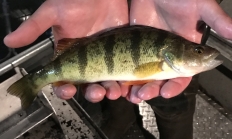
Features: Yellow perch are golden, with six to nine dark vertical bars. They have two well-separated dorsal fins; the second fin has two or three spines. Lower fins are yellowish-orange and, unlike walleye, yellow perch do not have canine teeth. Maximum size in Oregon exceeds 3 pounds and 18-inches long. They are prolific spawners, often resulting in an overpopulation of stunted fish. Habitat: Yellow perch prefer lakes, reservoirs and slower moving streams that have cool, clean water and ample vegetation. Perch bite readily and are therefore popular with young and novice anglers. Technique: In the spring and fall, find yellow…

Features: Bluegills are distinguished from other panfish by the black ear flap and black spot at the rear base of the dorsal fin. Five to eight greenish, vertical bars are faintly visible on their sides. The body is olive-green in color, bluish above and silvery below. Breeding males develop a bright orange to red flush on the throat area. Adults in most waters measure 5- to 8-inches, but the state record bluegill exceeded 12-inches. Habitat: Bluegills prosper in clear, clean ponds, lakes and backwaters of slow streams with abundant vegetation. They feed on both plant and animal life, but primarily…


Piloted in 2014, the Tag Team program helps ODFW fish biologists better evaluate resident gamefish, bass, and stocked rainbow trout fisheries. It's also a chance for anglers to participate in fishery management and, perhaps, come away with up to $50.