Search myodfw.com
Showing 361 - 380 of 746 results
Flocks of these big, brown, plain sparrows are a common sight in winter in western Oregon. By early spring their faded head markings become a beautiful gold, black and white, and their plaintive descending songs become frequently heard from almost any large brush pile. They are an abundant migrant in western Oregon, less common farther east, and abundant in winter throughout the Willamette Valley. Hear the song of the Golden-crowned sparrow Photo by Dave Budeau, ODFW
Adult Northern leopard frogs have smooth skin that is green or brown and covered with dark brown spots outlined with white rings. Females grow to just over four inches in length; males are slightly smaller at just over three inches. They live in and near various water sources with abundant vegetation such as wet meadows, marshes, riparian areas and moist, open woodlands. These frogs use the vegetation, such as grasses, sedge, weeds or brush, as cover from predators. During the winter, they need ponds or slow-running streams for hibernation. Photo from ODFW
This salt-loving bird is possibly the most abundant grebe in the world. These grebes nest in the large, tule-fringed marshes of southeastern Oregon. They also use almost any open water for feeding after the breeding season. The eared grebe has been reported breeding in nearly every eastern Oregon county, but principal breeding areas are in Klamath, Lake, and Harney counties. It is local elsewhere east of the Cascades. Hear the call of the eared grebe Photo by Dave Budeau, ODFW
The brush rabbit rarely ventures more than a few meters from the extremely dense brush that constitutes the requisite component of their habitat. Runways are interlaced through brushy clumps into surrounding grassy areas and are kept clear of vegetation for easy and quick access to and from foraging areas. In Oregon, the brush rabbit occurs in the Willamette Valley and other interior valleys, in coastal areas, and in valleys along coastal streams from the Columbia River south, and from the foothills of the Cascade Range west. Photo by ©Keith Kohl, ODFW
The Douglas' squirrel is one of the smaller tree squirrels in Oregon. The color and markings of this squirrel differ individually, geographically and seasonally, appearing a dusky olive to brownish gray with an indistinct band of reddish brown with a blackish band along the flanks. In Oregon, it occurs in coniferous forests from the Pacific coast to as far east as western Baker County. Douglas' squirrels are active during the daylight hours year-round, although they may remain in their nests or tree dens for a day or two during inclement weather. Photo by Kathy Munsel, ODFW
The presence of this medium-sized shorebird often is announced by its high-pitched ringing call as it forages along rocky coastlines amid crashing waves. Unlike most shorebirds, Wandering tattler is a loner and is rarely encountered in flocks. Loose aggregations may sometimes be found together strung out along jetties in migration. The Wandering tattler is a fairly common migrant during spring and fall along the entire Oregon Coast. Hear the call of the Wandering tattler Photo by Dave Budeau, ODFW
This small, remarkably delicate long-legged wader can be found in migration across most of Oregon. It is speckled gray and white with some variation by season and is typically noticed mincing about in shallow pools and in the water adjacent to mudflats or on seasonally flooded fields, as well as in small isolated ponds. It is an uncommon to common migrant, most birds in fall. In the eastern one-third of Oregon, it usually outnumbers Greater yellowlegs in fall. Hear the call of the Lesser yellowlegs Photo by Dave Budeau, ODFW
The Bohemian waxwing is a nomadic species, invading locations with fruit-bearing trees or shrubs. Referred to as a "roving bands," their name reflects this view of their unpredictable and seemingly carefree lifestyle. Very sociable birds, they exhibit pronounced flocking habits in the winter, and frequently give themselves away with their constant gentle seeping or trilling voice. Their sleek profile and elegant, almost exotic coloration also distinguish these birds. Hear the song of the Bohemian waxwing Photo by Kathy Munsel, ODFW
This large brown sparrow with its handsome black-and-white head pattern is a common breeder in brushy semi-open country throughout much of the state. In winter, it is frequently found in large flocks, often in the company of Golden-crowned sparrows and other seed eaters. White-crowns are easily seen as they feed on the ground, repeatedly dashing back into the cover of dense shrubs before emerging for another foraging bout. Hear the song of the White-crowned sparrow Photo by Kathy Munsel, ODFW
The Mink is a semiaquatic species. The body is elongate and cylindrical, the legs are short and stout, the tail is bushy and about half as long as the head and body. The head is flattened, the ears small and rounded, and the nose is pointed. The pelage consists of dense grayish underfur and long lustrous guard hairs. Dorsally, it is dark brown to blackish but somewhat lighter on the venter. In Oregon, the mink is found throughout the state and is associated with river, lake, pond, or marsh environments. They forage along overhanging banks, and in holes and crevices…
As their common name implies, these lizards are found in sagebrush habitats, but also occur in chaparral, juniper woodlands, and coniferous forests. They require well-illuminated open ground near cover and are primarily ground dwellers. They eat a variety of small invertebrates, including crickets, beetles, flies, ants, wasps, bees, mites, ticks, and spiders. Also called the Northern sagebrush lizard, it is an Oregon Conservation Strategy Species in the Columbia Plateau ecoregion. Photo by ©Keith Kohl, ODFW
Much variability in coloration exists in the common garter snake but the best identifying characteristic is a stripe down the middle of the snake's back. While the common garter snake frequents wet meadows and forest edges, it occurs in a variety of habitats far from water, including open valleys and moist coniferous forest. Smaller snakes eat earthworms, but adults feed on a variety of vertebrate prey, including frogs, toads, salamanders, birds, fish, reptiles, and small mammals. Invertebrates, including slugs and leeches, are also eaten. Photo by Dave Budeau, ODFW
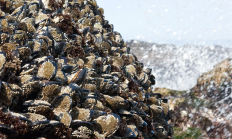
NEWPORT, Ore – Mussel harvesting is now open coastwide from the Washington border to the California border the Oregon Department of Agriculture and Oregon Department of Fish and Wildlife announced today. Marine biotoxin levels tested below the alert level. People should always call the Shellfish Safety Hotline at 1-800-448-2474 before…
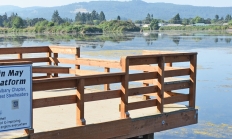
Coquille Valley Wildlife Area was initially established in 2013 with two equally important primary objectives; (1) To protect, enhance, and restore fish and wildlife habitats located on the WA, and (2) to provide a wide variety of wildlife-oriented recreational and educational opportunities to the public.
This large brown shorebird is the most wide-ranging of the curlew species. It is distinctive, having contrasting light-brown and dark-brown head stripes and a long decurved bill that it uses to probe for food on coastal mud flats and beaches. It is a common spring and fall migrant in coastal areas although it is also found, rarely, in small numbers inland as well. It is a rare spring migrant in the Willamette Valley with generally about one record annually, typically in late April or early May. Hear the call of the Whimbrel Photo by ©Keith Kohl, ODFW
This active and often unwary woodpecker, the smallest in North America, is generally the most often seen black and white woodpecker in human-settled areas. A preference is shown for decayed wood for nesting, though sound wood is also utilized. Nest sites are usually 10 to 12 feet off of the ground. It is found mostly at low to moderate elevations in deciduous and mixed deciduous-coniferous forests throughout much of the state, and less often in coniferous forests. Hear the call of the Downy woodpecker Photo by ©Keith Kohl, ODFW
Noted for its familiar call, chick-a-dee-dee-dee, the Black-capped chickadee is widely heralded as one of Oregon's friendliest and cheeriest residents. Even in the midst of winter, this bird "fairly overflows with good spirits." The Black-capped chickadee is resident at low to moderate elevations in western Oregon from the Willamette Valley and coastal counties to Douglas County and in most of eastern Oregon with the exception of the southeastern corner of the state. Hear the song of the Black-capped chickadee Photo by Dave Budeau, ODFW
Chestnut-backed chickadees are one of the most common species of bird in conifer forests of western Oregon. They are distinguished from other chickadees by their chestnut-colored back, lack of an eye-line, and their wheezy song. Like other chickadees, they are frequently observed performing acrobatic maneuvers such as hanging from branch tips while foraging high in the canopy. They also frequent bird feeders for suet and sunflower seeds, and will nest in boxes if they are placed near groves of conifers. Hear the call of the Chestnut-backed chickadee Photo by Kathy Munsel, ODFW