
Search myodfw.com
Showing 381 - 400 of 1702 results
This thrush-like ground-foraging warbler breeds from southeast Yukon and eastern British Columbia across Canada and through the eastern United States and locally elsewhere east of the Rocky Mountains. It migrates east of the Rocky Mountain to winter in Middle America. It is occasionally found in winter in its breeding range and in California. Small numbers regularly occur in western North America. Most Oregon records are from the southeast part of the state. Spring records range from early-May to mid-June. Fall records are fewer than in spring, and occur between late August and early September. Hear the song of the Ovenbird…

One of Oregon's rarest and most local breeders, this vocal but somewhat secretive warbler can be heard and sometimes seen in summer in the south central Cascades. The patient observer may catch a glimpse of a chunky, dark-backed bird feeding low in dense willows, sometimes showing its pale underparts with dark streaks. It is otherwise a rare migrant or vagrant statewide, mostly in Spring. An isolated population of this species has summered and presumably bred in the south central Cascades. No nest has been found in Oregon, owing mainly to the impenetrable habitat. Reports suggest that a small population may…

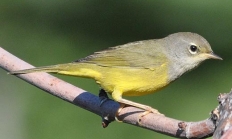
During the breeding season, this gray-hooded warbler is conspicuous, singing boldly from riparian thickets, clear-cuts, and roadside brush. However, when household cares occupy the daylight hours, they become elusive as field mice, slipping about through the thickets like shadows, only the sharp alarm note betraying their presence to an intruder. After many minutes of careful pursuit, an observer is often left with only a brief glimpse of an olive-colored back or a broken white eye-ring. MacGillivray's warbler is one species that appears to thrive in areas that have been disturbed by industrial forest practices. It has been reported from every…
The Common yellowthroat is one of North America's most widespread warbler species and its witchity-witchity-witchity song is also among the most easily recognized. This skulker may breed in any suitably damp brushy or weedy habitat throughout the state, and can be abundant in extensive marshy habitat. They are rare in winter in western Oregon in interior valleys and along the coast. Hear the song of the Common yellowthroat Photo by Kathy Munsel, ODFW

The golden-yellow face and breast of the male Wilson's warbler distinguish it as one of the brightest of Oregon's breeding warblers. Adult females are similar in plumage to males, and may even have a full black cap; however, the caps of females are smaller and duller than those of males, and are flecked with olive green. These lively warblers nest and forage for insects in tall, dense shrub growth, understory, or riparian thickets. It is an abundant breeder in woods and tall shrubs in the Coast Range, and is common in the Willamette Valley and west Cascades. Hear the song…

The chat's coming in the spring is like the arrival of a brass band. Male chats are loud, continuous singers, sometimes heard through the night. Chats inhabit lowland tangles and thickets along rivers and floodplains. It is the largest of North American warblers. In western Oregon, the chat is an uncommon to common summer resident of the interior Rogue Valley. It is a locally uncommon summer resident in the interior Umpqua Valley. In the Willamette Valley it is a locally rare to uncommon summer resident, and rare east to Oakridge. In eastern Oregon, the chat is a rare spring migrant…

The Western tanager is Oregon's only species of tanager. It lives in wooded habitat throughout the state.

The bright yellow, red, and black plumage of the male Western Tanager, so conspicuous in open situations is very obscure in forested areas where it tends to blend into the shaded foliage. The species perhaps is best known in migration when it visits city parks, orchards, and other open urban and suburban areas. It is attracted to birdbaths but seldom to bird feeders. It breeds in open coniferous forests and mixed coniferous and deciduous woodlands, primarily in mountains. They usually nest in conifers - rarely deciduous trees - at varying heights, usually well out on a branch, often at the…

Towhees, sparrows, grosbeaks and buntings are ground-dwelling birds that are typically drab looking. They feed on insects in summer and seeds in winter.

A large and colorful member of the sparrow family, the Green-tailed towhee is perhaps more recognizable by its eye-catching chestnut crown than by its less intense green-gray back and olive tail. As a ground forager, it spends most of its time on the ground or in thick cover, scratching about industriously in the leaf litter, and it may go unnoticed. But its catlike mewing call, which it often gives from a brushy perch, is one of the quintessential sounds of the shrublands of the east slope of the Cascades and the Great Basin. It is locally fairly common east of…

This well-known ground-dwelling bird is black above on the male and brown on the female, including the entire head and upper breast. On both sexes the upperparts are spotted with white on the wings and the long tail. It has rufous sides and a white belly. It frequents brushy areas and is common at bird feeders wherever seed is scattered on the ground, but does not feed far from cover. The varied song usually has one to three parts. The Spotted towhee breeds statewide and winters primarily west of the Cascades and in small numbers in lowland areas east of…

The California towhee can be found in chaparral habitats of southern Oregon, quietly flitting in and out of the brush in search of seeds. It is a plain brown bird with a rusty throat patch and undertail coverts. It is noticeably larger than the Spotted towhee. Its long slender tail is also a useful identifying feature. Sexes cannot be told apart in the field, but juveniles can be distinguished by the extensive streaking and spotting of the underparts. The California towhee is a fairly common permanent resident throughout the Rogue, Applegate, and Illinois Valleys. Hear the song of the California…

This winter visitor is a study in gray and tan, with a small dark spot on an otherwise gray breast, dull rufous stripes on the side of the head and crown, and brown wings with distinct white stripes. Tree sparrows visit Oregon only in winter, mainly in lowlands within the Blue Mountains and Owyhee upland regions with a few farther west in some years. They frequent willow clumps in grassy areas and occur occasionally at feeders. Hear the song of the American tree sparrow Photo by Eric Began, Flickr

The Chipping sparrow is a small and slender sparrow that has a distinctive sharp chip note and simple, trilling song. Breeding adults display a chestnut crown, a black eye-stripe, and crisp white eyebrow. After nesting season, both male and female lose their distinctive bright cap for a streaky dull brown head pattern that is similar to other winter sparrows. It is a common summer resident in open forests and drier woodland edges throughout Oregon and is especially abundant in the Blue Mountains. The Chipping sparrow is an Oregon Conservation Strategy Species in the Willamette Valley ecoregion. Hear the song of…

This is a sparrow of the dry brushlands. The Clay-colored sparrow breeds chiefly across the northern prairies from northeast British Columbia east to Michigan and south into Colorado. It winters in the southern United States and Mexico. It has expanded its range westward and northward in recent years and is now nesting in small numbers in eastern Washington. It was seldom reported west of the Rocky Mountains prior to 1960. Since that time, it has become a regular migrant and wintering bird along the west coast. Hear the song of the Clay-colored sparrow Clay-colored sparrow. Photo by "Always a birder"…

One of the most nondescript birds found in Oregon, this sparrow makes up for its drab appearance by its extraordinary song. It is by far the most abundant bird breeding in the vast sagebrush expanses of the Intermountain West. The Brewer's sparrow is an abundant migrant and summer resident east of the Cascades summit, particularly in the southeast quarter of the state among the vast sagebrush communities of the Great Basin Shrub-steppe. In the Columbia Plateau ecoregion, it is an Oregon Conservation Strategy Species. Hear the song of the Brewer's sparrow Photo by Dave Menke, USFWS

The song of this bird is one of the characteristic sounds of spring evenings in much of the high desert country of eastern Oregon. This temperate migrant is a ground-nesting, ground-foraging bird of most of the grassland, agricultural land, and shrubs steppe habitats of Oregon. The streaked brownish plumage of the Vesper sparrow is similar to that of several small to medium-sized sparrows, except for white outer tail feathers, shown most conspicuously in flight. The Oregon vesper sparrow is an Oregon Conservation Strategy Species in the Klamath Mountains and Willamette Valley ecoregions. Hear the song of the Vesper sparrow Photo…

The adult Lark sparrow is one of the most easily recognized passerines. The head pattern is sharp and crisp, with a chestnut crown and cheek patch surrounded by alternating white and black stripes. White underparts with a a small black central spot and a long, blackish tail with conspicuous white wing corners further aid identification. Courtship behaviors, including turkey-like strutting by males, differ markedly from that of other passerines. In Oregon, the Lark sparrow is a locally common summer resident and migrant east of the Cascades. Hear the song of the Lark sparrow Photo by Beken Bulgic Schneider, Flickr

This uncommon inhabitant of Oregon's high desert can be a challenge to find unless the observer becomes familiar with its territorial song and preferred habitat. Habitat requirements are specialized and population distribution and densities are highly variable from year to year in Oregon. The Black-throated sparrow occurs along boulder-strewn, sparsely vegetated slopes of arid deserts. They prefer warm dry sunny slopes of desert basins. Hear the song of the Black-throated sparrow Photo by Ashley Tubbs, Flickr

Although common within its range, this handsome sparrow can easily be overlooked. The gray head, black malar stripe, white eyebrow, and prominent black spot set in the middle of a white breast identify the bird. It is widespread throughout the extensive shrub-steppe of central and eastern Oregon. The principal breeding range of Sagebursh sparrow is southeast and central Oregon. It is found throughout the arid expanses of the Great Basin and usually associated with big sage. Although considered by some authors to be a sagebrush obligate, Sagebrush sparrows have been found in other plant communities exclusive of sagebrush. Hear the…
