
Search myodfw.com
Showing 41 - 60 of 220 results
Find maps, boundary descriptions and hunts available in the new DeGarmo Hunt Area. Download printable PDF map
Find maps, boundary descriptions and hunts available in the new Southeast Hunt Area. Download printable PDF map
Find maps, boundary descriptions and hunts available in the new Trout Creek Hunt Area. Download printable PDF map
WILLAMETTE WILDLIFE VIEWING July 30, 2026 Corvallis area EE Wilson Wildlife Area There are lots of deer, shorebirds and waterfowl to see on the wildlife area – look for goose, mallard, hooded merganser and wood duck broods. Wildlife viewing remains good for waterfowl and shorebirds. Note: Dogs are required to be on a leash inside the wildlife area boundary. Rifles and pistols are prohibited year-round. Find directions to EE Wilson Wildlife Area. A parking permit is required to park at EE Wilson Wildlife Area. Find out how to buy a parking permit. Eugene area Fern Ridge Wildlife Area Observant visitors may catch a glimpse of black-tailed deer and furbearers including…
The pelage of this mouse is grayish or brownish dorsally, the venter hairs are white with lead-colored bases, and the tail is light colored. In Oregon, it occurs within the area circumscribed by a line connecting Denio Nevada; Fort Rock, Lake County; Powell Butte, Crook County; Malheur National Wildlife headquarters, Harney County; and Burns Junction, Malheur County. On a daily basis, activity begins with an intense burst during the first light to hours after sunset, and declines to almost nil six hours after sunset, then, especially in summer, increases again before sunrise. The Dark Kangaroo Mouse constructs elaborate nests with…

Following droughts in the 1930s that affected most of North America, major conservation efforts, by both private and governmental entities, were enacted to reverse trends of degrading and disappearing wetlands. During this time period there was a major creation and expansion of federal wildlife refuges and state wildlife areas. As the concept of waterfowl flyway management was endorsed and developed, wildlife areas were acquired and managed as part of a larger plan focused on migratory waterfowl needs. LMWA was one of several wetland-focused wildlife areas established in Oregon. Ladd Marsh Wildlife Area was established in 1949, with primary objectives of…

Find maps, boundary descriptions and hunts available in the new Devils Garden Hunt Area. Download printable PDF map
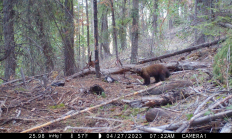
CENTRAL POINT, Ore. – The Oregon Department of Fish and Wildlife is conducting research on fisher, a forest-dwelling carnivore that once occupied forests across the Cascade and Klamath-Siskiyou regions. Today, Oregon's remaining fisher persist as a small, isolated population in the Klamath-Siskiyou Mountains. And ODFW researchers want to know how…
Find maps, boundary descriptions and hunts available in the new Poverty Basin Hunt Area. Download printable PDF map
This tiny jewel is the smallest breeding bird in North America and the smallest long-distance avian migrant in the world. The average weight of males is approximately 0.09 oz, about half of that of an Anna's hummingbird, and a little more than the weight of a penny. It breeds predominantly in mountain habitats, and despite its diminutive size, successfully withstands the chilly summer nights at high elevations. It is a common summer resident of the Blue and Wallowa Mountains and other high ranges east of the Cascade summit. Spring and fall migrants are rare at lower elevations east of the…

The coyote is a typical canid intermediate in size between the foxes and the gray wolf. The pelage of the coyote is grayish, buff, pinkish cinnamon, or brownish, or a combination of those colors, often overlain by blackish tipped hairs on the ears, muzzle feet, and dorsum. The lips and eyelids are black, accentuated by contrasting borders of white fur. The underparts are paler than the remainder of the body. Considerable variation in color and markings of coyotes is evident among individuals and regionally east and west of the Cascade Range. True albinos with pink eyes and pink foot pads…

Find maps, boundary descriptions and hunts available in the new Devils Garden Hunt Area. Download printable PDF map
The House finch is the most widespread of Oregon's "red finches." It is a congenial, cheerful singer from urban areas to desert plateaus. The male has a red forehead, throat, eyebrow, rump and varying amounts of red in the breast. It may have small amounts of reddish wash in its otherwise brownish cheek, hindcrown, nape,and streaked back. In some males, red is replaced with red-orange, orange, yellow-orange or yellow. The female is drab grayish-brown, overall, with indistinct streaking above and no red. The House finch is a fairly common resident in lowlands, urban, rural, and agricultural areas throughout Oregon. They…

The flight of Pacific loons by the thousands along the coast each spring and fall is one of Oregon's most dramatic bird migrations. Stunning plumage often clothes these fast-flying travelers. The straight bill, distinguishing Pacific from red-throated and yellow-billed, is less robust than that of common loons. The Pacific's head is larger and its neck thicker than those of the red-throated. In flight, Pacific's wing-beats are faster than those of common, loons the feet appear larger, the forecrown is rounder, and the hindcrown more sloped than those of red-throated loons. This is the most abundant loon off the Oregon coast…
