
Search myodfw.com
Showing 441 - 460 of 657 results
Features: Dungeness crab can sometimes be confused with rock or other crab species. However, it is easily identified by its white-tipped claws and reddish-brown to purple color. Habitat: Adult Dungeness crab forage on a number of fish and invertebrate species. They can be found throughout the sandy and muddy areas in the shallowest parts of lower estuaries all the way to depths of almost 1,500 feet. Techniques: There are many kinds of crab catchers – from crab pots and rings, to traps you can cast with a fishing rod. You can easily crab from a dock in many coastal bays…

Find maps, boundary descriptions and the percent public land for the Santiam Unit.
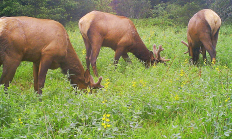
Need to figure out controlled hunts, find a place to clam, learn how to fish or get directions to a wildlife area? We've got information on all that and more, straight from ODFW biologists and other accomplished hunters, anglers and wildlife watchers. Header image by Dave Budeau

Features: Coastal rainbow trout are often residualized steelhead that spend their entire life cycle in fresh water, never migrating to sea. They are a silvery color with black spots on their backs and fins, and a pink band running down their sides. Often their gill covers are pink as well. The pelvic anal, and dorsal fins have a white edge to them. Habitat: They can be found in cold rivers, creeks, and inland lakes. However, they require streams with clean gravel, complex habitat, and cool temperatures for spawning and rearing. Techniques: Trout in stillwaters tend to be on the move…

In Oregon, the nutria is considered an invasive species. The nutria is a large rat-like semiaquatic rodent. The species has a hunched body; a round, nearly hairless tail; a valvular mouth and nose; and pentadactyl feet with naked soles. The toes of the hind feet, except for the hallux, are included in a web. As an adaption to the aquatic environment, the eyes, nostrils, and small ears are set high on the sides. The pelage consists of long, course guard hairs and soft, dense underfur. Overall, the color usually ranges from dark brown to yellow-brown. The muzzle is frosted with…

The mottled petrel breeds in New Zealand and nearby islands, and ranges throughout much of the Pacific Ocean, mostly far from land. It is a common May to October visitant in the northern and eastern North Pacific, with non-breeding birds occurring during the winter months. Photo by Dominique, Flickr

Features: Drakes are easily distinguished from American wigeon drakes by a reddish brown head, gray flank, and lack of green eye stripe. Hens are similar to American wigeon hens and difficult to distinguish. The call of the male is a shrill whistling, whe'e you; the female's voice a low purr or croak. It is a rare to uncommon visitant east of the Cascades.

NW WILDLIFE VIEWING April 2, 2026 Tillamook County Birds Large numbers of waterfowl are arriving daily, moving back to spring nesting grounds. They will raft up out in the middle of most local estuaries on calm days but will move around with the incoming tide and on windy days. Many species of diving ducks can be seen on area lakes and bays. Likewise, many migrating geese are beginning to arrive and are using area fields, along with many egrets, herons and wintering raptors. Pastures and fields are heavily used by a variety of waterfowl when flooded and by wading birds under nearly any conditions…
This bat is brown to reddish brown and has relatively long forearms. It gets its name from the fringe of hairs along the bottom of its tail. It roosts in trees, snags, buildings, caves, rocks, cliffs and bridges. It likes beetles and moths but will eat spiders and crickets. The fringed myotis occurs in the Coast Range from Jackson County to Clatsop County and in the northeastern corner of the state. It's an Oregon Conservation Strategy Species in seven of the nine ecoregions. Photo by ©Michael Durham

Find maps, boundary descriptions and hunts available in the new Devils Garden Hunt Area. Download printable PDF map
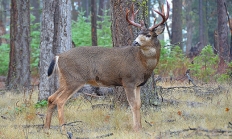
Nearly a dozen subspecies of Odocoileus hemionus are recognized. Of these, two occur in Oregon - the mule deer and Columbian black-tailed deer, often just referred to as "Black-tailed deer." The mule deer is larger, lighter in color, and often associated with more open habitats, whereas the black-tailed deer is smaller and darker, and frequents dense, early seral forest communities. The most distinguishing feature of the black-tailed deer is the tail. Although not as long or wide as that of the white-tail, it is much larger than that of the mule deer. Because of the differences in size, color, marking…
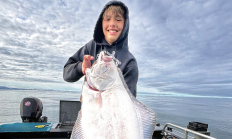
NEWPORT, Ore – Pacific halibut angling opens Aug. 17, Sundays through Friday through Sept. 30 or until quota is reached in the Columbia River subarea (Leadbetter Pt., WA to Cape Falcon, OR) all-depth fishery. The daily bag limit is one Pacific halibut. The Columbia River subarea received a 5,000-pound allocation…
Along coastal shores and islands, the chatter and flight calls of Black turnstones invite an observer to look more closely at the rocky substrates to find these birds busily picking about in their search for food. They primarily use rocky shores, jetties, and offshore islands, but may also be found on shorebird flats and sandy beaches. The Black turnstone is a common transient and winter visitant on the coast. Hear the call of the Black turnstone Phogo by ©Keith Kohl, ODFW

The Costa's hummingbird is a very rare spring and summer visitant to central and southwestern Oregon. Males are sometimes present for the entire year in the Rogue Valley. Males have been observed in canopy-free riparian habitat along Bear Creek and semi-open tall white oaks at the edge of Agate Lake. Many of these birds go undetected in Oregon because of their similarity with other hummingbird species. Hear the call of the Costa's hummingbird Photo by Mick Thompson, Flickr


This winter visitor is a study in gray and tan, with a small dark spot on an otherwise gray breast, dull rufous stripes on the side of the head and crown, and brown wings with distinct white stripes. Tree sparrows visit Oregon only in winter, mainly in lowlands within the Blue Mountains and Owyhee upland regions with a few farther west in some years. They frequent willow clumps in grassy areas and occur occasionally at feeders. Hear the song of the American tree sparrow Photo by Eric Began, Flickr

Features: Blue sharks are named for their brilliant blue color. They are slender with a long, pointed nose. They can grow to be 12-feet long, though they rarely get over 10-feet. Habitat: Blue sharks are found in all the world’s temperate and tropical oceans. They have been spotted as far north as Norway and as far south as Chile. They roam both open and coastal waters in search of octopuses, squid, cuttlefish, and fish. Technique: Typically chumming the water will attract blue sharks. You will need a wire leader to protect your line from the blue shark's saber-shaped teeth. Fins…
