
Search myodfw.com
Showing 461 - 480 of 660 results
This winter visitor is a study in gray and tan, with a small dark spot on an otherwise gray breast, dull rufous stripes on the side of the head and crown, and brown wings with distinct white stripes. Tree sparrows visit Oregon only in winter, mainly in lowlands within the Blue Mountains and Owyhee upland regions with a few farther west in some years. They frequent willow clumps in grassy areas and occur occasionally at feeders. Hear the song of the American tree sparrow Photo by Eric Began, Flickr

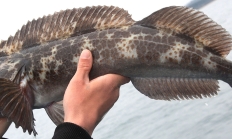
Features: Lingcod have an elongated body with a large mouth and sharp, canine-like teeth. They are generally mottled gray or brown but sometimes green or blue. A green-colored “ling” should not be confused with a greenling. Lingcod can get 5-feet long, but those caught in Oregon average between 2- and 3-feet. Habitat: Adults like to be near rocks, inshore and to 230-fathoms deep. Young lingcod prefer the sand or mud bottoms of bays and inshore areas. Technique: Bounce some bait along the bottom with 5/0 or 6/0 hooks, a 4- to 6-ounce sinker, and 20-pound line on a stout rod…
NEWPORT, Ore – Mussel harvesting is now open coastwide from the Washington border to the California border the Oregon Department of Agriculture and Oregon Department of Fish and Wildlife announced today. Marine biotoxin levels tested below the alert level. People should always call the Shellfish Safety Hotline at 1-800-448-2474 before…
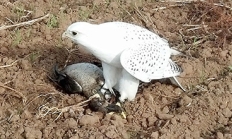
This is a large and power falcon. The majority of Gyrfalcons seen in Oregon are immatures or adults of the "gray" type, but there are several reports of "white" birds. The Gyrfalcon is a regular winter visitant to Oregon. The majority of sightings come from coastal and Willamette Valley lowlands near waterfowl concentrations. Individuals have been seen chasing and feeding on geese, ducks and gulls. Gyrfalcons forage by flying low over the ground and flushing prey, then often giving spectacular tail chases. If a bird refuses to flush the hunt is usually unsuccessful. East of the Cascades it occurs around…
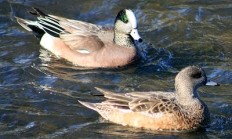
This foreign visitor is regularly found in Oregon among wintering flocks of American widgeon. Drakes are easily distinguished from American wigeon drakes by reddish brown head, gray flank, and lack of green eye stripe. Hens are similar to American Wigeon hens and difficult to distinguish. The call of the male is a shrill whistling, whe'e you; the female's voice a low purr or croak. It is a rare to uncommon visitant east of the Cascades. Hear the call of the eurasian wigeon Photo by ©Greg Gilson

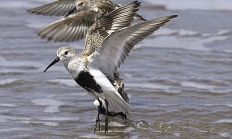
The Dunlin undergoes one of the most dramatic changes in appearance of all shorebirds when it molts from winter to breeding plumage. In winter, these medium sized sandpipers are brownish gray above with white underparts, but in breeding plumage they have a striking rufous-brown back and cap and black belly. Females are larger than males but otherwise similar in appearance. The Dunlin is an abundant transient and winter visitant in estuaries and occasionally on beaches along the coast of Oregon, but significant numbers winter in the Willamette Valley, especially the southern part. Hear the call of the Dunlin Photo by…
In winter plumage, the crisp black head, white neck patch, and gray back are striking, and when combined with a pale bill this species is readily distinguished from small alcids in Oregon. Wing-propelled divers, they are nonbreeding visitors to Oregon's offshore waters. They are the only seabirds whose young are reared entirely at sea. The Ancient murrelet is an uncommon to common fall migrant and winter visitant in shelf waters near shore; rare to uncommon in spring; absent to rare in summer. Hear the call of the Ancient murrelet Photo by Patty Mcgann, Flickr

The Swamp sparrow uses wet areas that have thick vegetation for cover. Several glimpses of this reclusive bird may be required before it can safely be separated from Lincoln's sparrow or the more common Song sparrow, though its distinctive call will give it away to observers familiar with it. Chestnut coloration on the wing coverts helps separate this species from other wintering sparrows. The Swamp swallow is a rare to uncommon spring and fall transient and winter visitant in western Oregon, especially along the coast. Hear the song of the Swamp sparrow Photo from USFWS

The Veery is known less for its appearance than for its ethereal song, a series of spiraling, reverberating flutelike notes, each lower in pitch, suggesting the name: vee-ur, vee-ur, vee-ur. A patient observer may get a fleeting glimpse of a small thrush with reddish brown upperparts, pale undersides, and a buffy upper breast with a few darker spots. It is an uncommon breeder in lower to middle elevations in the Blue Mountains where sufficient riparian thickets exist for cover and forage needs. It is locally common along watercourses in Union, Wallowa, and east Umatilla counties, and less common in north…

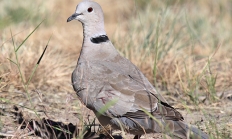
The Eurasian collared-dove is quite similar to the Ringed turtle-dove but is somewhat larger with grayer underparts and darker primaries. It is a bird of agricultural areas and readily visits bird feeding stations in urban and rural neighborhoods. During the 1600s this Indian species began to expand its range until today it occurs in all of Europe and most of Asia. After introductions in the Bahamas in 1974 and Guadeloupe in 1976 it soon expanded throughout the Caribbean and reached Florida by 1980. It is now expanding into other parts of North America, reaching Oregon in 1988. It is expected…
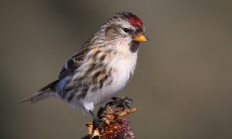
These tiny finches brighten the winter landscape of northeastern Oregon in some years. Their tan and ivory streaked with brown is plain enough, but the red forehead, black chin, and breast suffused in pink add a spot of color to snow-covered trees and shrubs. The Common redpoll is an uncommon to rare, irregular winter visitor, mainly in lowlands of the eastern Blue Mountain ecoregion. In peak years, this species can be locally common in Union, Wallowa, and Baker counties but in other years, it is essentially absent. It is an irregular visitant to Umatilla and Grant counties and in all…
Find maps, boundary information and the percent public land in the Ochoco unit.
NEWPORT, Ore. – To reduce the risk of humpback whale entanglements in commercial Dungeness crab gear, the Oregon Department of Fish and Wildlife is moving the May 1 "late-season" regulations to April 1 this year. These regulations require commercial crab fishermen to fish in waters less than 40 fathoms, use…
Wigeon drakes are beautifully marked with white pate, green eye stripe, purplish breast and flanks, white belly and wing covert patch, and iridescent black/green speculum. The grayish hen shows white on the wing covert patch. Drakes give a three-note whistle and get progressively noisier as spring approaches and courting flights begin. Medium sized flocks are common in fall and winter, and like geese, will be found grazing pastures, park lawns, and golf courses. It is a rare to locally common breeder in eastern Oregon and rare in summer in western Oregon. It is a common to abundant migrant and wintering…
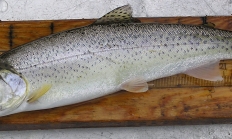
Features: Coastal cutthroat trout are typically are blue/green on top, red along the lateral line, and white on the belly. They are lightly or heavily spotted and adults have a red slash mark on the throat. Habitat: The most common variety of trout in Oregon is the coastal cutthroat, found in the streams and beaver ponds in coastal drainages. They also are stocked in high mountain hike-in lakes where the water stays cool throughout the summer. Techniques: Cutthroats that are year-round residents of small streams may not get any bigger than 8- or 9-inches, but can reward the angler with…
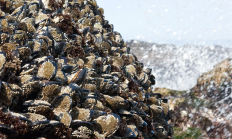
NEWPORT, Ore – Mussel harvesting is now open from Cascade Head to the California border the Oregon Department of Agriculture and Oregon Department of Fish and Wildlife announced today. Marine biotoxin levels in this area tested below the alert level. People should always call the Shellfish Safety Hotline at 1-800-448-2474…
CORVALLIS, Ore. — The Oregon Hatchery Research Center Board will meet in Corvallis on Tuesday, June 17 from 10:00 a.m. to 2:00 p.m. at the Oregon State University, Nash Hall Room 032, 2820 SW Campus Way. In addition to the regularly scheduled items, the agenda includes OHRC research updates, an…
Western Oregon observers enjoy these large, elegant plovers almost year-round, and as a consequence they are one of the most familiar larger shorebirds. Almost all migrants and winterers visiting Oregon inhabit mudflats and open wet dirt fields. A few can be found on sand beaches and even occasionally on rocks, but the great majority are found feeding and resting on open mud. In Oregon, it is a fairly common to common transient in western interior valleys. East of the Cascades, the Black-bellied plover is an uncommon transient in the Klamath Basin and at Malheur National Wildlife Refuge. In winter it…

Insects swept up in a rising air mass are favorite prey of this species nicknamed the "cloud swift." It prefers to nest near or even behind the curtain of a waterfall. This dark swift glides for long distances, often very high in the sky, with its wings held somewhat downward. It is larger and darker than the more common Vaux's swift, and has a slightly forked tail. The Black swift is a rare to uncommon spring and fall transient and summer visitant throughout the state. It's an Oregon Conservation Strategy Species in the West Cascades ecoregion. Hear the call of…
