
Search myodfw.com
Showing 501 - 520 of 795 results
A group of twittering, tiny gray birds streaming through bushes and trees and across openings surely are Bushtits. Females' eyes are pale, males' dark. They are highly gregarious except when nesting. The intricately made sock-like nest is unusually large for the size of the bird. Bushtits show a distinct indifference to humans and regularly nest within residential neighborhoods and establish foraging routs throughout many cities. They regularly take suet at bird feeding stations and visit backyard birdbaths. The Bushtit is a fairly common resident throughout Oregon except in Umatilla, Union, and Wallowa counties and at higher elevations of mountain ranges…

The canyon mouse is a moderate to small-sized mouse-like rodent with a long tail, nearly naked ears and a long, lax, and silky dusty gray pelage. In Oregon, most locations where the canyon mouse has been found are in Harney and Malheur counties, but the distribution includes a group of localities in Crook, Jefferson, Wasco, and Wheeler counties and another group in Lake County. There are also records of the species in extreme southeastern Baker County. Rock, primarily rimrock and talus slopes, seems to be the key component of habitats occupied by the canyon mouse. They are usually active nocturnally…
Find maps, boundary descriptions and the percent public land for the Melrose Unit.
These small, chunky plovers are uncommon to locally abundant migrants statewide, where they are among the most visible and easily identified small shorebirds. The only single-banded plover that occurs in Oregon, they can be remarkably easy to see when they are moving about on mud flats, and remarkably hard to detect when only their unmoving brown backs are visible against the mud. It is an uncommon to locally abundant migrant, with most birds at estuaries and some concentrations in spring at larger lakes of southeast Oregon. In the fall, it's rare in the Cascades; in winter, it's uncommon at larger…

This mid-sized, pink-legged gull has caused much of the confusion in west coast gull classification and identification. Its plumage characteristics are similar to Herring, Iceland, and some Glaucous-winged hybrids, and great care is needed for correct identification. It differs from the Herring gull in having a much smaller bill, a darker eye, less black in the wing-tips and, often, a more rounded head. Opportunistic feeders, Thayer's gulls regularly concentrate about landfills, food-processing plants, and over fish runs. It is a common migrant and fairly common winter visitor along the coast. The largest wintering numbers are found in the Portland metropolitan…
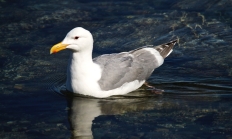
This large arctic gull visits the Northwest in winter where its pale bulk often stands out in gull flocks. Finding one is a highlight of winter birding. Even at a distance the size and frosty tones of this bird can be spotted in a flock. Most Oregon birds are in the whitish first-or-second-year plumage showing a pinkish bill with sharply delineated black tip, but third-year birds and adults occur now and then, mainly on the north coast and at Sauvie Island. They are rare but regular along the coast and the Columbia River, and rare in the Willamette Valley. It…

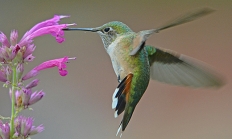
Perhaps the most enigmatic hummingbird found regularly in Oregon, the Broad-tailed hummingbird has so far eluded documentation of its breeding in the state, likely due to identification uncertainties and the remoteness of its preferred habitat. Primarily a Rocky Mountain species, its hard-to-define breeding range seems to reach its limit at Oregon's eastern edges where reports of this beautiful and rare species arise each summer. The relatively large adult male has a rose-red gorget and green plumage with no dorsal Rufous coloration. Females and immatures are nearly indistinguishable in the field from those of the more common Rufous hummingbird. Hear the…
This striking songbird is best known for its habit of impaling prey on thorns and barbed wire, or wedging items in a v-shaped branch for easier handling and storage. The Loggerhead shrike breeds in open habitats east of the Cascades where they are rare but regular in the winter, especially at low-elevation sites. They are uncommon and declining in northeast Oregon. West of the Cascades, there are usually a few records each year during fall, winter, and spring in open habitats of the coast and the Willamette, Umpqua, and Rogue valleys. The Loggerhead shrike is an Oregon Conservation Strategy Species…

Dashing and darting about, flashing its bright white underparts, the Violet-green Swallow is one of the characteristic birds of summer. Unlike the Tree Swallow it commonly nests in niches and cavities on urban buildings and readily uses nesting boxes in residential areas. Its soft twittery call notes are a familiar pre-dawn sound as they fly about overhead. The Violet-green swallow is a very early spring migrant concentrating about streams and wetlands where emerging insects can be found until warmer weather allows them to move into more upland areas. It is a common to abundant summer resident and breeding species throughout…

Arguably the most widely recognized of Oregon's birds, the American robin is the largest, most abundant, and most widespread thrush in the state. Ranging from sea level to treeline, the robin's loud, musical voice and conspicuous brick-red chest make it unmistakable to even the most casual of observers. The robin thrives in both human-dominated and natural landscapes and is considered to be a habitat generalist throughout its range. Considering the robin's natural history, we know most about its diet, which comprises primarily of soft invertebrates in the spring and summer and fruit in the fall and winter. It is most…

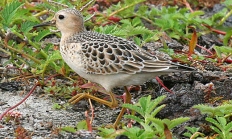
The Buff-breasted sandpiper resembles a plover with a high-stepping, pigeon-like gait. One of the few Oregon shorebirds that frequents dry, sparsely vegetated coastal grasslands. Fall migrants consist of juveniles. It has scaly, buffy-brown underparts, yellow legs, a small head, and a short black bill. Beady black eyes stand out on a plain, pale face. It bobs its head while moving. Gleaming white underwings are displayed in a graceful flight pattern. It is unique among North American shorebirds in having a lek mating system. This is a rare but regular fall migrant on the Oregon coast where it has been recorded…
This medium-sized shorebird is the most common dowitcher in eastern Oregon and inland locations, where it sometimes gathers in large flocks feeding in shallow water. It is also the only dowitcher in the state that regularly winters. Although breeding plumage adults are reddish below and heavily patterned above, most birds seen in Oregon are duller postbreeding adults or browner immatures. During winter, when shorebirds are hard to find, a small flock of chattering dowitchers, even in plain gray basic plumage, often brightens a day in western Oregon. In migration, it can be found at almost any shallow water site in…

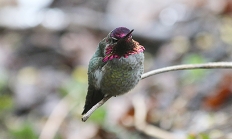
Anna's hummingbird is the largest hummingbird common to our region. It is the only hummingbird regularly found in Oregon in winter, during which time it is exposed to short day lengths, limited sources of food and periods of intense cold. It is more vocal than most hummingbirds with males uttering a dry, scratchy buzz of a song that can be heard throughout the year. It is a rare to locally uncommon summer resident west of the Cascades in interior valleys and along the coast; also along the Columbia River east to The Dalles. It occurs and probably breeds into the…
Even in the most barren and desolate reaches of the Great Basin, the cheerful song of the hardy Rock wren will contradict any notion that the desert is devoid of life. This specialist of cracks and crevices can be found almost anywhere there is exposed rock. One of its most unique features is the mysterious pebble path is constructs from its stone-cave nest to the outside entrance. Drab and pale overall, the gray head and back, white to tawny underparts, and gray tail with buff-tipped corners distinguish this species from other wrens. The Rock wren is a common breeder in…

This moderately small wren maintains the frenetic energy that is so obviously typical of this family of birds. It is a summer inhabitant in many parts of Oregon, generally in open woodlands, thickets, and occasionally in residential gardens. The House wren occurs over the widest latitudinal range of any New World passerine. The House wren nests in a wide variety of native and human-influenced habitats. Nest sites are primarily located within preformed cavities in snags. It is a very uncommon to common transient and summer resident in semi-open woodland habitats throughout the state. In southwest Oregon, it is most common…

The Veery is known less for its appearance than for its ethereal song, a series of spiraling, reverberating flutelike notes, each lower in pitch, suggesting the name: vee-ur, vee-ur, vee-ur. A patient observer may get a fleeting glimpse of a small thrush with reddish brown upperparts, pale undersides, and a buffy upper breast with a few darker spots. It is an uncommon breeder in lower to middle elevations in the Blue Mountains where sufficient riparian thickets exist for cover and forage needs. It is locally common along watercourses in Union, Wallowa, and east Umatilla counties, and less common in north…

This bat, found in older forests, has a wingspan of about 10 inches. Its fur is glossy black, tipped with white. It forages over ponds, streams, meadows and roads, often flying very low and roosting behind loose tree bark. Maternity roosts of the silver-haired bat are found in trees. This bat usually bears twins. The silver-haired bat occurs statewide in Oregon except for most of the Columbia Basin and is an Oregon Conservation Strategy Species in all ecoregions except the Nearshore ecoregion. It is primarily associated with coniferous forests, including the juniper woodlands in the southeastern portion of the state…

Features: Spiny dogfish are gray or brown with white spots on their back and a white belly. They can grow to be 5-feet long. They are called "spiny" as they have a spine behind each of the fins on their backs. Habitat: Spiny dogfish are widely dispersed, traveling from Alaska to Chile, and from intertidal waters down to 3,000 feet. They mostly eat small fish, squid, and octopus. Techniques: Being relatively small, spiny dogfish can be taken with light tackle. They tend to school around prey over soft bottoms. A good amount of weight will probably be necessary to keep…

SALEM, Ore. – ODFW is seeking applicants for two vacancies on its Access & Habitat Board, announcing openings for both a Landowner Representative and a Hunter Representative. Applications will be accepted through Sept. 18, 2026. To apply, visit the A&H Program's "Get Involved" page at http://www.dfw.state.or.us/lands/AH/get_involved.asp. ODFW encourages candidates with…