

Search myodfw.com
Showing 501 - 520 of 1128 results
Press Release
SALEM, Ore.—Do you have a love of hunting and passion for wildlife conservation? Are you knowledgeable about forestry and/or agriculture? If so, there are vacancies for a Landowner Representative and a Hunter Representative on the Access & Habitat (A&H) Board. Applications are being accepted by the Oregon Department of Fish…
June 5, 2025
Article
Cougars currently occupy most of the available cougar habitat in the state and are expanding into lower quality habitats that include human habitation. At the same time, urban areas are expanding into cougar habitat due to population growth and development. Follow these tips to stay safe in cougar country.
March 27, 2026

Workshop and Events
Hunter's Guide Hunter's Resources Hunter's Technique Hunter's Bounty
Date
Various seasons
Location
Online Learning
Article
Information gleaned from the teeth of harvested black-tail deer will help ODFW biologists learn more about the deer population.
December 5, 2025
Article
This online module serves as the required training for Bighorn Ewe and Rocky Mountain Goat tag holders. It is recommended that Bighorn Ram hunters complete training also but it is not required. See more information below from the Big Game Hunting Regulations.
June 12, 2025
Landing page
This 141-acre property along both sides of the Yachats River was first purchased in the early 1980s to provide forage for elk and help alleviate elk damage to surrounding agricultural land. It also provides public access to the Siuslaw National Forest along the Yachats River Highway, where there are few public access points.
February 07, 2018
Article
Hunter's Technique Hunter's Bounty Hunter's Plan Hunter's Guide "Gobble" up some new skills every spring! Register to attend a turkey hunting workshop or clinic --> ODFW education offers wild turkey hunting workshops designed for adults and youth turkey clinics before the season starts.
March 24, 2026

Article
This is your one-stop platform for learning how to hunt and fish in Oregon. Register to participate in one or more of the many statewide events and workshops, check back items are updated weekly. Build your confidence and expand your knowledge to enjoy the great outdoors. Looking for the required youth hunter safety courses and field days, choose between a conventional in-person course or complete one of the online education courses and an in-person field day. Sign up for a location, date and time that works with your schedule. Hunter safety events are taught by certified volunteer instructors statewide. To…
May 5, 2026
Zones or Areas
The transition from forested foothills of Mt. Hood to the beginnings of the Columbia Basin offers big game hunters an array of opportunities. The challenge can be finding public land or getting permission to hunt on private land.
Zones or Areas
This vast area covers the Columbia Basin through the Blue, Wallowa and Elkhorn mountains to Hells Canyon. Some of Oregon's most prized big game hunts are managed in this area.

Zones or Areas
Southeast Oregon, with its ponderosa pine forests, sage steppe expanses and aspen pocked mountains, is a very popular area to hunt mule deer, elk and pronghorn antelope.

Zones or Areas
This area extends from the eastern flanks of the Cascade Range through the Ochoco Mountains to the beginning of the Great Basin, making it a great place to explore.

Zones or Areas
This area extends the eastern flanks of the Cascade Range through the Ochoco Mountains to the beginning of the Great Basin, making it a great place to explore.
Species and Subspecies
Features: Overall, medium-gray with a white underside. Gray, bushy tail has a white "halo." Habitat: It is commonly associated with mixed forest communities in central Wasco, Jefferson, Deschutes, and Klamath counties west, except for unforested portions of the Willamette Valley, to central Washington, Benton, Lane, Douglas, Coos, and Curry counties. It is active at all seasons and exhibits diurnal activity almost exclusively. Techniques: Most hunters use a small caliber rifle, and aim for the head to avoid ruining the meat.

Species and Subspecies
Features: Slightly larger than its cousin, the rock pigeon, band-tailed pigeons have a grey body. As its name suggests, a wide pale band stretches along the tip of tail feathers. Up close a distinctive white, crescent-shaped mark across its neck is noticable. Habitats: Found on the west side of the state, the band-tailed pigeon frequents semi-open coniferous forests. It forages on wild seeds and fruits in tree tops. In search of food, it travels in flocks from tree top to tree top. Techniques: Find a food source, such as elderberry or cascara, and location with open shooting lanes. Then wait…

Species and Subspecies
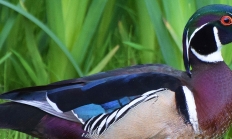
Features: Wood ducks can not be mistaken. The drake's iridescent chestnut, greens and white patterning are distinctive. The hen has a unique profile and white pattern around the eye. Habitat: Wood ducks are found in wooded swamps, on rivers and ponds. They feed on mostly seeds, but wood ducks will supplement their diet with aquatic plants, insects and crustaceans too. Acorns, hazelnuts, waste grains, and fallen seeds from trees and shrubs make up a good deal of their diet. As the name implies, they nest in tree cavities near water. Techniques: Search out a wood duck's food source and wait…
Species and Subspecies

