Search myodfw.com
Showing 521 - 540 of 705 results
This is one of the most audacious of Oregon's resident avifauna both in appearance and behavior. Its black coat and streaming tail dappled in blue-green iridescence contrasts starkly with its flashing white wing feathers during flight. Common and conspicuous east of the Cascades, the magpie prefers open areas stippled with dense thickets or trees. They are highly social, often gathering in large flocks. Historically despised and persecuted by hunters, farmers, and ranchers, this trickster has flourished in the tradition of the coyote. Hear the call of the Black-billed magpie Photo by Kathy Munsel, ODFW

SE Fishing September 10, 2026 Best bets for weekend fishing Catch and Release for Redband Rainbow Trout with no bait is required through October 31 on all of Upper Klamath Lake including but not limited to Pelican Bay, Crystal Creek, Recreation Creek, Harriman Creek, Odessa Creek, Short Creek, Fourmile Creek, Thomason Creek, Fourmile Canal, Barkley Springs Channel below highway 97 and mouth of Williamson River. Yellow perch angling should be excellent in the Williamson River, Crystal Creek, Pelican Bay and Fourmile Canal. Willow Valley Reservoir is good for largemouth bass, yellow perch and some large crappies. The Wood River below…
The Northern shoveler's specialized bill earned it in the nickname "spoonbill" among waterfowl hunters. The drake is strikingly handsome with a dark head, white breast, reddish belly, blue wing coverts and an iridescent green speculum. Brown hens also have blue wing patches similar to that of the cinnamon and blue-wing teal. This duck is locally common in summer in eastern Oregon and uncommon in western Oregon. It is a common spring and fall migrant statewide. Hear the call of the Northern shoveler Photo by Kathy Munsel, ODFW

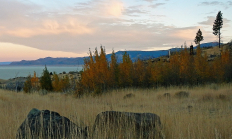
OTIS, Ore.—ODFW's recent legislatively adopted budget did not include funding to continue the operation of Salmon River Hatchery, one of more than 30 hatcheries that ODFW maintains in the State. The cost of operating and maintaining the hatchery exceeded available revenue, but funding is just one of the issues facing…
A slender, orange bill, pearl gray upperparts, and fringed black crest adjoining a white face and neck indeed render this graceful hunter from the south elegant. The foreheads of adults turn white in post-breeding plumage, their usual state in Oregon. These terns frequent quiet waters or lagoons when diving for fish, but also dive in calm ocean waters. They roost with flocks of gulls and other terns on coastal spits, estuarine sandbars, and on mudflats close to bay mouths. Virtually all records of the Elegant tern in Oregon are coastal or within half a mile of shore. None have been…

NE Fishing September 10, 2026 Best bets for weekend fishing: Morgan Lake has reopened with bass and trout. Fishing for trout will be best near shore especially on the South end of the lake near the inlet of the Wallowa River. Kokanee have started spawning in the Wallowa River above the lake. They can readily be seen throughout Wallowa Lake State Park and make for some great fall wildlife viewing. Try Willow Creek Reservoir for trout, bass, and crappie. Penland Lake is producing limits of rainbow trout. Try warmwater fishing for bass in the lower Grand Ronde. Trout stocking Stocking…
In Oregon, the opossum is considered an invasive species. The Virginia opossum is a cat-sized mammal with a pointed nose, unfurred, black, leathery ears with white edges; beady eyes; a hind foot with an opposable hallux (big toe); and a naked scaly tail. It was introduced in Oregon between 1910 and 1921. Populations were established in northwestern Oregon apparently from releases of animals brought to the state as pets or novelties. Small streams, forest communities, and agricultural lands planted to a variety of crops are typical of many habitats occupied by Virginia opossums in Oregon. They are active nocturnally and…

The ears of the pygmy rabbit are short, rounded, and covered with long silky hairs inside and out; the tail is small and covered with hairs possessing wide buffy bands with narrow blackish tips above and below; and the feet are short, densely furred below, and colored a light orangy-buff. In Oregon, pygmy rabbits have been found east and south of a line connecting Klamath Falls, Fremont, Redmond, and Baker City. This rabbit is closely tied to habitats dominated by big sagebrush. The Pygmy rabbit is an Oregon Conservation Strategy Species in the Northern Basin and Range ecoregion. Photo from…

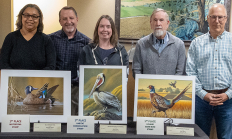
SALEM, Ore. – The winning artwork has been selected for the 2026 Oregon Waterfowl, Upland Game Bird, and Habitat Conservation Stamp Art Contests. In the Waterfowl Stamp category, first place went to Richard Clifton of Milford, Del., for his artwork featuring a blue-winged teal. For the Upland Game Bird category…
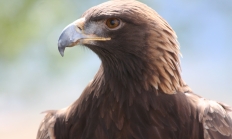
The Golden eagle is the largest soaring raptor inhabiting open country and mountainous terrain in eastern Oregon. A powerful and skillful hunter, the Golden eagle has become the National icon of the American West. A very large, dark raptor, the nape golden in all plumages, the females are slightly larger. Juvenile birds show white patches at the base of the primaries and a white tail with a broad dark terminal band. They are common residents in all Oregon counties east of the Cascade range. The Golden eagle inhabits shrub-steppe, grassland, juniper, and open ponderosa pine and mixed conifer/deciduous habitats. It…
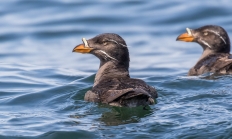
Rhinoceros auklet are one of the rarer breeding alcids in Oregon. Adults are easily recognized during the breeding season by the vertical "horn" at the base of the upper mandible. Birds in breeding plumage have brownish gray backs, a gray-brown chest, and a dirty white belly. Two distinct plumes are present on the head, one above and one below the eye. The bill is orange. In non-breeding plumage the horn is greatly reduced, the plumes absent or reduced, and the bill duller. It nests in small numbers in Oregon with Goat and Hunter Islands having the largest concentrations of breeding…
Features: Common carp are deep-bodied, heavy-looking fish with short heads and forked tails. They have large (really large) scales ranging from grey to bronze. Two barbels hang from each side of the upper lip of their subterminal (near the bottom of the head) mouth. This distinguishes them from goldfish that have no barbels. The dorsal fin is elongated. Habitat: Though tolerant of most conditions, common carp prefer large bodies of slow moving or standing water with soft sediments like mud or sand, and good growths of aquatic vegetation. They’re omnivorous bottom feeders that prefer aquatic insects, worms, mollusks and zooplankton…


A big, well-mannered bird of friendly, even playful disposition, with an abundant curiosity as to human presence and activities within the realm of open ocean over which he presides. Long-winged, to seven feet, and dark sooty-brown; adults have a white rump and feathering, which juveniles lack, around the base of a large bill. Every sighting of these gentle giants gliding up to the boat evokes delight. The black-footed albatross is a regular visitant spring through fall offshore, but is irregular in winter. They glean squid, fish and fish eggs from the ocean surface and also eat galley scraps. Hear the…

Although common within its range, this handsome sparrow can easily be overlooked. The gray head, black malar stripe, white eyebrow, and prominent black spot set in the middle of a white breast identify the bird. It is widespread throughout the extensive shrub-steppe of central and eastern Oregon. The principal breeding range of Sagebursh sparrow is southeast and central Oregon. It is found throughout the arid expanses of the Great Basin and usually associated with big sage. Although considered by some authors to be a sagebrush obligate, Sagebrush sparrows have been found in other plant communities exclusive of sagebrush. Hear the…

Known as "bluebill" to most hunters, this species is one of the most abundant and widespread of North American ducks. The lesser scaup is similar to the greater scaup in appearance and habits, but is smaller and lacks the white on the primaries. In the field, however, the black-and-white drakes and brown hens are very similar to greater scaups. The common vocalization is the purr call of the female; drakes are usually silent, but utter a low single-note whistle in courtship. In general, the lesser scaup is more apt to be found in interior or freshwater habitats while the greater…

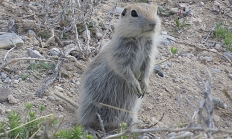
The Piute ground squirrel is the other of the two small gray ground squirrels without stripes or spots. In Oregon, it occurs south of Sheepshead and Cedar mountains in Malheur County. It is a species of the High Desert and commonly occurs in habitats in which the dominant shrub is big sagebrush, saltbush, or greasewood. It is commonly associated with rocky outcrops, levees, railroad embankments, ditchbanks, and sand dunes. Some occur in fencerows and edges of alfalfa and small-grain fields. These ground squirrels are usually active for three to five months each year. They emerge from their hibernacula in February…