Search myodfw.com
Showing 581 - 600 of 897 results
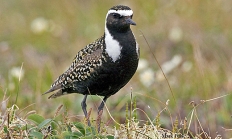
These elegant shorebirds are found as often in dry or damp upland areas as they are on mudflats or beaches. The plain brown immature birds of autumn become spangled with black and gold as breeding approaches. It is an occasional to uncommon migrant in western Oregon (mainly coastal) and locally rare, irregular migrant in eastern Oregon, with most reports at Malheur National Wildlife Refuge, in the Klamath Basin (summer) and in Umatilla County. Hear the call of the American golden-plover Photo by Mark Peck, Flickr
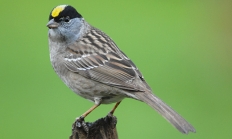
Flocks of these big, brown, plain sparrows are a common sight in winter in western Oregon. By early spring their faded head markings become a beautiful gold, black and white, and their plaintive descending songs become frequently heard from almost any large brush pile. They are an abundant migrant in western Oregon, less common farther east, and abundant in winter throughout the Willamette Valley. Hear the song of the Golden-crowned sparrow Photo by Dave Budeau, ODFW
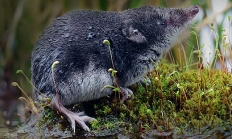
The water shrew is a large shrew with a very dark gray to black dorsal pelage, a white venter and throat, and a sharply bicolored tail. It occurs, in Oregon, as disjunct populations in the Wallowa, Blue, Ochoco, Strawberry, Steens, and Hart mountains and in the High Cascade Range west and downslope to McKenzie Bridge, Lane county. It is almost always found near water. Undercut banks, exposed tree roots, and boulder-strewn streamsides vegetated by willow, willow-grass, or willow-alder associations seem to be prime habitat. Photo by Charlie Marshall, Flickr
This is a medium-sized bat with large, long ears. It is gray, brown, or black and generally active only after full darkness. Townsend's big-eared bat is very vulnerable to human disturbance, and its numbers are declining. In Oregon, it is classified as a State Sensitive Species. It's also an Oregon Conservation Strategy Species in all ecoregions except Nearshore. Never disturb this bat if you are in a cave. Photo by ©Michael Durham

The golden-yellow face and breast of the male Wilson's warbler distinguish it as one of the brightest of Oregon's breeding warblers. Adult females are similar in plumage to males, and may even have a full black cap; however, the caps of females are smaller and duller than those of males, and are flecked with olive green. These lively warblers nest and forage for insects in tall, dense shrub growth, understory, or riparian thickets. It is an abundant breeder in woods and tall shrubs in the Coast Range, and is common in the Willamette Valley and west Cascades. Hear the song…

This large brown sparrow with its handsome black-and-white head pattern is a common breeder in brushy semi-open country throughout much of the state. In winter, it is frequently found in large flocks, often in the company of Golden-crowned sparrows and other seed eaters. White-crowns are easily seen as they feed on the ground, repeatedly dashing back into the cover of dense shrubs before emerging for another foraging bout. Hear the song of the White-crowned sparrow Photo by Kathy Munsel, ODFW

Features: The coot can't be mistaken in a wetland. With a black body, white curved bill and red eyes, these birds often move in rafts on the water. Low flyers, they still require furious wing beats before taking flight. Habitats: These birds can be found in wetlands, estuaries and bays where other waterfowl are found. Techniques: Coots are often taken as they enter decoy spreads. Not widely targeted, hunters may pinch a raft into a choke point to take birds on the wing.

Features: They are dark olive on the tops of their bodies, silver on the sides, and white underneath, with 6-9 black stripes running horizontally from behind their heads to their tails. Habitat: Striped bass spend most of their time in fresh water, with occasional and unpredictable trips to the sea. Technique: In the spring and fall stripers are likely to be closer to the surface. During this time bait, such as dead minnows or night crawlers, will entice the fish to bite. During summer, the bass go deeper to escape the heat. This is the time to use flashy bait.

Features: Drakes show graceful patterns of black and white plumage, glossy purple heads, white crescent-shaped patches between the eye and bill, steep forehead, and short bill. Females and juveniles have a chocolate-brown head, slate-gray back, wings and tail; adult females have a golden bill. Habitat: Not common, but usually scattered on lakes, reservoirs and coastal estuaries. They share Snake River habitat with the common goldeneye. Techniques: Not usually targeted, they are a rare part of a mixed duck bag.

Seemingly misnamed, pelagic cormorants are rarely seen far from land. During the breeding season the distinct white flank patches contrast markedly with their black plumage. In bright light the slender neck has a purple iridescent sheen, and the back shines green accenting white filoplumes. They nest in loose colonies on ledges on vertical cliffs on rocky islands and headlands. It is common year-round along the entire coast and is not found away from salt water. Hear the call of the pelagic cormorant Photo by ©Greg Gilson

This large sparrow is white below and in most plumages has at least some black around the face or throat, more in adults than younger birds. Cheeks are golden-tan in fall and winter and grayish in spring. It is streaked above. It is a winter visitor usually found with other sparrows. A very rare migrant and rare but regular visitor, you can find the Harris's sparrow statewide. Numbers vary considerably from year to year, but a few birds are typically found in the state every year. They are most regular in the Columbia Basin and in valleys within the Blue…

The Townsend's pocket gopher is a large pocket gopher. The pelage is dark buffy-gray to sooty gray on the dorsum and a rich buff on the venter; the face, nose and auricular patch are black; the feet are dirty gray; and the chin is white. This gopher occurs along the Malheur and Owyhee river valleys in Malheur County and in southern Harney County. Townsend's pocket gophers have been found in alkaline soils along the south shore of Harney Lake and in deep fertile soils near Sod House School near the headquarters of the Malheur National Wildlife Refuge and in Stergen…
The sagebrush vole is among the smaller voles in the state. The tail does not exceed the length of the hind feet. The long, soft, and dense dorsal pelage is grayish tan; the bases of the hairs are lead colored and the tips are black. The ventral pelage is pale buff, the feet light gray, and the tail slightly bicolored. In Oregon, it occurs mostly east of a line connecting The Dalles, Bend, and Klamath Falls, except it is absent from the Columbia Basin and most of the Blue and Wallowa mountains. Clustering of burrows tends to indicate that the…
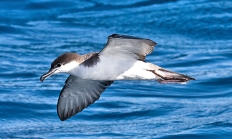
Few seabirds have been labeled "stunning;" but with their graceful flight, boldly patterned upperparts, and brilliant white underparts, these birds truly are one of the most beautiful in Oregon waters. They have a black cap, wings angled forward, long body and tail, and a unique dark 'M' pattern against light gray back and wings. Often seen in small groups mixed among other more abundant shearwaters, they sometimes form pure flocks all flying in gracefully synchronized flight. While regular in Oregon in late fall, they are still uncommon enough to excite observers when encountered at sea. Photo by Tony Morris, Flickr
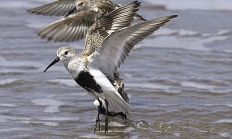
The Dunlin undergoes one of the most dramatic changes in appearance of all shorebirds when it molts from winter to breeding plumage. In winter, these medium sized sandpipers are brownish gray above with white underparts, but in breeding plumage they have a striking rufous-brown back and cap and black belly. Females are larger than males but otherwise similar in appearance. The Dunlin is an abundant transient and winter visitant in estuaries and occasionally on beaches along the coast of Oregon, but significant numbers winter in the Willamette Valley, especially the southern part. Hear the call of the Dunlin Photo by…
In winter plumage, the crisp black head, white neck patch, and gray back are striking, and when combined with a pale bill this species is readily distinguished from small alcids in Oregon. Wing-propelled divers, they are nonbreeding visitors to Oregon's offshore waters. They are the only seabirds whose young are reared entirely at sea. The Ancient murrelet is an uncommon to common fall migrant and winter visitant in shelf waters near shore; rare to uncommon in spring; absent to rare in summer. Hear the call of the Ancient murrelet Photo by Patty Mcgann, Flickr

The Snow bunting is a large finch that breeds throughout the high arctic tundra. In winter, many move south, sometimes forming large flocks in open grasslands, steppes, and dunes. When feeding in agricultural fields, these flocks may be hidden among the stubble, but when alarmed they often arise as a group and whirl about in a white cloud before returning to their spot or a nearby one. Oregon is at the southern edge of their winter range, and their wanderings about the state are erratic. In basic plumage, they are buffy and cream-colored with black and white wings. Hear the…

Features: Similar to the greater scaup in appearance and habits, but smaller and lacking the white on the primaries. In the field, however, the black-and-white drakes and brown hens are very similar to greater scaups. Habitat: In general, the lesser scaup is more likely to be found in interior or freshwater habitats while the greater scaup is more a coastal bird. Techniques: Scaup are rafting birds attracted to large spreads of scaup decoys. Popular hunting destinations include coastal estuaries and lakes, where most hunters hunt from a boat. However, in the marshes of eastern Oregon, there can be good hunting…