Search myodfw.com
Showing 581 - 600 of 795 results
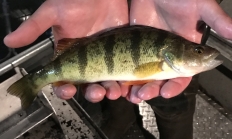
Features: Yellow perch are golden, with six to nine dark vertical bars. They have two well-separated dorsal fins; the second fin has two or three spines. Lower fins are yellowish-orange and, unlike walleye, yellow perch do not have canine teeth. Maximum size in Oregon exceeds 3 pounds and 18-inches long. They are prolific spawners, often resulting in an overpopulation of stunted fish. Habitat: Yellow perch prefer lakes, reservoirs and slower moving streams that have cool, clean water and ample vegetation. Perch bite readily and are therefore popular with young and novice anglers. Technique: In the spring and fall, find yellow…
SALEM, Ore. – The deadline for applications has been extended to July 11, 2025, for the Landowner Representative. Application forms are available at http://www.dfw.state.or.us/lands/AH/get_involved.asp. The Landowner Representative position is looking for individuals with experience in forestry or agriculture with an interest and experience in hunting and wildlife conservation. You do…

Features: Bluegills are distinguished from other panfish by the black ear flap and black spot at the rear base of the dorsal fin. Five to eight greenish, vertical bars are faintly visible on their sides. The body is olive-green in color, bluish above and silvery below. Breeding males develop a bright orange to red flush on the throat area. Adults in most waters measure 5- to 8-inches, but the state record bluegill exceeded 12-inches. Habitat: Bluegills prosper in clear, clean ponds, lakes and backwaters of slow streams with abundant vegetation. They feed on both plant and animal life, but primarily…

NEWPORT, Ore. – The commercial Dungeness crab fishery opens Dec. 31 from Cape Falcon to the Washington border. Fishermen can begin the presoak period – setting baited crab pots in the water – on Dec. 28 in this area. ODFW delayed opening the north coast until crab in Long Beach…

Piloted in 2014, the Tag Team program helps ODFW fish biologists better evaluate resident gamefish, bass, and stocked rainbow trout fisheries. It's also a chance for anglers to participate in fishery management and, perhaps, come away with up to $50.
Gnat Creek Hatchery was constructed in 1960 as part of the Columbia River Fisheries Development Program (Mitchell Act)—a program to enhance declining fish runs in the Columbia River Basin. The facility is used for egg incubation and rearing of spring Chinook and winter steelhead. Most of the production is released off-station. The hatchery is an easy drive toward Oregon’s coast on Highway 30 and a visitor-friendly place for the entire family. With lots to do, located on beautiful Gnat Creek and tucked away amid the rainforest, this is a worthwhile stop on the way to the coast.
Sauvie Island Wildlife Area protects vital waterfowl habitat and provides a public hunting area while supporting a rich diversity of wildlife, including hundreds of bird, mammal, reptile, and plant species.
Greater sage-grouse are best known for their elaborate courtship displays that occur on traditional strutting grounds, known as leks, where males gather each spring. At all seasons, both sexes are readily identified by large size and chicken-like build. Adults are mottled dark gray, black and buff, with black bellies and pointed tails. Males have specializations used in display. Their tail feathers are long and pointed with white spots. They have yellow combs over each eye and a chest sac with two bare, yellow patches of skin which are inflated during display. The display lasts only a few seconds and is…

Features: These fish are light silvery-white, dark on top, and have up to 8 dark, broken stripes running along the sides of their bodies. They are typically less than 10 lbs but can grow to 22 lbs. They have two dorsal fins, the front one with eight or nine spines and the rear one with one spine and 13 or 14 soft rays. Habitat: Hybrid bass were originally stocked in Tenmile Lakes on the south coast and in Ana Reservoir in Lake County. They have since been introduced into Thompson Reservoir, also in Lake County. The only established population is…

Jewell Meadows Wildlife Area is located in the Oregon Coast Range Mountains, in the northwestern part of the state. The wildlife area was established in 1969, with an initial purchase of 183 acres. It now encompasses 1,114 acres. The wildlife area’s purpose is to protect and enhance habitat to benefit native wildlife species, to reduce wildlife damage to adjacent properties, and to provide the public with an opportunity to observe wildlife in a natural setting.
Phillip W. Schneider Wildlife Area provides winter range for mule deer populations and year-round habitat for a variety of wildlife including mammals, birds, reptiles and amphibians. Elk, deer, and bighorn sheep viewing is often good during winter and early spring. Bird watching is excellent all year. Native habitats include sagebrush shrubland, riparian, ponderosa pine forest, western juniper woodland and mixed conifer which support a diversity of fish and wildlife. The riparian areas along the mainstem John Day River, South Fork John Day River and Murderers Creek provide excellent habitat for many birds. Upland areas provide important habitat for passerines and…
Find the weekly statistics for waterfowl and upland game birds for E.E. Wilson Wildlife Area. More information about E.E. Wilson Wildlife Area
The Wolverine is the largest terrestrial mustelid in Oregon that, to some degree, resembles a small bear. It is powerfully built with a broad, dog-like head; short round ears; small eyes; a slightly humped back; relatively short legs and a bushy, somewhat drooping tale. The pelage consists of a dense, wooly, crimped under fur overlain by course, stiff and somewhat shaggy guard hairs. Fur on the tail is about twice as long as on the body. The base color is blackish brown with a pale brown stripe extending along the sides from the head or shoulders to the base of…

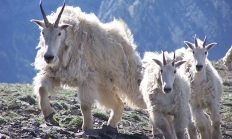
The mountain goat is a stockily built bovid with black scimitar-shaped horns, large black hooves and prominent dew claws, and an entirely white, wooly pelage. Sometimes the pelage contains scattered brown hairs on the dorsum and rump. A long beard, pointed ears, and a squarish muzzle are also characteristic. Males are larger, and have longer, larger-diameter, and more evenly curved horns that females. Mountain goats are denizens of high altitudes, remote, and barren montane regions where they are capable of moving through exceedingly rugged and precipitous terrain with speed and agility. Nevertheless, mountain goats are known to fall occasionally, whereupon…
Features: Green sunfish have more of a bass-shaped body and a larger mouth than the other sunfishes, other than the warmouth. Also, unlike other sunfish except the warmouth, the pectoral fin is rounded, rather than pointed. Green sunfish are olive green on the back and sides with a yellowish-copper or brassy hue on the lower sides of the belly. Dusky, vertical bars are often present. Turquoise mottling, often in the form of bars, radiates backward from the snout and eye. They have a dark spot at the base of the rear lobe of the dorsal fin. Habitat: Green sunfish are…

ASTORIA, Ore. – Clatsop beaches reopen for razor clam harvesting Oct. 1 following the annual conservation closure that began July 15. Before harvesting razor clams or any shellfish, always call the Shellfish Safety Hotline at 1-800-448-2474 or visit the ODA Recreational Shellfish Biotoxin Webpage. During the closure, Oregon Department of…