Search myodfw.com
Showing 61 - 80 of 220 results
Features: Olive brown to red on back, silvery-red to pink on sides. Lower jaw is long and extends at least to the eye socket. Short second anal fin spine. These fish can grow up to 3 feet long. Habitat: Most common between 160 and 820 feet deep. Adults show a preference to stay close to their home swatch of rocky bottoms or outcrops. Technique: Their diet consists of invertebrates and small fishes – try a lure that mimics these sea creatures.
Features: Pinkish red to copper pink, white ventrally, pink fins. Lateral line in red zone. Second anal spine short, edge of anal fin slants posteriorly. Chin projects outward. No spine on edge of gillraker. Habitat: Large schools of chilipepper rockfish are often found between 330 and 990 feet. They will stay over sandy, muddy, or rocky bottoms but also spend time in the midwater. Technique: Play to this species’ midwater foraging nature by presenting lures that mimic their natural diet – forage fish and small squids.
Features: The redstripe rockfish appears red and pink. The dorsal fin is shallowly notched and the lateral line is a distinct red stripe. It has dark lips, a protruding lower jaw, and greenish stripes radiating from the eyes. Habitat: Commonly found over high-relief, rugged bottoms from 500 feet to 900 feet below the surface. Technique: Best success will be by first locating suspended schools of redstripe rockfish in offshore areas during periods open for fishing offshore. Work rubber tail jigs or shrimp flies through the schools.

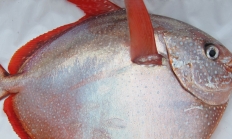
Features: Opah are also known as moonfish due to their round, laterally compressed bodies. These fish are very beautiful with pale red colored and lighter spots throughout resembling the craters on the moon, and orange-red fins. Opah grow to an average of 3-feet long and 100 pounds. Habitat: Opah can be found in temperate and tropical waters. They tend to be at depths of 300- to 1,000-feet during the day and come above 300-feet at night. Technique: These fish are rare in Oregon's waters and are difficult to catch by rod and reel, though they are occasionally brought in.
The Black oystercatcher is easily recognized with its black plumage, long, strait, laterally compressed, orange-red bill with a yellow tip, orange-red eye ring, yellow iris, and pale pink legs. These birds are restricted to rocky coastal shorelines where they feed in the intertidal zone. They are an uncommon to fairly common resident on rocky shores and sand/gravel beaches along the entire coast. Along the sandy central coast, they are present only as an occasional dispersing or wandering individual, typically on jetties. Black oystercatchers are Oregon Conservation Strategy Species in the Nearshore ecoregion. Hear the call of the Black oystercatcher Photo…

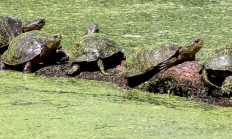
Oregon's native turtles are in trouble. Invasive, non-native turtles such as the red-eared slider and snapping turtle compete with Oregon's turtles for food, habitat and nesting sites. Our native turtles are also preyed upon by bullfrogs and are affected by habitat loss and degradation. Check out this video to learn more about Oregon's native turtles and invasive turtles.
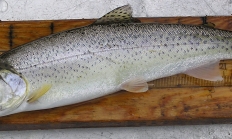
Features: Coastal cutthroat trout are typically are blue/green on top, red along the lateral line, and white on the belly. They are lightly or heavily spotted and adults have a red slash mark on the throat. Habitat: The most common variety of trout in Oregon is the coastal cutthroat, found in the streams and beaver ponds in coastal drainages. They also are stocked in high mountain hike-in lakes where the water stays cool throughout the summer. Techniques: Cutthroats that are year-round residents of small streams may not get any bigger than 8- or 9-inches, but can reward the angler with…
Adult Oregon spotted frogs have moist bumpy skin that is reddish-brown on their topsides. On their heads, backs, sides and legs, they have black spots with light centers that darken with age. They also have red bellies and orange-red underlegs. Adult females grow to four inches in length and males to three inches. Oregon spotted frogs live in wet areas that provide abundant aquatic vegetation such as marshes, permanent ponds, lake edges and slow streams. When frightened, they hide in dense vegetation or under debris at the bottom of shallow wetlands. Adult frogs hibernate during the winter in freeze-free seeps…

One of the "winter" finches that appear unpredictably in the state, the White-winged Crossbill wanders in flocks year-round searching for food, and may actually be seen in parts of Oregon in any month of the year. Its peculiar twisted bill, specialized for prying seeds out of conifer cones, is smaller than that of the Red Crossbill, and it prefers smaller, softer cones, mainly spruce. Males are a dull pinkish red, with distinctive broad with bars on black wings. Females are dusty brown and dull yellow with blurry streaks. The White-winged crossbill is a very rare and erratic visitor in Oregon…

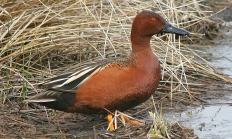
Features: Male cinnamon teal have a cinnamon-red head, neck, breast and belly. Like blue-winged teal, t hey have a bright patch of iridescent green on the rear of the wing and a bright blue patch on the front of the wing . They also have a distinctive red eye, a black bill and yellow legs and feet. Female and young male cinnamon teal are often confused with female blue-winged teal. Habitat: Prefer shallow, alkaline lakes where they dabble on aquatic plans. Techniques: Most cinnamon teal in Oregon are taken in eastern Oregon in the early season. They are not common…
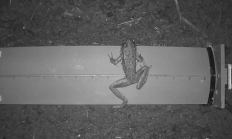
Adult frogs have moist bumpy skin that is tan or olive-green colored on their topsides. On their heads, backs, sides and legs, they have dark spots with light centers that darken with age. They also have red bellies and orange-red underlegs. Adult females grow to four inches in length and males to three inches in length. Columbia spotted frogs live in wet areas that provide abundant aquatic vegetation such as marshes, permanent ponds, lake edges and slow streams. When frightened, they hide in dense vegetation or under debris at the bottom of shallow wetlands. Adult frogs overwinter in springs, spring-fed…

SALEM, Ore. – People across Oregon are being urged to avoid contact with sick or dead birds as highly pathogenic avian influenza (HPAI) continues to impact wild and domestic bird populations across the state. There is currently no effective treatment for wild and domestic birds, and the virus can spread…

SALEM, Ore. – The Oregon Conservation and Recreation Fund (OCRF) is now accepting letters of interest for its summer 2025 Wildlife Crossing Infrastructure Grant Opportunity, supporting capital construction projects that reduce wildlife-vehicle collisions and restore critical movement and migration pathways across Oregon. Letters of Interest must be submitted before 11:59…
SALEM, Ore. – ODFW's Oregon Conservation and Recreation Fund (OCRF) is now accepting letters of interest for its summer 2025 Wildlife Crossing Infrastructure Grant Opportunity, supporting capital construction projects that reduce wildlife-vehicle collisions and restore critical movement and migration pathways across Oregon. Letters of Interest must be submitted before 11:59…
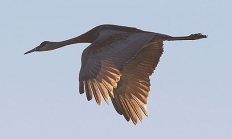
The Greater sandhill crane is Oregon's tallest bird. This large majestic crane has a guttural gurgling or bugling call, and is easily noticed in flight by its profile, with long neck and head extending straight ahead and long legs trailing behind. The Greater sandhill crane is distinguished by its red crown and white cheek patches, contrasting with with a light gray body. Fledged young resemble adults, but have a feathered forehead, a lighter tawny plumage, and lack the red crown and white cheek patches during their first fall. Fledged young have a squeaky cheap call often heard in flight during…