
Search myodfw.com
Showing 621 - 640 of 897 results
NEWPORT, Ore. – The Oregon Department of Fish and Wildlife is helping investigate the entanglement of a young humpback whale stranded earlier this week near Yachats. The whale was entangled in gear attributed by NOAA Fisheries to the Oregon commercial Dungeness crab fishery. Veterinarians from the West Coast Marine Mammal…
Newport, Ore. – Oregon's commercial Dungeness crab season is delayed coastwide until at least Dec. 16, the Oregon Department of Fish and Wildlife announced today. Oregon Dungeness crab met both meat and safe biotoxin level requirements; however, the season is delayed as Long Beach, WA crabs have not yet met…
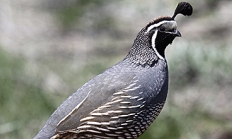
California quail are the most widely distributed upland game birds in Oregon. Most easily recognized by the comma-shaped, black, plume, or "topknot," which bends forward and is larger on the male. It has been a resident statewide since the early 1900s, except for most forests of the north Coast Range and west Cascades; it is generally absent along the coast north of Coos Bay. California quail is also absent from high-elevation areas of the east Cascade range. They are common residents in rural and even some suburban areas, particularly in eastern Oregon where many coveys gather at feeding stations during…
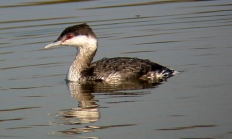
In alternate plumage this striking bird's lower neck, chest, and sides are bright chestnut. Three groups of yellow plumes adorn the sides of the head. Its head and throat are black. This grebe favors areas with much open water surrounded with emergent vegetation. The horned grebe is a rare breeder east of the Cascades. Malheur National Wildlife Reserve averages four to five pairs per summer. It is also rare along the coast in summer and is an uncommon spring and fall transient on lakes, reservoirs, and large rivers west of the Cascades and uncommon to common east of the Cascades…
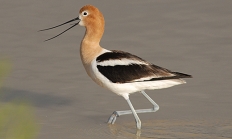
A conspicuous wader of shallow wetland habitats with a striking appearance and graceful movements. These long-legged shorebirds have contrasting black and white upperparts and during the breeding season, the head and neck turn from gray or white to a deep rust color. One of their most notable traits is a long, slender upturned bill. It is a common breeder east of the Cascades at wetlands of south central and southeast Oregon. Distribution and number of breeding birds vary annually depending on regional and local water levels and habitat availability. Regardless, most breeders occur in the western Great Basin counties of…
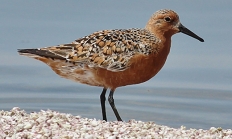
These stocky shorebirds stand out among their fellow migrants in spring, resplendent with rich rufous breasts shading into white on the lower belly. Red knots have short, black bills tapering to a fairly fine tip; short legs give them a low-slung appearance. They are highly gregarious and tend to form tight foraging and roosting flocks. Found primarily on the coast, they are regular transients in spring and fall. Knots forage on open estuarine tide flats, less commonly on margins of sand ocean beaches. Inland, they are found on margins of sewage ponds and at large brackish lakes such as Malheur…
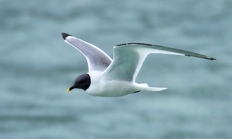
The striking tri-colored upperwing pattern on this graceful little gull is diagnostic in all plumages - a bold white triangle bordered by black outer primaries and gray back and inner wing. The Sabine's gull is most often observed flying in a steady migration over the ocean, and is seen seldomly foraging offshore. When ashore, it is found about coastal estuaries and inland lakes and impoundments picking food from the surface of the water, tidal flats, and along inland mud flats and shore edges. In Oregon, it is is a common to abundant spring and fall transient over the continental shelf…
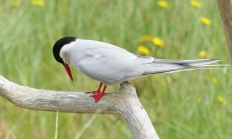
This graceful tern, with its aerodynamic body and streamlined wings, is infrequently seen from land in Oregon. It is most often encountered at sea as it makes one of the most incredible journeys in the animal kingdom, migrating from the Arctic to the Antarctic and back again each year, a journey of nearly 22,000 miles. A medium-sized bird with a reddish bill, it has a black cap and nape, and a white throat and cheek shading to a light gray body. It is a common offshore transient in Oregon waters and an occasional migrant along the coast. The bulk of…
A slender, orange bill, pearl gray upperparts, and fringed black crest adjoining a white face and neck indeed render this graceful hunter from the south elegant. The foreheads of adults turn white in post-breeding plumage, their usual state in Oregon. These terns frequent quiet waters or lagoons when diving for fish, but also dive in calm ocean waters. They roost with flocks of gulls and other terns on coastal spits, estuarine sandbars, and on mudflats close to bay mouths. Virtually all records of the Elegant tern in Oregon are coastal or within half a mile of shore. None have been…

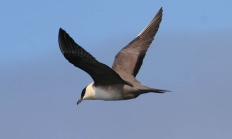
Graceful and buoyant fliers, adults are light gray-brown above with black caps, have dark flight feathers contrasting with grayer mantles and light underparts. Breeding adults have a central pair of tail feathers extremely long and pointed, extending up to eight inches past the rest of the tail. They are not usually as aggressive as other jaegers and rely as much on food they pick from the ocean's surface as they do from food they steal from other small seabirds. The Long-tailed jaeger is a rare to fairly common fall transient offshore. They are usually detected when Arctic terns and Sabine's…
This medium-sized owl is easily recognized by its conspicuous "ear" tufts, yellow eyes set in a round facial disk, size, and mottled plumage of black, brown, gray, buff, and white. Legs and toes are densely feathered. Females are larger and darker in coloration than males. It is strictly nocturnal and secretive during nesting. The Long-eared owl is a fairly common breeder in open country east of the Cascades in wooded riparian areas and junipers. It is a common breeder on Boardman Bombing Range, Morrow County and widespread in Malheur County. It is a rare breeder in the foothills of the…

This small, brown, earless owl with a black framed, square face was long thought to be restricted to the boreal forests of Canada and Alaska but during the 1980s, it was found breeding in the Rocky Mountains of Idaho and Colorado. In Oregon, these shy owls are strictly nocturnal and live in remote mountain forests often covered by deep snows and with few passable roads. It is presumed to be a permanent resident in Oregon. It has been regularly observed about the Wenaha-Tucannon Wilderness in northeast Umatilla and northwest Wallowa counties and on the south slopes of South Sister Mountain…

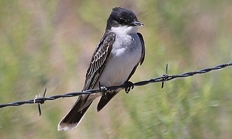
The plumage and perching habits of the Eastern kingbird make it one of the more conspicuous birds in open habitats of eastern Oregon. The plumage is well defined: black on the upperparts and white on the underparts, and a white band on the terminal tip of the tail feathers. It is a relatively large flycatcher, often perching on powerlines, fences, or exposed perches on trees or snags. They hawk aerial insects during the breeding season. The Eastern kingbird breeds throughout non-forest of most of northeast Oregon lowlands with spotty distribution in central and southeast Oregon. They are most abundant in…
This well-known ground-dwelling bird is black above on the male and brown on the female, including the entire head and upper breast. On both sexes the upperparts are spotted with white on the wings and the long tail. It has rufous sides and a white belly. It frequents brushy areas and is common at bird feeders wherever seed is scattered on the ground, but does not feed far from cover. The varied song usually has one to three parts. The Spotted towhee breeds statewide and winters primarily west of the Cascades and in small numbers in lowland areas east of…

The Chipping sparrow is a small and slender sparrow that has a distinctive sharp chip note and simple, trilling song. Breeding adults display a chestnut crown, a black eye-stripe, and crisp white eyebrow. After nesting season, both male and female lose their distinctive bright cap for a streaky dull brown head pattern that is similar to other winter sparrows. It is a common summer resident in open forests and drier woodland edges throughout Oregon and is especially abundant in the Blue Mountains. The Chipping sparrow is an Oregon Conservation Strategy Species in the Willamette Valley ecoregion. Hear the song of…

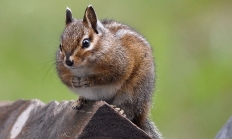
The Siskiyou chipmunk is slightly smaller than the Townsend's chipmunk and slightly larger than the Allen's chipmunk. The pelage is marked with five dark and four light stripes on the dorsum; the middorsal stripe is usually black and nearly always darker than the other four dark stripes. The sides of the face are marked with three brown and two light gray stripes; a patch behind the ear is light gray. It occurs in Curry, Josephine and Jackson counties south of the Rogue River; in extreme western Klamath County; in extreme eastern Douglas and Lane counties; and in extreme southeastern Linn…
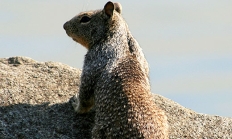
The California ground squirrel is a large, long-tailed gray squirrel with a large, nearly-black, triangular patch between light-gray shoulder patches. The gray dorsal pelage is speckled with buffy white spots. The tail is bushy, but not so full and spreading as those of tree squirrels. In Oregon, it occurs throughout the area west of the Cascade Range and throughout much of Central Oregon. It is considered among the most generalized of the ground squirrels as it inhabits a variety of habitats. Although it is a ground-dwelling squirrel, it has a strong propensity to climb. It is commonly observed sitting on…
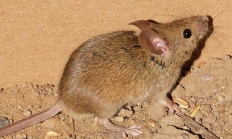
The deer mouse is a moderately small mouse-like rodent that exhibits considerable variation in color, tail length and markings. In general, the pelage of adult deer mice is buff to dark brown on the dorsum and white on the venter. The ears are moderately long, essentially naked and usually held erect and directed forward. The eyes are black and beady. The deer mouse has the broadest distribution of any species within the genus and occurs throughout Oregon. Below the treeline, it occurs as part of essentially all communities. It is active nocturnally, the time of onset of activity is cued…

The house mouse is the smallest member of the subfamily in Oregon and smaller that most other members of the family. The ears are large and membranous; the tail is long, tapering, and scaly; and the soles of the feet are naked. The pelage is short, harsh, and usually grayish brown to nearly black dorsally, lighter brown or buffy ventrally. Albino, spotted, and other colormorphs are known to occur. House mice occur throughout the world in association with humans. In Oregon, this mouse is found in 30 of the 36 counties. House mice are usually more active at night, but…
Features: Starry flounder are a flatfish with both eyes on the "top" side of their heads. They are dark on the eyed side with very rough scales, and alternating yellow/orange and black bands in the dorsal, anal, and tail fins. Habitat: Flounder tend to stay near the bottom, looking for food above. Technique: Drift a small jig or bait (such as shrimp, marine worm or mussel) on a #2 hook with 2-ounce sinker rigged on a 10- to 15-pound line over a sandy or muddy bottom. Header photo by Sam Grover, Flickr
