
Search myodfw.com
Showing 681 - 700 of 903 results
This snake is found in meadows and at the edges of clearings in forests. It prefers areas with dense vegetation but, when basking, can be found in open areas or on talus slopes. It occurs in wooded areas on the floor of the Willamette Valley and has been found in the Rogue Valley. This garter snake is commonly found in suburban areas and city parks. The Northwestern garter snake feeds mainly on slugs and earthworms, but also takes insects, small salamanders, frogs, fish, small mammals, and possibly nestlings of ground nesting birds. Photo by J. Maughn, Flickr

This small, remarkably delicate long-legged wader can be found in migration across most of Oregon. It is speckled gray and white with some variation by season and is typically noticed mincing about in shallow pools and in the water adjacent to mudflats or on seasonally flooded fields, as well as in small isolated ponds. It is an uncommon to common migrant, most birds in fall. In the eastern one-third of Oregon, it usually outnumbers Greater yellowlegs in fall. Hear the call of the Lesser yellowlegs Photo by Dave Budeau, ODFW

Southern Oregon is the northwest limit of the breeding range of Blue-gray gnatcatcher, which, as its name implies, is an active, diminutive bluish-gray. This is an energetic bird, commonly jerking its tail sharply to one side, wings held below, occasionally spreading its tail. It breeds in numerous disjunct localities and may be expanding its range in Oregon. It is an uncommon to common summer resident in the interior Rogue Valley. Hear the song of the Blue-gray gnatcatcher Photo by John Sutton, Flickr

This colorful bird of coniferous forests and mixed woods is a common breeding species of eastern North America. It winters in the West Indies and Middle America and occasionally in California and the southern United States. It is a regular migrant in very small numbers in spring and irregular in summer and fall in the southwestern United States to California and Oregon and is occasionally found elsewhere in the West. The majority of Oregon records are from late April to late June, mostly from the east of the Cascades. Hear the song of the Northern parula Photo by Jeff Bryant…

This species is found in pine forests, oak woodlands, and in chaparral of southwestern Oregon valleys. It is usually found in, under, or near rotting logs in open wooded areas near streams. The California mountain kingsnake preys upon snakes, lizards, birds and their eggs, and some small mammals. It is an Oregon Conservation Strategy Species in these ecoregions: Coast Range, Columbia Plateau, East Cascades, Klamath Mountains, and West Cascades. Photo by William Grenfell, Flickr

Much variability in coloration exists in the common garter snake but the best identifying characteristic is a stripe down the middle of the snake's back. While the common garter snake frequents wet meadows and forest edges, it occurs in a variety of habitats far from water, including open valleys and moist coniferous forest. Smaller snakes eat earthworms, but adults feed on a variety of vertebrate prey, including frogs, toads, salamanders, birds, fish, reptiles, and small mammals. Invertebrates, including slugs and leeches, are also eaten. Photo by Dave Budeau, ODFW

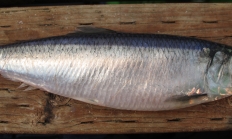
Features: Herring are silver with large scales. They are an important food source for larger fishes, sea birds and marine mammals. Habitat: Herring are frequently offshore in large schools but can be caught inshore in harbors and large estuaries during spawning. Technique: Herring are a schooling fish, and anglers can target them from docks, piers or boats in the bays. The most popular rig is a multiple-hook herring jig. Header photo by Steve, Flickr
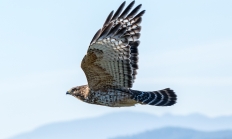
A medium-sized hawk, the Red-shouldered hawk has bold black-and-white flight feathers and rusty shoulder patches. Seen in flight from underneath, especially when lit from the sun, its wings show a translucent 'window' near the tips. It relies on perches for hunting and is closely affiliated with wooded wetlands and riparian bottomlands. In the breeding season this hawk is found in moist woodlands with at least a few deciduous trees. It prefers riparian bottoms, especially those near shallow wetlands or open meadows. In winter, it may use more open lands such as found in the Rogue and Willamette valleys, depending on…
Popularly called "Gooneybird" for its elaborate mating antics and clumsy takeoffs and landings and breeding islands, this is a large, spectacular seabird. Though small for an albatross, it glides on wind currents just above the ocean waves on long narrow wings which span approximately six-and-a-half feet. The dark gray wings, back and tail contrast with a white body and upper tail coverts. Singles or small groups are reported occasionally on offshore Oregon birding trips, primarily in winter. Hear the call of the Laysan albatross Photo by ©Greg Gilson

Noted for its familiar call, chick-a-dee-dee-dee, the Black-capped chickadee is widely heralded as one of Oregon's friendliest and cheeriest residents. Even in the midst of winter, this bird "fairly overflows with good spirits." The Black-capped chickadee is resident at low to moderate elevations in western Oregon from the Willamette Valley and coastal counties to Douglas County and in most of eastern Oregon with the exception of the southeastern corner of the state. Hear the song of the Black-capped chickadee Photo by Dave Budeau, ODFW

This is a bird of riparian thickets, farmlands, and towns. Since 1980, it has been observed almost annually in Harney County, usually in numbers less than five. A pair successfully fledged young near the Malheur National Wildlife Refuge headquarters in 1994. Most Harney County records occur from early April to late October. Away from Harney county individuals have also been seen in the various eastern and southeastern counties of Oregon. Hear the song of the Great-tailed grackle Photo by Kathy Munsel, ODFW

Although they occur in a wide variety of habitat types, from deserts and chaparral to open forests across Oregon, Western rattlesnakes usually occur near rocks, cliffs, or downed logs. They overwinter in dens typically located on south-facing rocky hillsides exposed to sunshine. Western rattlesnakes feed mainly on small mammals, including mice, gophers, squirrels and rabbits, but will also take birds lizards, and amphibians. The Western rattlesnake is an Oregon Conservation Strategy Species in the Willamette Valley. Photo by Simon Wray, ODFW

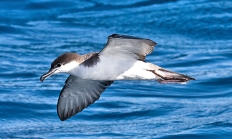
Few seabirds have been labeled "stunning;" but with their graceful flight, boldly patterned upperparts, and brilliant white underparts, these birds truly are one of the most beautiful in Oregon waters. They have a black cap, wings angled forward, long body and tail, and a unique dark 'M' pattern against light gray back and wings. Often seen in small groups mixed among other more abundant shearwaters, they sometimes form pure flocks all flying in gracefully synchronized flight. While regular in Oregon in late fall, they are still uncommon enough to excite observers when encountered at sea. Photo by Tony Morris, Flickr
Often mistaken for a duck, the American coot is actually a member of the rail family. It is a smallish, slate-gray water bird with a white bill. At home swimming in ponds and marshes, it seems to propel itself through the water by rhythmically extending its neck. During the nesting season it can be seen enthroned on a sizable nesting platform built from marsh vegetation. It has the largest Oregon breeding population of any waterfowl. Rafts of thousands of coots stage for migration in spring and fall on lakes throughout Oregon. Hear the call of the American coot Photo by…

These, the most numerous jaegers off Oregon, are slightly smaller than Herring gulls. Gull-like and graceful, these piratical birds steal food from smaller seabirds. They come in a bewildering array of light and dark individuals, confounded by age and sexual differences. The Pomarine jaeger is an uncommon spring and fairly common fall transient offshore two to 50 miles, following shearwaters. Sightings have been centered near the continental shelf edge. They are occasionally observed from shore in fall. Hear the call of the Pomarine jaeger Photo by Martyne Reesman, ODFW

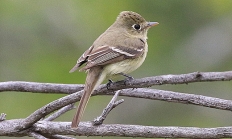
This small greenish flycatcher is easily overlooked in the moist, shady forests where it makes its summer home. It is a common to abundant breeder in forests of the Coast Range and west Cascades below about 4,000 feet and a common transient in western Oregon. The Pacific-slope flycatcher is most easily detected and identified by voice, but there is incongruence between published descriptions of vocalizations and some birds heard in the field lessens the certainty of identification to species, especially those in eastern Oregon. Hear the sounds of the Pacific-slope flycatcher Photo by Trish Gussler, Flickr
The more distinctive features on this gray and greenish vireo are the bright eye rings and lores, together called "spectacles." This bird is often difficult to see as it forages among the foliage; identification is usually based on hearing its distinctive song. Widespread in migration, when its habitat includes city parks and heavily wooded neighborhoods. The Cassin's vireo is an uncommon to rarely common summer resident in forests and woodlands, except along the immediate coast. it is an uncommon transient throughout the state. Hear the song of the Cassin's vireo Photo by Trish Gussler, Flickr

When walking through riparian areas in certain parts of Oregon in summer, one can often hear a song which suggests the Robin's but with less volume and energy, and with a greater variety of phrase. Yet, when one looks up, the bird is often hidden within the canopy foliage. The Red-eyed vireo is a fairly common summer breeder in Wallowa County and an uncommon to rare breeder in Union County, Baker County, and eastern Grant and Umatilla counties, and northern Malheur County. Hear the song of the Red-eyed vireo Photo by John Sutton, Flickr

The California towhee can be found in chaparral habitats of southern Oregon, quietly flitting in and out of the brush in search of seeds. It is a plain brown bird with a rusty throat patch and undertail coverts. It is noticeably larger than the Spotted towhee. Its long slender tail is also a useful identifying feature. Sexes cannot be told apart in the field, but juveniles can be distinguished by the extensive streaking and spotting of the underparts. The California towhee is a fairly common permanent resident throughout the Rogue, Applegate, and Illinois Valleys. Hear the song of the California…

This is a sparrow of the dry brushlands. The Clay-colored sparrow breeds chiefly across the northern prairies from northeast British Columbia east to Michigan and south into Colorado. It winters in the southern United States and Mexico. It has expanded its range westward and northward in recent years and is now nesting in small numbers in eastern Washington. It was seldom reported west of the Rocky Mountains prior to 1960. Since that time, it has become a regular migrant and wintering bird along the west coast. Hear the song of the Clay-colored sparrow Clay-colored sparrow. Photo by "Always a birder"…
