
Search myodfw.com
Showing 741 - 760 of 897 results
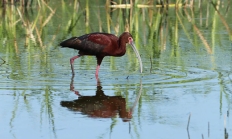
Sporting the form of a curlew, this medium-sized marsh wader is almost always found in flocks, flying in formation and quacking like ducks. Their long, down-curved bill complements their long neck and legs. Although their feathers appear black, a closer look will reveal an iridescence of bronze, purple, maroon, and green. They are named for their "white face" which appears in alternate plumage as a narrow border of white feathers along the edge of their reddish-purple facial skin, delineating a mask around the red eye. The White-faced ibis has extended its breeding grounds in Oregon to wetlands in Harney, Lake…
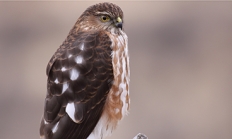
The Sharp-shinned hawk is North America's smallest and most migratory accipiter. As a hunter of songbirds (and sometimes young chickens) it historically endured harsh reproach, and was often depicted as a blood-thirsty villain, even by some ornithologists. Across the U.S., many thousands were shot in the first half of the 20th century. But prevailing attitudes have changed, and today a glimpse of this slender, secretive hawk darting through the treetops is more likely to elicit admiration than malice. Adult plumage, nearly identical to the slightly larger Cooper's hawk, consists of slate gray back and wings, breast and sides barred with…
Features: The color of all trout varies with environment. In general, the rainbow is bluish-green on the back, silvery on the sides and belly, and has a white edge to the dorsal, anal, and pelvic fins. A generous sprinkling of black spots appear along the back, and on the dorsal, adipose and caudal fins. A pinkish band usually extends along the sides. Habitat: Rainbow trout are the most widely stocked and distributed trout in Oregon. They occur naturally in many rivers and streams, and each year ODFW stocks millions more in ponds, lakes and streams. Prime trout waters are clear…


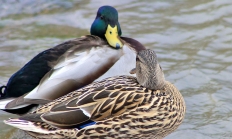
Features: During the fall, winter and spring months, males can be quickly identified by their distinctive iridescent green heads. Females are mottled-brown, with a dark brown stripe through each eye, an orange bill with black splotching and have orange legs. Immature ducks resemble adult females until the males develop more colorful plumage in early fall. After breeding season, males develop duller eclipse plumage beginning in June and resemble hens until mid-September. Wings of both sexes have a violet-blue speculum bordered in front and behind by a pronounced white stripe. Habitat: Mallards are the most common breeding and wintering duck in…
The kit fox is the smallest canid that occurs in Oregon. It has the typical canid conformation: the body is slim, the legs are long and thin, and the ears are large and erect. The tail is about 40 percent of the total length and is tipped with black, but has no dark mane on the dorsal surface. The feet and legs are whitish interiorly, light rusty-brown posteriorly. The dorsum is grizzled brownish-gray medially blending to grizzled gray then to light buff laterally and finally to white on the chest and venter. The head and posterior surface of the ears…

Features: Coastal rainbow trout are often residualized steelhead that spend their entire life cycle in fresh water, never migrating to sea. They are a silvery color with black spots on their backs and fins, and a pink band running down their sides. Often their gill covers are pink as well. The pelvic anal, and dorsal fins have a white edge to them. Habitat: They can be found in cold rivers, creeks, and inland lakes. However, they require streams with clean gravel, complex habitat, and cool temperatures for spawning and rearing. Techniques: Trout in stillwaters tend to be on the move…

Features: A medium-size goose, adult snow geese are white with black-tipped wings that are visible in flight. Their pronounced pink bill has a dark "grinning" patch across it, and they have pinkish feet. Young of the year snow geese are grayish white with grey legs and bills. These birds are very vocal and can be heard over a mile away. Habitat: Snow geese are well-adapted to agricultural land. They can also be found in wetlands, roosting in open water. Sauvie Island, Summer Lake and Klamath wildlife areas have abundant snow goose populations during various times of year. Technique: Snow geese…

ORDER Replacement Hunter Safety Card
Available
Online

Sperm whales inhabit all oceans of the world, and have been observed in Oregon waters from March through November. Sperm whales are usually found in deep off-shore waters so they are only occasionally seen off Oregon by fishers and birders on offshore trips. It is the largest of the toothed whales and possesses the largest brain of any animal with an enormous head to house it. Sperm whales have 20 to 26 large conical teeth found only in their lower jaw. A mature male can grow to 52 feet long with its head representing up to one-third of its length…

The southwest zone includes Umpqua River, Coos Bay, Coquille River, Port Orford, Rogue River and Chetco River - all of which offer shellfishing.
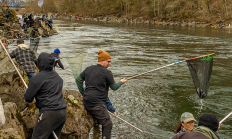
SALEM, Ore. – Recreational harvest of eulachon smelt on the Sandy River will be open from 12-7 p.m. on Wednesday, March 11 only. Regulations : Open area: From the mouth of the Sandy River upstream to the Stark Street Bridge. Limit: 10 pounds per dipper. Each dipper must dip smelt…
SALEM, Ore. – The Oregon Fish and Wildlife Commission meets March 19-20 in Medford for a field tour on Thursday and a regular meeting on Friday. The Friday meeting agenda and livestream are available from the Commission page. To virtually testify on an agenda item, register here at least 48…
Image: The circles show monitoring stations in the basin and the green shows detection of a tagged salmon. KLAMATH FALLS, Ore. — Salmon are making exciting progress in their return to the upper Klamath Basin, with fisheries biologists from ODFW and The Klamath Tribes celebrating a series of firsts as…
Bonneville Hatchery was constructed in 1909. In 1957, the facility was remodeled and expanded as part of the Columbia River Fisheries Development Program (Mitchell Act)—a program to enhance declining fish runs in the Columbia River Basin. The hatchery underwent another renovation in 1974 as part of the U.S. Army Corps of Engineers' (USACE) mitigation of fish losses from the construction of the John Day Dam. In 1998, construction was completed on the Captive Broodstock Facility for the Grande Ronde Basin spring Chinook supplementation program.