
Search myodfw.com
Showing 781 - 800 of 1702 results
Features: Except for adult drakes in breeding plumage, blue-wings are difficult to distinguish from cinnamon teal. Adult blue-wing drakes have a gray head with white crescent between the eye and bill. Hens and young of both species are nondescript small brown ducks, but show the prominent blue wing-covert patch in flight. Blue-winged teal is an early migrant and extremely rare winter resident in Oregon. Many hunters who believe they have shot a blue-winged teal actually have probably taken a hen or young drake cinnamon teal, both of which have identical wings with a large blue shoulder patch.

Features: Male cinnamon teal have a cinnamon-red head, neck, breast and belly. Like blue-winged teal, t hey have a bright patch of iridescent green on the rear of the wing and a bright blue patch on the front of the wing . They also have a distinctive red eye, a black bill and yellow legs and feet. Female and young male cinnamon teal are often confused with female blue-winged teal. Habitat: Prefer shallow, alkaline lakes where they dabble on aquatic plans. Techniques: Most cinnamon teal in Oregon are taken in eastern Oregon in the early season. They are not common…
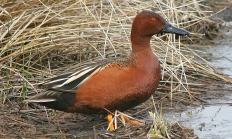
Features: In breeding plumage, green-winged drakes have a cinnamon-colored head with a green eye-stripe, gray back, flanks, and a bright patch of iridescent green on the rear of the wing (speculum). Hens are brown with a green speculum. Habitat: Green-winged teal are primarily winter migrants in Oregon. They are puddle (dabbling) ducks that prefer shallow areas like ponds and marshes, where they feed on or near the surface of the water by tipping up. Techniques: Teal are early migrants that begin arriving in Oregon in August but will continue to arrive into November. There are good early season hunts in…


Features: Brant are a small to medium-size goose. They have smoky black backs and bellies, and dissected white collars and white around the tails provide striking contrast. The brant can live up to 20 years and are resilient enough to ride out storms on the open ocean. Habitats: Brant are primarily found in bays and estuaries, but on occasion can be found inland. They forage on eel grass and other aquatic vegetation. Most of their feeding is in shallow water or in tidal flats. They tend to feed in flocks. Techniques: As with any waterfowl hunting, location is key. Seek…

Features: Canada geese come in many sizes and colorations. All have the same general long, black neck and white chinstrap. Their breast color can range from light gray to a dark brown. Habitats: Canada geese have become abundant in many city parks and agricultural fields where forage grasses are available. They can be found floating in bays, estuaries, rivers, reservoirs and lakes as well. Techniques: Canada geese can be hunted like other waterfowl. From jump shooting to calling birds into a decoy spread, Canada goose hunting can be productive. Note: If you want to hunt geese in Northwest Oregon, a…

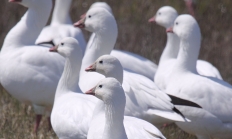
Features: A medium-size goose, adult snow geese are white with black-tipped wings that are visible in flight. Their pronounced pink bill has a dark "grinning" patch across it, and they have pinkish feet. Young of the year snow geese are grayish white with grey legs and bills. These birds are very vocal and can be heard over a mile away. Habitat: Snow geese are well-adapted to agricultural land. They can also be found in wetlands, roosting in open water. Sauvie Island, Summer Lake and Klamath wildlife areas have abundant snow goose populations during various times of year. Technique: Snow geese…

Features: The small Ross's goose looks very similar to a snow goose, but with some slight distinguishing features. Like the snow goose, this goose has black primary feathers. But it does not have the black grin of a snow goose on its pink bill. Also, their wing beat is faster and call higher pitched than a snow goose's. Habitats: The Ross's goose can be found in shallow lakes and wetlands while in migration. It feeds on grasses, sedges and small grains. Techniques: Often taken while snow goose hunting, the techniques are similar. Create a white decoy spread with silhouettes, white…
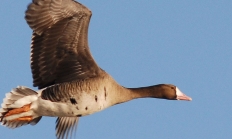
Features: The distinctive white band across the base of their bill gives this goose its name. It is medium in size with a gray and brown body. Adults have d ark brown and black spots on their chests and breasts give this goose the "specklebelly" nickname, while the young of the year birds are a nondescript gray with yellow legs and bills. Habitats: The white-fronted goose grazes on a mixture of grasses and grains. It can often be found in agricultural lands. Techniques: Hunting white-fronted geese is not for the faint-hearted. Scouting is necessary. And since they're mostly found in…

Features: Blue grouse are large in comparison to most other grouse species. The females are mottled brown, tan, and gray. The males are similar, but with solid blue-gray on the underside and bright orange-yellow combs over the eyes. Habitat: Blue grouse occupy the coniferous forests of western Oregon, the eastern slopes of the Cascades, the Blue Mountains of northeastern Oregon, and the Klamath Basin and south Warner Mountains. Preferred habitat includes timber edges, open timbered slopes, mountain meadows adjacent to springs or other sources of water, and near berry producing areas such as chokecherry thickets. Technique: Effective hunting techniques involve…

Features: Columbian sharp-tailed grouse are brown-gray with small black and white markings, a white underside, and a short tail that is white at the base. They are a medium-sized grouse. Both the males and females have a yellow-orange comb over each eye. Habitat: Columbian sharp-tailed grouse were historically found in most counties of eastern Oregon. These birds preferred the bunchgrass prairies interspersed with stream bottoms containing deciduous shrubs and trees. This habitat was particularly common in north-central Oregon and the Columbia Basin. Technique: In 1929, Oregon closed its hunting season for sharp-tailed grouse and it has never re-opened. By the…
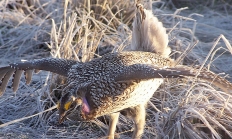
Features: Greater sage-grouse are a large grouse species. They are mottled gray-brown with black undersides. Males have black on the head and throat, while females have white behind their eyes. Habitat: Sage-grouse were originally found through much of the sagebrush dominated areas of eastern Oregon, but were eliminated from large areas by the mid 1900s through conversion of land for agricultural purposes. There has been little change in sage-grouse range, however since the 1950s. They live exclusively in sagebrush steppe habitat. During dry years, they may be concentrated in the vicinity of water sources. Technique: Due to greater sage-grouse fluctuating…

Features: Both the male and female are gray or reddish-brown on the body with dark bars and spots throughout. They have variable tail colors but always have a black band near the tip. Habitat: Ruffed grouse are most commonly found in brushy riparian areas in eastern Oregon and in early-aged mixed woodlands in western Oregon, though birds may be found in pockets of good habitat nearly anywhere. Technique: The ruffed grouse is a bird of the edge, so look in edges of meadows, clearcuts, and where brushy growth meets timber. In September, when most ruffed grouse hunting takes place in…
Features: Spruce grouse are gray with white spots on the belly. The back feathers often have dark bars. Females tend to be paler in color than the males. The eyes are outlined by red combs over and white arcs underneath. Habitat: The spruce grouse is native to Oregon and found in coniferous forests across northern North America. However, Oregon is on the periphery of this species' range and they likely were never abundant in the state. Currently, spruce grouse can only be found in the Wallowa Mountains and Snake River divide of northeastern Oregon. Technique: Spruce grouse have been protected…

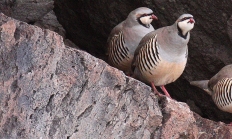
Features: Chukars are brown-gray with a black stripe running across the head, through the eye, and down onto the chest. Their bills and feet are red, and their sides have white and black barring. Habitat: Extensive areas in eastern Oregon provide ideal habitat for chukars. Cheatgrass, an introduced plant species, was already well established through much of eastern Oregon prior to the 1950s, and provides one of the most important year-around food resources for the chukar. Their habitat is generally steep, rocky, dry, and largely unsuitable for development, agriculture or other commercial uses except grazing. Important chukar areas in Oregon…

Features: Hungarian partridge have a gray-brown body with reddish brown barring on their wings, back and tail. Their beak and legs are gray. Habitat: In eastern Oregon, the best partridge populations exist in Columbia and Snake River basin counties. Although some birds may be found many miles from farming areas, the bunchgrass and sagebrush foothills adjacent to wheat and other farmlands provide the best habitat and the most stable populations. Technique: "Huns" are swift and challenging birds to hunt, usually bursting from the cover with a startling squeal and clatter of wings. They are typically hunted incidentally to pheasants or…


Features: Valley quail are often detected by their distinctive call which seems to say "Chicago". They are a covey-loving bird and wintering groups may number over 100. They are gray to brown with intricate scaling in the feathers on the belly. Their top knot droops forward toward the beak. Habitat: Valley quail are among Oregon's most widely distributed game birds. They may be found associated with agricultural and urban areas, as well as in riparian habitats located miles from human habitation. Within these areas, however, valley quail habitat needs are rather specific. Valley quail feed on a wide variety of…
