Search myodfw.com
Showing 821 - 840 of 1702 results
Adult Klamath black salamanders that live in Oregon are fully black with a smattering of bronze or green specks across the top of their heads, backs, tails and legs. The black salamander is one of the lungless salamander species and it breathes through its skin. Female black salamanders are generally larger than males and grow up to five-and-a-half inches in total length. Black salamanders live in forest, open woodland, moist talus (rock fragment piles) and streamside habitats. They use crevices in moist decaying logs or stumps, wet talus slopes or just under surface debris for cover during warm wet weather…

This dark colored salamander has a reddish-brown ragged edged stripe that runs along the top of the head to the tip of the tail with black or dark brown sides. It has a long body and tail and the belly is black with large white flecks. The Oregon slender salamander is a lungless salamander species, relying on its skin to breathe. Mature adults can grow to just under four inches in total length, with females about 12 percent larger than males. Oregon slender salamanders are most common in stable, moist old-growth (late successional and second-growth) forests where there are abundant…

California slender salamanders are a lungless species that has an especially long and slender worm-like body. They have reddish-brown stripes along their backs from head to tail. This stripe fades as the animal ages. Mature adults can grow to five-and-a-half inches in total length. In Oregon, this salamander usually lives in humid coastal conifer forests. In redwood forests, this salamander easily blends in with bark and other debris. During warm wet weather, California slender salamanders take cover just beneath the surface; if conditions are especially dry, salamanders may retreat deep into crevices, logs, stumps, or insect and worm burrows underground…

Worldwide, frogs and toads are in trouble because of habitat loss, pollution, pesticides, climate change, diseases, the pet trade and competition from invasive species. Many of Oregon's 12 native species of frogs and toads are listed as Oregon Conservation Strategy Species of concern. Frogs and toads belong to the same animal group but are very different. Toads have dry, rough and bumpy skin covering a wide body while frogs are slender with smooth, moist skin. Frog eyes are higher on the head than toads and are rounder and bulging. And there's a reason we play "leap frog" - frogs take…

The coloring of adult coastal tailed frogs often matches the color of local rocks ranging from brown or reddish-brown to gray with little flecks of yellow or gray. They have grainy textured skin that further enhances their camouflage. Male coastal tailed frogs have a short tail, the signature for tailed frogs. Adult males grow to one and three-quarter inches long and adult females to two inches long. They live in very shallow and heavily shaded water of fast running, small, permanent mountain streams with cold and clear water, rocky substrates and little silt in older forests. These streams are often…

The Rocky Mountain tailed frog’s coloring often matches the color of local rocks ranging from brown or reddish-brown to gray. They have grainy textured skin that further enhances their camouflage. Males have a short tail, the signature for tailed frogs. Adult males are slightly smaller than adult females that grow to two inches in length. Rocky Mountain tailed frogs are found in the water or close by it. They live in very shallow and heavily shaded water of fast-flowing, small, permanent streams in older mountain forests with cold and clear water, rocky substrates and little silt. These streams are often…

The Great Basin spadefoot is a species of toad. Adult spadefoots are gray with light lines along the back and light colored bellies. Their skin has abundant dark colored small bumpy spots. They have a single, black, hard spade on the heel of each hind foot. Adult females are larger than males, growing to two-and-a-half inches in length. Great Basin spadefoots live in dry sagebrush, grasslands and woodlands with sandy soils near ponds. Though they live in semi-arid habitats, they love the rain and damp weather. They spend most of the year in underground burrows that they dig quite efficiently…

These large toads are well camouflaged in earth tones with dry bumpy skin that aids in protection from predators. Their color can be highly variable among individuals ranging from gray or reddish-brown to yellow or green. They have a light colored stripe that runs along the center of the back. Adult female toads are larger than males, growing to five inches in length. They live mainly on land in a range of habitats from forests to mountain meadows to desert flats. During the non-breeding season, they are nocturnal. They dig their own burrows in loose soil, use existing burrows or…

These large toads have bumps on their dry skin which contain poison glands to discourage predators. Color varies between individuals ranging from gray or yellow to dark brown. They have thin white stripes along their backs and yellow bellies with dark specks. Females are larger than males and grow to five inches in length. Woodhouse’s toads live in river valleys in sagebrush and grassland habitats. They rest in burrows throughout the daytime hours and use wetlands during the breeding season. During dry weather, they burrow underground. Photo by Cameron Sponseller

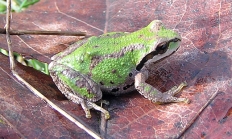
Adult treefrogs have a dark mask that extends from the tip of the nose across the eyes to the shoulders. Coloration varies between individuals, ranging from green or reddish to brown or gray. Most have dark blotches along their sides with light colored bumpy undersides. They have special skin glands that produce a waxy coating to keep their skin moist. Male treefrogs have a dark gray, inflatable throat pouch during the breeding season. As the smallest frog species in Oregon, adult Northern Pacific treefrogs only grow to two inches in length. During the non-breeding season, this treefrog is found in…
Adults have smooth, moist skin that is brown or reddish-brown in color with black flecks on their backs, sides and legs. They may also have a dark colored mask. Adults have red underlegs, hence their name. Females, growing to four inches in length, are almost twice the size of males. Adult red-legged frogs like cool damp coniferous or deciduous forests and forested wetlands. During the non-breeding season, adult frogs spend most of their time on land in woodlands along streams, in moist sedge or brush, along shaded pond edges or under logs and other forest debris. Damp weather permits them…

Adult Cascades frogs have tan, copper or green backs with black spots and yellow bellies. Their skin has small bumps on the back and sides. Females, which grow to three inches in length, are slightly larger than males. Cascades frogs live in a variety of moist habitats including mountain meadows, bogs, seasonally flooded forested swamps and shallow ponds, marshes and lakes. They use woody debris, mud or dense vegetation for cover from predators and spend their winters hibernating in mud. They emerge during the summer and live in wet meadows and bogs or along forested streams and pond edges. The…
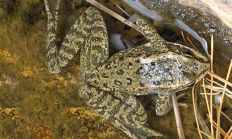
Adult Oregon spotted frogs have moist bumpy skin that is reddish-brown on their topsides. On their heads, backs, sides and legs, they have black spots with light centers that darken with age. They also have red bellies and orange-red underlegs. Adult females grow to four inches in length and males to three inches. Oregon spotted frogs live in wet areas that provide abundant aquatic vegetation such as marshes, permanent ponds, lake edges and slow streams. When frightened, they hide in dense vegetation or under debris at the bottom of shallow wetlands. Adult frogs hibernate during the winter in freeze-free seeps…

Adult frogs have moist bumpy skin that is tan or olive-green colored on their topsides. On their heads, backs, sides and legs, they have dark spots with light centers that darken with age. They also have red bellies and orange-red underlegs. Adult females grow to four inches in length and males to three inches in length. Columbia spotted frogs live in wet areas that provide abundant aquatic vegetation such as marshes, permanent ponds, lake edges and slow streams. When frightened, they hide in dense vegetation or under debris at the bottom of shallow wetlands. Adult frogs overwinter in springs, spring-fed…

Adult frogs are gray or brown with yellow underbellies and thighs. Their color and grainy textured rough-looking skin helps camouflage them, making them hard to see among rocks. Adults can grow to three inches in length; males are slightly smaller than females. Foothill yellow-legged frogs live in or along edges of permanent streams and rivers with exposed rocky streambeds and off-channel waters that are slow flowing and quiet. In summer, they are likely to hide under rocks in streams or among clumps of vegetation along pools. They use rocks or debris at the bottom of the streams as refuge from…

Adult Northern leopard frogs have smooth skin that is green or brown and covered with dark brown spots outlined with white rings. Females grow to just over four inches in length; males are slightly smaller at just over three inches. They live in and near various water sources with abundant vegetation such as wet meadows, marshes, riparian areas and moist, open woodlands. These frogs use the vegetation, such as grasses, sedge, weeds or brush, as cover from predators. During the winter, they need ponds or slow-running streams for hibernation. Photo from ODFW

If this is a new activity for you, our friends at the Audubon Society have tips on how to start birding and how to connect with other birders. This is a great resource that also includes tips on choosing binoculars, reviews and recommendations on the best birding apps and field guides, and an easy seven-point guide on how to identify birds. The Cornell Lab of Ornithology has an extensive website that includes the world's largest archive of wildlife sounds and videos, bird cams, eBird citizen science opportunities, scientific publications, bird guides, bird nesting box plans and more. ODFW's Living with…
Swans, ducks and geese belong to the Anatidae family and occur on all continents. Special oils let their feathers shed water, so they are adapted for swimming and floating, and some are even talented divers. For tips on discouraging geese from overwhelming your yard, check our Living with Wildlife, Birds page.

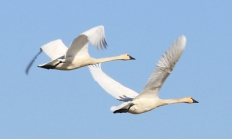
The majestic trumpeter swan is the largest of our native waterfowl and one of the heaviest flying birds in the world with males sometimes exceeding 30 pounds. Historically hunted to the brink of extinction, it was recognized as an endangered species long before there was an Endangered Species Act, and its recovery is a conservation success story. The adult's snow-white plumage with contrasting black bill and feet and 8-foot wingspan define this magnificent bird. Their neck is as long as their body and is used to reach food at the marsh bottom. In spring, the trumpeter swan is a locally…

Of several swans found in Oregon, the tundra swan is by far the most common during the non-breeding season. It is most readily distinguished from the similar-appearing trumpeter swan by voice, although subtle differences in physical appearance and behavior can separate the two with difficulty. It is a fairly common transient throughout the state but most abundant at large bodies of water and wetland complexes east of the Cascades including the Malheur National Wildlife Refuge and the surrounding Harney Basin, Summer Lake Wildlife Area and the Klamath Basin. Hear the call of the tundra swan Photo by Kathy Munsel, ODFW