
Search myodfw.com
Showing 781 - 800 of 1410 results
Find maps, boundary descriptions and hunts available in the new Northeast Hunt Area. Download printable PDF map
Initial Columbia River spring Chinook seasons set - Sturgeon retention days added in The Dalles Pool
UPDATE FEB. 26, 2026: Fishery managers added another day of sturgeon retention in The Dalles Pool (Tuesday March 3, 2026). The same bag limit and legal size restrictions apply on the days noted below. CLACKAMAS, Ore.—Fishery managers from Oregon and Washington adopted initial recreational spring Chinook seasons on the Columbia…
NEWPORT, Ore. – The commercial Dungeness crab fishery opens Dec. 31 from Cape Falcon to the Washington border. Fishermen can begin the presoak period – setting baited crab pots in the water – on Dec. 28 in this area. ODFW delayed opening the north coast until crab in Long Beach…
SALEM, Ore.— ODFW will host an open house on Tuesday, April 7 from 2-4 pm to discuss development of its 2027-29 Agency Request Budget. The meeting will be hosted in ODFW's headquarters classroom (4034 Fairview Industrial Drive, SE, Salem) and will be streamed online via YouTube. In Oregon, state agency budgets…
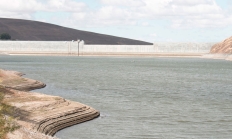
ODFW's legislatively adopted 2025-27 budget did not include funding to continue the operation of Salmon River Hatchery. The hatchery is shifting fish production to other facilities but will remain open for public/fishing access with a volunteer host and occasional staff on site. Learn more.
Find maps, boundary descriptions and hunts available in the new South Wallowa Hunt Area SW-02. Download printable PDF map
Look here to find out how waterfowl counts this week compare to years past.
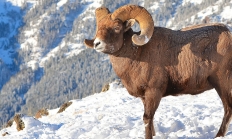
Features: Rocky Mountain bighorn sheep are the largest-bodied bighorn in North America and one of two subspecies of wild sheep in Oregon. Bighorn sheep were extirpated from the state in the 1800s so current populations are the result of a reintroduction effort by ODFW and sportsman groups. Habitat: Oregon’s estimated 800 Rocky Mountain bighorn sheep are found in the northeast corner of the state, in canyons of the Snake River and its tributaries and in alpine areas of the Wallowa Mountains. Techniques: Bighorn sheep are one of the rarest game species hunted in Oregon today, with about 100 tags available…
Features: Rocky Mountain elk are one of two subspecies of elk found in Oregon, with a population estimate of more than 74,000 in the state. They are lighter in color and slightly smaller in size than Roosevelt elk, but their antlers are the largest of all elk and can weigh up to 40 pounds. Habitat: Rocky Mountain elk inhabit most of eastern Oregon with concentrations in the Blue Mountains and south-central Oregon. Techniques: Rocky Mountain elk live in much more open country that Roosevelts so try glassing, still hunting, spot and stalk and calling. Rifle, archery and muzzleloader seasons are…

Leaburg Hatchery was built in 1953 to mitigate for lost fishing opportunity because of the many dams on Willamette Basin rivers. These dams include Cougar, Blue River, Carmen-Smith, Lookout, Dexter, and others. The hatchery rears rainbow trout, summer steelhead and Chinook salmon, and has a staff of four employees. Come visit our show pond and see huge white sturgeon and rainbow trout. There’s a viewing platform built by the McLaren School for Boys in 1993 to allow visitors to get a close up look at spring Chinook salmon spawning in the creek below.
ROSEBURG, Ore. – Fishing for fall Chinook salmon (hatchery and wild) closes at 12:01 a.m., Aug. 19 on the Umpqua, Smith, and North Fork Smith rivers because the quota of 500 wild fall Chinook has been reached. With forecasted low returns of wild fall Chinook salmon in the Umpqua, Smith…
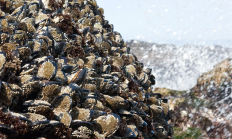
SALEM, Ore – Mussel harvesting is now closed from Cape Blanco to the California border due to levels of paralytic shellfish poisoning above the safety threshold, the Oregon Department of Agriculture and the Oregon Department of Fish and Wildlife announced today. On the mid-coast, marine biotoxin levels tested below the…

Features: Common carp are deep-bodied, heavy-looking fish with short heads and forked tails. They have large (really large) scales ranging from grey to bronze. Two barbels hang from each side of the upper lip of their subterminal (near the bottom of the head) mouth. This distinguishes them from goldfish that have no barbels. The dorsal fin is elongated. Habitat: Though tolerant of most conditions, common carp prefer large bodies of slow moving or standing water with soft sediments like mud or sand, and good growths of aquatic vegetation. They’re omnivorous bottom feeders that prefer aquatic insects, worms, mollusks and zooplankton…

Find maps, boundary descriptions and hunts available in the new North Blues Hunt Area. Download printable PDF map
Trask River Hatchery was constructed in 1916 to replace an earlier hatchery that was located three miles upstream from the present site. Many improvements have been made to the hatchery since original construction including a new alarm system, early rearing building, and a 40’ x 60’ pole building. Trask Pond was constructed in 1970 and Tuffy Creek was constructed in 1988. The hatchery is used for adult collection, incubation, and rearing of fall and spring Chinook, coho, wild winter steelhead and hatchery winter steelhead.
Willamette Trout Hatchery and the adjacent Oakridge Salmon Hatchery were combined in 1983 and operate today as Willamette Hatchery. The trout hatchery was constructed in 1922 and the salmon hatchery in 1911. The U.S. Army Corps of Engineers (USACE) rebuilt the salmon hatchery in 1952 to mitigate for fishery losses caused by Hills Creek, Lookout Point and the Dexter hydroelectric/flood control projects. The trout side was rebuilt between 1950 and ‘56. Today, Willamette Hatchery is used for adult holding/spawning, egg incubation and rearing of spring Chinook and rainbow trout. In addition, both summer and winter steelhead are reared at this…
Oak Springs Hatchery was constructed in several phases beginning in 1922 with the last major construction in 1996. The facility is currently used for egg production, incubation and rearing of rainbow trout, incubation and rearing of summer and winter steelhead, and maintains one resident rainbow trout and one resident cutthroat broodstock.