Search myodfw.com
Showing 81 - 100 of 542 results
ODFW's legislatively adopted 2025-27 budget did not include funding to continue the operation of Salmon River Hatchery. The hatchery is shifting fish production to other facilities but will remain open for public/fishing access with a volunteer host and occasional staff on site. Learn more.
Irrigon Hatchery began operation in 1984 as part of the Lower Snake River Compensation Program (LSRCP)—a program to mitigate for spring Chinook and summer steelhead losses caused by the four federal dams constructed on the lower Snake River. This facility serves as an egg incubation and rearing facility for summer steelhead destined for the Grande Ronde and Imnaha river systems and egg incubation for 575,000 Umatilla coho eggs for transfer to Cascade Hatchery. Irrigon Hatchery also rears 1.4 million fall Chinook for the Grande Ronde and Snake Rivers and is used as a rearing site for legal-sized and trophy rainbow…
Klaskanine Hatchery was first operated in 1911 by the state of Oregon. In 1959 the hatchery was enlarged and renovated under the Columbia River Fisheries Development Program (Mitchell Act)—a program to enhance declining fish runs in the Columbia River Basin. The hatchery is now closely tied to the Select Area Fisheries Enhancement (SAFE) program and works closely with Clatsop County Fisheries (CCF). The facility is currently used primarily for rearing coho for SAFE commercial fisheries, as well as for adult collection and spawning of fall Chinook and as a rearing facility for fall Chinook and winter steelhead.

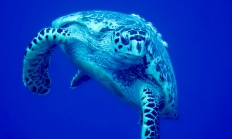
Sea turtles are federally protected under the Endangered Species Act of 1973. NOAA Fisheries is responsible for conservation and recovery of sea turtles in the marine environment, while the U.S. Fish and Wildlife Service is lead on conservation and recovery of sea turtles on nesting beaches.
The E.E. Wilson Wildlife Area came into existence in 1950 when the U.S. Government gave quitclaim title to the property to the Oregon Department of Fish and Wildlife. The wildlife area covers approximately 1,788 acres, is located on Highway 99W about 10 miles north of Corvallis and is situated on the Willamette Valley floor. SHOTGUN RANGE BACK OPEN AS OF LATE OCTOBER 2025: The renovation is complete and the shotgun range is back open. Improvements include: four times as many shooting lanes, fully paved ADA-compliant walkway with pullouts that will make it easier for disabled shooters, a new covered pole…
SALEM, Ore. – The Oregon Department of Fish and Wildlife is accepting applications for the Chair position on the state Access & Habitat (A&H) Program Board. The deadline to apply is April 3, 2026. Application forms and additional information are available at: http://www.dfw.state.or.us/lands/AH/get_involved.asp The current Chair has completed the maximum…
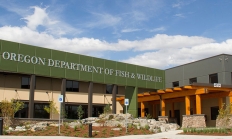

The goal of the Oregon Hatchery Research Center (OHRC) is to answer scientific questions related to fish recovery and hatchery programs. Information gained at the Research Center will help answer questions vital to the success of the Oregon Plan for Salmon and Watersheds and implementation of the Native Fish Conservation Policy. The Oregon Hatchery Research Center is a cooperative research project between the Oregon Department of Fish and Wildlife and the Oregon State University Department of Fisheries and Wildlife.
NE WILDLIFE VIEWING April 23, 2026 Baker County Bighorn sheep can be seen in the Burnt River Canyon west of Durkee or along the Snake River Road south of Richland. The best viewing is in the early morning and late in the evening. Take the Snake River Road between Richland and Huntington to see bald and golden eagles along the Snake River. There are deer throughout the valley. Early in the morning and late in the afternoon are good times to view wildlife. A drive through the foothills of the Baker valley and through the Keating valley can turn up…
Find the weekly statistics for waterfowl and upland game birds at Fern Ridge Wildlife Area.
Construction of this facility began in 1924 and production started in 1925 by the state of Oregon. Various renovations have taken place with the most recent being the addition of 4 new fish rearing raceways and improvements to the pollution abatement system which was completed in 2016. Other renovations made throughout the hatchery have utilized the Restoration and Enhancement Program.. The purpose of this facility is to enhance spring Chinook, winter steelhead, summer steelhead, and coho populations for various coastal streams. The facility is used for adult collection, egg incubation and rearing of spring Chinook, fall Chinook, winter steelhead, summer…
Prineville Reservoir Wildlife Area came under the shared management of the Oregon Department of Fish and Wildlife & United States Bureau of Reclamation in 1962. It is managed for the protection and enhancement of wildlife habitat, big game winter range, improving riparian wetlands, and to promote wildlife stewardship. Goals of the PRWA include creating recreational opportunities for viewing and enjoying wildlife, including mule deer, bald eagles, and a variety of waterfowl. Boating, hiking, and camping are a few popular activities permitted in the wildlife management area. Hunting and fishing opportunities are also available within Prineville Reservoir Wildlife Area, as regulated…
SALEM, Ore. – ODFW staff received a report of an incident involving a coyote biting an adult along Orchard Heights Rd., just outside the city limits of West Salem that occurred on Feb. 11. The Polk County Sherriff's Office (PCSO) initially responded to the area to conduct a site investigation…


Columbia Fishing April 23, 2026 Current and upcoming fishing opportunities: Columbia River regulation changes for the 2026 spring Chinook fishery are posted. Please see the fishing regulation update page for details. Announcements For the latest regulations, including in-season changes See the fishing regulations update page. Forecasts for 2026 Columbia River Spring Chinook, Summer Chinook and Sockeye are available here. Fish consumption advisories The Oregon Health Authority has issued consumption guidelines for parts of the Columbia River due to high levels of mercury and/or PCBs. Fish with these chemicals look, act, smell and taste like any other fish, so caution is…