Search myodfw.com
Showing 861 - 880 of 1128 results
Find maps, boundary information and the percent public land in the Paulina Unit.
Find maps, unit descriptions and the percent public lands in the Starkey Unit.
Find maps, boundary descriptions and percent public land for the Fossil Unit.
Find maps, boundary descriptions and the percent public land for the Silver Lake Unit.
Find maps, boundary descriptions and the percent public land for the Willamette Unit.
Oregon requires all hunters under the age of 18 to complete a hunter safety education course before hunting in the state. Upon course completion, students will receive a temporary Hunter Safety certification card to be carried while hunting in Oregon until a permanent card is received in the mail to replace it. Hunters over 18 are encouraged to take the online education course, as it may be required for out of state hunts. Note: Youth under the age of 9 may struggle with the course material and may not have the physical strength needed to safely handle a firearm during…

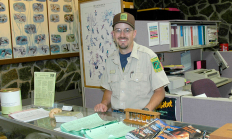
Whether it's concerns about your local fishery, questions about an upcoming hunt, or comments about an agency policy, we want to hear from you. Please feel free to call or send us an e-mail.
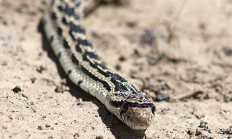
The gopher snake occurs in a wide variety of habitats, from deserts and grasslands to woodlands and open forests. It frequents agricultural regions, especially where there is brushy cover such as fence rows. Diet varies according to size, with young eating insects, lizards, rodents, and birds and their eggs. Adults can take larger prey, occasionally as large as rabbits. Photo by Simon Wray, ODFW
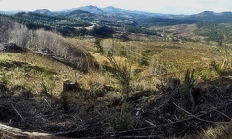
Update 8/27/26: Northeast Oregon A&H access areas to reopen Aug. 29. LA GRANDE, Ore. – All northeast Oregon Access and Habitat (A&H) access areas will reopen effective Aug. 29. Improved conditions in northeast Oregon including cooler temperatures, higher humidity levels, reduced fire activity, and a favorable extended forecast support reopening…
Oregon's diverse habitats and terrain offers something for every hunter. From the densely forested Coast Range to the expansive sage steppe of the Great Basin, hunting opportunities are practically unlimited. Visit e-regulations
SALEM, Ore. – ODFW staff at the Ashland Boat Inspection Station found quagga mussels on a motorboat that was being transported from Lake Havasu, Arizona into Oregon on March 21. This was the first instance in 2026 where crews found invasive freshwater mussels on a boat entering Oregon. The watercraft…
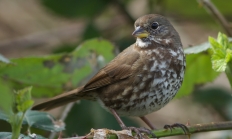
These big, medium-brown sparrows with variable grayish faces and heavily streaked or blotch undersides can be found in summer at higher elevations across much of the state except the Coast Range. Darker brown birds from more northerly breeding populations are common in western Oregon in winter, often coming to feeders, where they scratch like towhees for seed on the ground. Hear the song of the Fox sparrow Photo by Robin Horn, Flickr
California myotis is an acrobatic flyer. It is dark brown to blond with dark ears, and feeds on moths and flies. Early in the summer, a female joins a maternity or nursery colony where she gives birth to one offspring. In winter, these bats roost in mines, caves and buildings. The California myotis is an Oregon Conservation Strategy Species found throughout the state except for the Columbia Basin. Photo by ©Michael Durham

The song of this wren is often mistaken for the Song sparrow in the thickets and open woodlands where it resides. When in view, however, its long tail, thin bill, and white line above its eye are distinctive. Found in a variety of habitats, it readily takes advantage of cleared forest grown to large shrubs, especially blackberries. It is a permanent resident west of the Cascades, in Klamath and Warner basins, and along the upper Columbia River and tributaries. Hear the song of the Bewick's wren Photo by David Hoffman, Flickr

The Pacific wren makes its home in dense coniferous forests with understory thickets where it often forages for insects. This bird was considered the same species as the winter wren but is now separated as its own distinct species. The Pacific wren is rufous brown above, richly colored below, and barred with a darker brown and dusky. Young birds are distinctly less barred. It’s most easily found by its sharp kep-kep call and ringing, tinkling song. Males defend territory by singing in spring and in hopes of attracting a mate.

Merriam's ground squirrel is one of the two small gray ground squirrels in Oregon without stripes or spots. Most of the geographic range of this squirrel is in Oregon, where it occurs south and east of a line connecting Huntington, North Powder, Maupin, Warm Springs, Bend, and Fort Rock, Summer Lake, and Plush. This species does not occur south of the North Fork Owyhee River in Malheur County. These ground squirrels emerge in early March, breed, rear their young, become exceedingly fat and go into their hibernacula by early August. Photo by ©John Rakestraw

Cassin's auklet uses a few offshore lands for breeding in Oregon. It forages in the marine environment and nests in a chamber under rocks or digs its own burrow, two to six feet long, in the soil. This species spends its day at sea and only comes to the burrow at night, perhaps to reduce discovery by predacious Western gulls. Although few Cassin's auklets nest in Oregon, nesting sites are found along the entire coast where offshore rocks provide appropriate habitat. During the non-breeding season this is the most abundant alcid seen at sea in Oregon. They are present offshore…

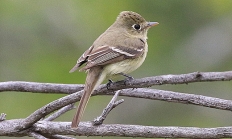
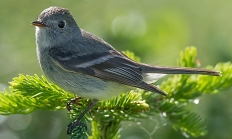
The Hammond's flycatcher spends much of its time in tall conifer canopies, where its subdued plumage and quiet, monotonous chant let it be easily overlooked. A diligent observer may be able to locate this aerial insectivore on a dead limb just beneath the live crowns of mature conifers from which it sallies into a canopy gap to capture insect prey on the wing. It is a common summer resident of montane coniferous forests through the state, on both sides of the Cascades. Hear the song of the Hammond's flycatcher Photo by Keith Williams, Flickr
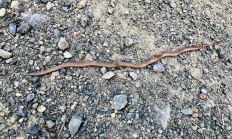
The Forest Sharp-tailed Snake was recognized as a separate species from the Common Sharp-tailed Snake ( Contia tenuis) in 2010. While these two species closely resemble one another, Forest Sharp-tailed Snakes can be identified by their long tails which have 43-58 subcaudal scales. This secretive species limits most of their activity to the rainy season, preferring to stay underground during dry conditions. Forest Sharp-tailed Snakes occur in southwest portion of the Oregon, where they select mesic environments and can be found in shaded forest habitats and mixed woodlands. Photo by russnamitz, iNaturalist
This small greenish flycatcher is easily overlooked in the moist, shady forests where it makes its summer home. It is a common to abundant breeder in forests of the Coast Range and west Cascades below about 4,000 feet and a common transient in western Oregon. The Pacific-slope flycatcher is most easily detected and identified by voice, but there is incongruence between published descriptions of vocalizations and some birds heard in the field lessens the certainty of identification to species, especially those in eastern Oregon. Hear the sounds of the Pacific-slope flycatcher Photo by Trish Gussler, Flickr