Search myodfw.com
Showing 101 - 120 of 399 results
SALEM, Ore. – Organizations and partners interested in funding conservation, outdoor access, and recreation projects in Oregon are encouraged to apply soon, as the Oregon Conservation and Recreation Fund (OCRF) grant application window is open now but closes Monday, Feb. 9, 2026. The OCRF Advisory Committee began accepting applications on…
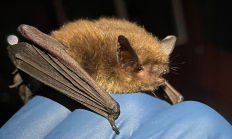
Bats are important pollinators and the only flying mammals; they use sound to locate their prey, and they live a long time. Oregon has 15 species of bats, and eight of those are Oregon Conservation Strategy Species. Strategy Species are those having small or declining populations, are at-risk, and/or of management concern. Some of Oregon's species migrate south in winter while some remain here and hibernate. Bats have echolocation which allows them to make high-pitched sounds then listen to the echo of those sounds to locate where objects are. Echolocation helps them find even the smallest insect.

SALEM, Ore. – ODFW completed a final draft of the 2025 State Wildlife Action Plan (SWAP), now available online for public review. A virtual public meeting will be held on Wednesday, July 16 at 6 p.m., where ODFW staff will present highlights from the plan and answer questions. The public…

CORVALLIS, Ore . — The Oregon Hatchery Research Center Board will meet virtually via Zoom on Wednesday, Sept. 3 from 9:00 a.m. to 11:00 a.m. In addition to the regularly scheduled items, the agenda includes a review of a proposal for use of the remaining OHRC Research Fund. The meeting…
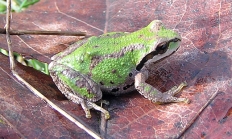
Adult treefrogs have a dark mask that extends from the tip of the nose across the eyes to the shoulders. Coloration varies between individuals, ranging from green or reddish to brown or gray. Most have dark blotches along their sides with light colored bumpy undersides. They have special skin glands that produce a waxy coating to keep their skin moist. Male treefrogs have a dark gray, inflatable throat pouch during the breeding season. As the smallest frog species in Oregon, adult Northern Pacific treefrogs only grow to two inches in length. During the non-breeding season, this treefrog is found in…
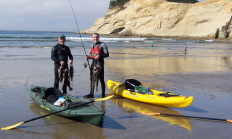
SW Fishing May 7, 2026 Best bets for weekend fishing: Trolling at Lost Creek and Applegate Reservoirs should be very good this weekend. Howard Prairie and Hyatt Reservoirs will be full of legal-size rainbow trout and holdover trout should be good sized this year. Spring Chinook are being caught in the upper Rogue River. Trout stocking Stocking schedules in SW Zone have been impacted by lower than normal water levels and lack of accessibility for liberation trucks. Please see individual waterbodies for updates or check the Trout stocking schedule. Scheduled to be stocked May 4- May 22: Applegate Res, Ben…
The Landowner Preference Program (LOP) was established to acknowledge the contribution of private lands to support wildlife and provide a form of compensation to landowners for resources used by wildlife. Tags are available to landowners, family members, and others designated by the landowner based on the acreage owned. Pronghorn hunts are only available to landowners and family members. Recipients of LOP tags may only hunt on the property for which they are registered. step-by-step instructions Create Landowner Account


Find maps, boundary descriptions and hunts available in the new Aldrich Hunt Area. Download printable PDF map
The Bald eagle is one of eight species of sea-eagle worldwide, and the only sea-eagle found throughout North America. It is one of the most studied North American birds. Large size, wingspan of six-and-a-half to eight feet, and the contrast of white head and tail, and yellow eyes, beak, and leg, to dark brown body and wings make the adult Bald eagle one of our most distinctive raptors. Six age-related plumages have been recognized; adult plumage is acquired at four-and-a-half to five years of age. Sexes have similar plumages, but females are larger than males, and the sex of individuals…

SALEM, Ore.— The fungus that causes white-nose syndrome in bats has been detected in Clatsop County. White-nose syndrome is an infection in bats caused by the fungus Pseudogymnoascus destructans that disrupts hibernation, causing dehydration and starvation. Samples analyzed by U.S. Geological Survey (USGS) confirmed the presence of the fungus in…

Alsea Hatchery was constructed in 1936 and is operated with state funds. Many improvements have been made to the hatchery since original construction. The hatchery produces both winter steelhead and rainbow trout. The facility is used for adult collection, spawning, egg incubation and rearing of winter steelhead, and egg incubation and rearing of rainbow trout.
SALEM, Ore. - Oregon's Fish Passage Task Force will meet Thursday, October 16 from 8:00 a.m. to 12:30 p.m. at the Red Lion, 1313 N Bayshore Dr, Coos Bay. The meeting will be open to the public. Members of the public who are interested in the meeting are encouraged to…