
Search myodfw.com
Showing 1001 - 1020 of 1410 results
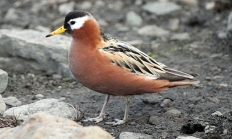
This is a portly, brightly colored shorebird, typically found in coastal salt marshes, mud flats, and sandy margins of freshwater ponds. Migrant juveniles rather than adults appear in Oregon. They have a flattish, dark rufous-colored crown with fine black streaking. The crown gives the appearance of a jaunty "cap" sitting forward on the head and abruptly ending at the rear. The breast is rich orange-buff shading into the white lower breast and belly. The well-defined creamy-white supercilium broadens behind the eye and is visible at a considerable distance. This is one of the most distinctive field marks on juveniles. They…
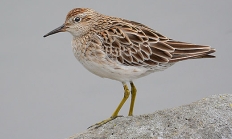
This medium sized, stocky sandpiper is rarely observed away from the rocky coastline as it forages close to the zone of salt spray. Primarily a late fall migrant with the major influx into Oregon occurring the last week in October and into early November. Generally silent during migration and on wintering grounds. Often found singly or in small groups with foraging Black turnstones and Surfbirds. Cryptic plumage makes it difficult to observe as it forages slowly over mussel and barnacle beds in typical sandpiper fashion. Roosts on rocks with Black turnstones and Surfbirds near feeding grounds, just above the spray…
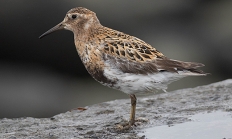
The Dunlin undergoes one of the most dramatic changes in appearance of all shorebirds when it molts from winter to breeding plumage. In winter, these medium sized sandpipers are brownish gray above with white underparts, but in breeding plumage they have a striking rufous-brown back and cap and black belly. Females are larger than males but otherwise similar in appearance. The Dunlin is an abundant transient and winter visitant in estuaries and occasionally on beaches along the coast of Oregon, but significant numbers winter in the Willamette Valley, especially the southern part. Hear the call of the Dunlin Photo by…
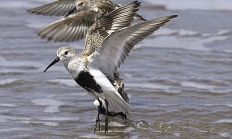
This slender sandpiper is a rare but nearly annual visitor to Oregon. Although easily overlooked, its drooped bill, light eyeline, long neck, long greenish legs, and unstriped wings in flight help set this medium-sized shorebird apart from similar species. Its preferred habitat during migration is shallow freshwater, usually avoiding mudflats and beaches. It feeds on invertebrates such as midge, beetle and mosquito larvae. A rare fall and occasional spring transient, it is most frequently found in estuarine habitat along the coast. It is also found along the shorelines of the Great Basin region. Hear the call of the Stilt sandpiper…
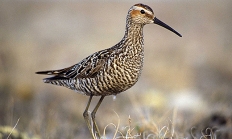
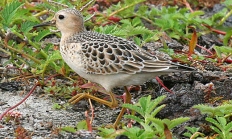
The Buff-breasted sandpiper resembles a plover with a high-stepping, pigeon-like gait. One of the few Oregon shorebirds that frequents dry, sparsely vegetated coastal grasslands. Fall migrants consist of juveniles. It has scaly, buffy-brown underparts, yellow legs, a small head, and a short black bill. Beady black eyes stand out on a plain, pale face. It bobs its head while moving. Gleaming white underwings are displayed in a graceful flight pattern. It is unique among North American shorebirds in having a lek mating system. This is a rare but regular fall migrant on the Oregon coast where it has been recorded…
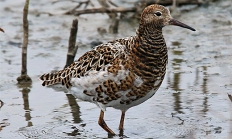
The male Ruff is a relatively large, distinctive, Eurasian shorebird that in breeding plumage sports head tufts and neck plumes from which it gained its name. However, most Ruffs seen in Oregon are juveniles that appear as lanky, buff-colored, pot-bellied, short-billed sandpipers showing white on both sides of the rump in flight. Females are about 20 percent smaller than males and are referred to as reeves. It is usually found on mudflats of coastal estuaries and adjoining wet meadows. The Ruff takes mostly aquatic insects, but will take crustaceans, mollusks, and some worms as well. The Ruff is a rare…
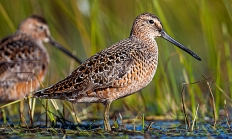
These chunky medium-small shorebirds are quite colorful in oranges and browns during most of their time in Oregon, where they are found mainly along the coast and locally in muddy areas inland. Their feeding motion has been likened to a sewing machine as flocks move slowly through shallow water and wet mud, probing with long straight bills. They are occasionally seen in marginal areas such as flooded pastures, but less likely than Long-billed to use such upland locations. They are a common to locally abundant coastal migrant, less common and more local in western interior valleys, and rare bur regular…
Cryptically colored, usually solitary and somewhat secretive, the Wilson snipe is often flushed before being seen, sometimes exploding from practically underfoot and rocketing off in a corkscrew flight. This plump-bodied, long-billed bird of open marshland is primarily crepuscular, peaking in feeding activity at dusk and dawn, and often sleeping during the day. In breeding season they become more flamboyant, appearing atop fence posts and displaying their unique winnowing flights from high in the air, their outer tail feathers vibrating with an eerie whistling sound. They are uncommon and local west of the Cascades in the summer and uncommon and local…

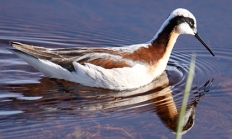
This is the largest and most terrestrial of the three species of phalaropes in Oregon. It is similar in shape to other Phalaropes, but larger size, longer bill and neck, lack of bar on the wing, and white rump distinguish it. In adaptation to a more terrestrial life than other Phalaropes, its toes are fringed, not lobed. It is a common transient and breeder east of the Cascades. The largest numbers breed on the great marshes of southeast Oregon. They are rare visitor west of the Cascades. Hear the call of the Wilson's phalarope Photo by Charlotte Ganskopp
Flying over the water in small flocks or riding the ocean swells like puffs of down, a more incongruous picture can hardly be imagined than these dainty mites riding the waves during rough weather, apparently entirely indifferent to the tumult of waters. Pelagic shorebirds, they come to shore only to breed. Adapted to life on the sea, they have glands that allow them to expel salt from the seawater they drink, and lobed, coot-like toes to swim. Brick red in their breeding plumage, they are mostly gray and white in winter. They are uncommon to common spring and fall transients…
Gulls and terns can be seen year-round in Oregon, depending on the species. Gulls like open areas around water bodies and are frequently seen where human food is concentrated, such as dumps or restaurants. Terns are in the same family and usually are smaller and more slender.

Heermann's gulls, the warm-water gulls of summer and fall, accompany Brown pelicans as they fly north each summer. Although most feed along the shore or in the ocean, some feed on tide flats. They often steal food from Brown pelicans. They may take fish directly from the pelicans' bills immediately after a dive or claim food that pelicans have located, discarded, or disturbed. This gull is common on the outer seacoasts, beaches, bays and estuaries. They are strongly associated with outer coasts and adjacent ocean waters, usually within a few miles of shore. A few wander inland during the fall…

This small, gentle looking gull is one of the most abundant wintering gulls along the Pacific coast. It is often found foraging in mixed flocks with Ring-billed, and to a lesser extent, California gulls. Its small plover-like head and bill, and the habit of bobbing its head while walking, make it fairly easy to identify. It is most often found actively foraging with similar-sized gulls on coastal farm fields and short grass meadows and lawn when such habitat is moist. This is an abundant migrant and winter visitor along the coast, the lower Columbia River and in the Willamette Valley…
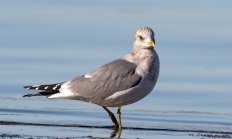
This is a colonial species that uses rocky islands or spits in large freshwater marshes, lakes, and rivers for nesting. It may fly at least five miles from the nest to forage in marshes, rivers, pastures, or other open habitats. There are colonies of Ring-billed gulls at marshes of southeastern Oregon and on islands in the Columbia and Snake rivers. There has been a colony near Baker City for over 20 years. Hear the call of the Ring-billed gull Photo by Kathy Munsel, ODFW
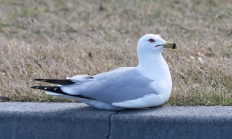
California gull colonies are usually located on islands with no vegetation in lakes or rivers. Sometimes colonies are on the shore, but these are subject to increased predation from mammalian carnivores. There are several large colonies of California gulls in the southeastern marshes, and at least 5,000 gulls nest on islands in the Columbia River. Smaller numbers nest on islands in the Snake River near Ontario, in Malheur County. Hear the call of the California gull Photo by ©Greg Gilson
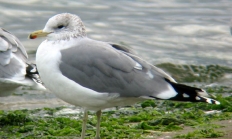
Identification of the large pink-footed gulls (Herring, Thayer's, Glaucous-winged, Western and Glaucous) along the West Coast is difficult. They are a common migrant and winter visitor offshore. Moderate numbers also winter in the Willamette Valley, concentrating with other gulls and landfills and other food sources and are most common around Portland and Eugene. Hear the call of the Herring gull Photo by ©Greg Gilson
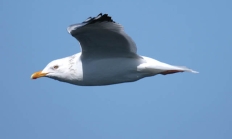
This mid-sized, pink-legged gull has caused much of the confusion in west coast gull classification and identification. Its plumage characteristics are similar to Herring, Iceland, and some Glaucous-winged hybrids, and great care is needed for correct identification. It differs from the Herring gull in having a much smaller bill, a darker eye, less black in the wing-tips and, often, a more rounded head. Opportunistic feeders, Thayer's gulls regularly concentrate about landfills, food-processing plants, and over fish runs. It is a common migrant and fairly common winter visitor along the coast. The largest wintering numbers are found in the Portland metropolitan…
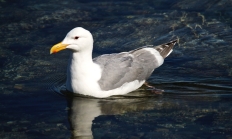
This is a marine gull that breeds on both offshore islands and rocky cliffs along the Oregon Coast. It also uses structures for nesting and, occasionally, will nest on grass-covered headlands. The Western gull's food comes from the marine environment, estuaries, and the immediate shoreline. It eats small fish, clams, mussels, bird eggs, the young of other birds nesting nearby, sea urchins, starfish, squid, crustaceans, marine worms, and carrion. it will scavenge garbage or waste from fishing boats as well. It is present all year along the entire coast of Oregon. Hear the call of the Western gull Photo by…

This gull nests on offshore islands, rocky coastal cliffs, and sometimes in grass on level parts of headlands. It forages in the marine and intertidal environments. Glaucous-winged gulls eat just about any animal material they find. They take small fish, barnacles, molluscs, sea urchins, bird eggs, carrion and animal waste discarded from fishing boats. It is rare but regular along the coast and the Columbia River; local and rare in the Willamette Valley. In can be uncommon midwinter at Sauvie Island. Most Glaucous-winged gulls in Oregon nest in the mouth of the Columbia River. Hear the call of the Glaucous-winged…
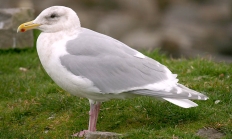
This large arctic gull visits the Northwest in winter where its pale bulk often stands out in gull flocks. Finding one is a highlight of winter birding. Even at a distance the size and frosty tones of this bird can be spotted in a flock. Most Oregon birds are in the whitish first-or-second-year plumage showing a pinkish bill with sharply delineated black tip, but third-year birds and adults occur now and then, mainly on the north coast and at Sauvie Island. They are rare but regular along the coast and the Columbia River, and rare in the Willamette Valley. It…
