
Search myodfw.com
Showing 1281 - 1300 of 1415 results
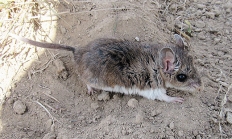
The Northern grasshopper mouse is a stockily built mouse with a thick tail. The dorsal pelage is dark sepia long the midline grading moderately sharply to a light tannish along the sides. The ventral pelage is white. A dark sepia line extends across the face between the eyes. The ears are thinly furred, sepia on the external surface and light grayish-tan on the internal surface. The feet and tip of the tail are white. In Oregon, Northern grasshopper mice have been found in grassland and desert areas in Crook, Deschutes, Gilliam, Harney, Jefferson, Klamath, Lake , Malheur, Morrow, Sherman, Umatilla…
The white-footed vole is among the smaller voles. The pelage consists of dark bluish-gray hairs tipped with a rich brown or black on the dorsum grading lighter on the sides, thence to light gray to pinkish buff on the venter. The tail is distinctly bi-colored: white or buff on the vental surface, brownish black on the dorsal surface. The dark dorsal stripe is much wider than the lighter ventral stripe. The feet are light grayish. This vole occurs from Old Fort Clatsop, Clatsop county, and near Rainier, Columbia County, south through the coast range. Various Oregon specimens have been found…
The moose is the largest member of the family Cervidae. The pelage is blackish or dark brownish grading to dark gray or grayish brown on the venter and leg. The muzzle is broad and overhanging, the palmate antlers of adult males are massive, and a "bell" (waddlelike flap of skin on the throat) is present. The first moose to come to Oregon wandered south from Washington or west from Idaho across the Palouse Prairie. They stayed to establish a herd in the Blue Mountains north of Elgin, and today there are an estimated 50 adults and calves in the area…

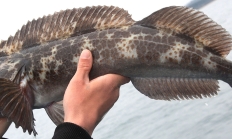
Features: Lingcod have an elongated body with a large mouth and sharp, canine-like teeth. They are generally mottled gray or brown but sometimes green or blue. A green-colored “ling” should not be confused with a greenling. Lingcod can get 5-feet long, but those caught in Oregon average between 2- and 3-feet. Habitat: Adults like to be near rocks, inshore and to 230-fathoms deep. Young lingcod prefer the sand or mud bottoms of bays and inshore areas. Technique: Bounce some bait along the bottom with 5/0 or 6/0 hooks, a 4- to 6-ounce sinker, and 20-pound line on a stout rod…
Features: Trout-like in appearance, the body is silvery in color with a bronze or dark back. They can be distinguished from trout by the forked tail and the small, down-turned mouth. Lengths run to 20-inches. Whitefish are often erroneously called graylings by many anglers. Habitat: Mountain whitefish inhabit many Oregon streams and lakes, thriving best in clear, cold water. Techniques: Whitefish tend to go for flashy flies, but are known for quickly spitting them out. Many sportsmen look with disfavor on the whitefish and often throw it away as undesirable. However, the flesh of the whitefish is firm and tasty…

Adult tiger salamanders are relatively large with olive-colored blotches outlined in black. They have gray undersides and can grow to 13 inches in total length. As adults, tiger salamanders live almost entirely on land, returning to the water to breed. Terrestrial adults spend a lot of time in burrows that they or other animals have dug. Tiger salamanders are found in grassland and shrub-steppe habitats. It is unknown whether tiger salamanders occurs naturally in Oregon, or whether they were introduced by people after larval salamanders used for bait colonized fishing lakes and ponds. Photo by Matt Reinbold, Flickr

This small salamander is evenly speckled with dark flecks and has a brown head, back and tail with a bright yellow belly. Southern torrent salamanders spend their lives in and near permanent, cold and clear water bodies including mountain streams, springs and seeps in older coastal coniferous forests. For a salamander, they are able to tolerate relatively dry forest conditions. Southern torrent salamanders are Oregon Conservation Strategy Species in the Coast Range, Klamath Mountains and Willamette Valley ecoregions. Photo by John Clare, Flickr

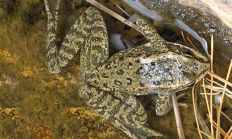
Adult Cascades frogs have tan, copper or green backs with black spots and yellow bellies. Their skin has small bumps on the back and sides. Females, which grow to three inches in length, are slightly larger than males. Cascades frogs live in a variety of moist habitats including mountain meadows, bogs, seasonally flooded forested swamps and shallow ponds, marshes and lakes. They use woody debris, mud or dense vegetation for cover from predators and spend their winters hibernating in mud. They emerge during the summer and live in wet meadows and bogs or along forested streams and pond edges. The…
Although not as imposing as the Canvasback, the redhead is a large, handsome, fast-flying diver. The drake has a red head, black breast and tail coverts, and steel gray back, flanks and tail. Hens are a medium brown. During courtship, the drake utters a very un-duck-like meow. Known for nest parasitism - laying eggs in the nests of other birds, usually other diving ducks - redhead eggs have also been found in the nests of a variety of species. It is an uncommon summer resident in northeast Oregon, but commonly breeds at Batch and Bogus lakes and locally elsewhere in…

Features: Along Oregon's coast there are two species of mussel. Bay mussels ( Mytilus edulis) are bluish-black and grow to about 3 inches in length. California surf mussels ( Mytilus californianus) are brown or black and grow to about 7 inches long. Habitat: Mussels often inhabit boulders in the upper tidal zone so it is best to go looking for them during low-tide. Technique: Wearing a glove, use a twisting motion to pull mussels off the rocks, then immediately pull the "beard" off the bottom, the hairs that previously anchored the shellfish to the rocks. Be sure to check the…

Known as "bluebill" to most hunters, this species is one of the most abundant and widespread of North American ducks. The lesser scaup is similar to the greater scaup in appearance and habits, but is smaller and lacks the white on the primaries. In the field, however, the black-and-white drakes and brown hens are very similar to greater scaups. The common vocalization is the purr call of the female; drakes are usually silent, but utter a low single-note whistle in courtship. In general, the lesser scaup is more apt to be found in interior or freshwater habitats while the greater…

Medium-sized diving ducks, Barrow's goldeneyes are the expected of the two goldeneye species in Oregon in the summer, but are typically less numerous in the winter. Drakes show graceful patterns of black and white, purple glossed head, white crescent-shaped patch between the eye and bill, steep forehead, and short bill. Females and juveniles have a chocolate-brown head, slate-gray back, wings and tail; adult females have a golden bill. They are the only waterfowl species known to defend winter territories different from breeding territories. It is uncommon from the Cascades eastward in both breeding season and winter, but it may concentrate…

The emperor is a medium-sized stocky goose with a white head and metallic blue-gray body reminiscent of a blue-morph snow goose. Dark throat and undertail coverts as well as yellow feet distinguish it from the latter. Juveniles are brown with a gray-black head and neck that becomes white with black flecking in late fall. Vocalizations include in-flight kla-ha, kla-ha, kla-ha, and an alarm call a deep ringing u-lugh, u-lugh, u-lugh. The emperor is a rare but regular visitor in Oregon during migration and in winter, most commonly on the coast. Hear the call of the emperor goose Photo from USFWS

This small white goose is similar in plumage to the snow goose in all ages. In mixed flocks, the Ross's smaller size, shorter neck, head and bill profile and more rapid wing-beat may be apparent. They are a common spring and fall migrant through Klamath and Harney basins. During migration and on wintering grounds, the Ross's goose uses lakes and shallow marshes for roosting and agricultural crops and irrigated hay meadows for feeding. They arrive in Oregon around mid-October and leave around mid-November to continue their migration. They are a common spring and fall migrant through Klamath and Harney basins…

The pied-billed grebe is an aquatic species that breeds at the edge of open water in freshwater lakes, ponds, sluggish rivers, and marshes. When disturbed, it sinks like a submarine, rather than diving, and re-emerges with only its head above water. This is a brownish grebe with a black vertical bar in the middle of the rather stubby, whitish bill, and jet-black throat patch on both sexes in alternate plumage. It has a surprisingly loud "yelping" call within a marsh. Young have striking stripes on the head. This bird is widespread and common in Oregon. It winters locally in open…

Skulking through wetlands, the American bittern is rarely seen - it has an extremely slow and stealthy walk, and when a threat approaches it freezes and mimics marshland plants with upright posture and beak pointed skyward. These behaviors combined with its cryptic plumage effectively camouflage the bird. However, it is occasionally seen in flight, and its low, gurgling song can be heard over long distances. An uncommon to fairly common breeder east of the Cascades and a rare migrant in Malheur county it has also been noted at mountain lakes east of the Cascades in Lake County. In western Oregon…

At first look, the Willet is a rather drab and nondescript medium-sized shorebird found in wetland habitats and nearby uplands. However, further observation reveals subtle patterning in its relatively uniform grayish plumage and birds in flight expose a distinct, bold white wing bar that contrasts with a black border. Sexes are similar in appearance at all times of the year. Willet are present on breeding grounds in Oregon for a short period of time during spring and summer, but displaying birds are conspicuous and emit a loud and persistent "pill-will-willet" call. These vigilant and vocal individuals often hover overhead and…

The nasal meow of the Franklin's gull can be heard as it soars above wetlands and meadows, and colonies of this species are reported to be the loudest of all the gulls. In breeding plumage, the black hood contrasts sharply with the white breast and bright red bill. This species depends much more on insects and other invertebrates than do other gulls, and is therefore considered economically beneficial and favored by farmers. The Franklin's gull occurs in the southeast portion of the state in spring and summer, especially Harney Basin. It is rare west of the Cascades. It nests locally…

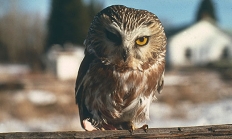
The Northern saw-whet owl is on of the most common forest owls in Oregon, but like most other owls, it is more often heard than seen. It is a small owl, approximately eight inches long, with a large head, large yellow eyes, and no ear tufts. The facial disk is reddish brown with small white streaks radiating outward from the eyes and a prominent white V above the eyes and beak. The back and wings are brown with white spots. The breast is white with rust-colored vertical streaking. This owl breeds in low to mid-elevation coniferous and mixed deciduous/coniferous forests…
On his historic expedition with Meriwether Lewis, Captain William Clark, the bird's namesake, first mistook this species for a woodpecker undoubtedly because of its long, sharp beak. However, this most specialized member of the North American Crow family uses this apparatus to pry loose its favored seeds from unrelenting cones of several pines with which the nutcracker has a symbiotic relationship. The whitebark pine, in particular, is totally reliant on Clark's nutcrackers for seed dispersal and germination. In Oregon the Clark's nutcracker is a resident along the crest of the Cascades, usually above 4,000 feet, lower on the east slope…
