
Search myodfw.com
Showing 1301 - 1320 of 1415 results
Even in the most barren and desolate reaches of the Great Basin, the cheerful song of the hardy Rock wren will contradict any notion that the desert is devoid of life. This specialist of cracks and crevices can be found almost anywhere there is exposed rock. One of its most unique features is the mysterious pebble path is constructs from its stone-cave nest to the outside entrance. Drab and pale overall, the gray head and back, white to tawny underparts, and gray tail with buff-tipped corners distinguish this species from other wrens. The Rock wren is a common breeder in…

The graceful short-distance flight of a bright male bluebird is a memorable sight. The Mountain bluebird haunts open country, providing an irreplaceable color note in the gray sagebrush landscape; particularly when in migration their brilliant blues flash in the desert sun in startling contrast to the prevailing dull colors of most other birds. Like other bluebirds, it readily accepts nest boxes. This accessibility, along with its sky-blue color, have always endeared it to nature lovers and made it a favorite of many. In Oregon, it is a common breeder and transient east of the Cascade summit except in treeless expanses…

Shadow-colored skulkers in dense riparian growth, catbirds are among the often heard, less frequently seen denizens of northeast Oregon. They are all dark gray except for a black cap and russet undertail coverts. The sound has variable melodious warblings with occasional imitations of other birds and off-key noises. A distinct mewing call is often heard. The Gray catbird is a fairly common breeder in dense riparian zones of the northeast Blue Mountain ecoregion and is common in the Wallowa and Union counties and in east Umatilla County along the Umatilla River, Pine Creek and Meacham Creek. They breed locally in…

One of the most numerous breeding birds in Douglas-fir and true fir forests of western Oregon is the Hermit warbler, yet it is often overlooked. This may be surprising, given the male's bold colors; however, it seldom descends from the higher reaches of the forest canopy. If you are familiar with its song, you can often hear three to five males singing on a spring morning from many places in appropriate habitat. The male Hermit warbler has a bright yellow head, set off by a black throat and nape. The gray back is marked with black stripes that vary in…

This small, dark-headed sparrow flashing white outer tail feathers is one of the state's most abundant species and one of the easiest to identify. When not nesting, the Dark-eyed junco might be seen nearly anywhere in the state. It is a regular visitor to city parks and neighborhood bird feeders. Most juncos occurring in Oregon show dark hoods, dull rusty-brown backs, and pinkish brown below the wings. Some are grayish, lacking much of the brown tones. They are most often observed in single-species flocks but individuals and small groups often join mixed wintering sparrow flocks. It is resident from the…

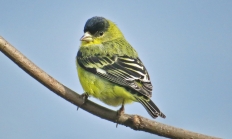
Formerly known as the Green-backed goldfinch, this species was either not present or overlooked during the 19th century by most Oregon ornithologists. The male's black forecrown contrasts smartly with the greenish back and bright yellow underparts. Females lack the clear contrasting colors of the males, though the tips of the secondary coverts and the base of the primaries are white in both sexes. Often the plaintive tee-yee call reveals the presence of the bird long before it is seen. In the north Willamette Valley the Lesser goldfinch is a fairly common breeder along the western fringe. Scattered and local in…
The House sparrow is an invasive species introduced from Europe. No other North American wild bird is so associated with human settlement as this introduced House sparrow. Its foods are nearly all imports, and its nesting and cover requirements are also human-derived. The House sparrow and European starling are the only introduced passerine birds that are thriving in Oregon. These birds can dominate bird feeders and utilize nest boxes that were intended for native species. The House sparrow can be found statewide around buildings at human developments of adequate size ranging from scattered farmsteads in remote and rural areas to…

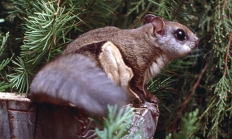
The Northern flying squirrel is the smallest arboreal squirrel in Oregon. It is typically squirrel-like except that the fore- and hind legs are connected by a furred patagium that extends from the ankle to the wrist. It is lead colored with buffy brown to brown tips. It occurs in forested areas west of the Cascade Range and eastward to near Lakeview, Lake County and Paulina Lake, Deschutes County. The species also occurs in the Blue, Ochoco, and Wallowa mountains. Northern flying squirrels are mostly nocturnal although individuals may be observed abroad during light hours on rare occasions. They are usually…
The Townsend's vole is a large vole with large ears that extend above the fur, a long brownish or blackish tail and brownish or blackish feet equipped with brown claws. In Oregon, it has been found along the Pacific Coast south to southern Coos County, throughout the Willamette Valley with eastward extensions along the Columbia River to near Hood River; the McKenzie River to Douglas County; and the Rogue River to Prospect, Jackson County. With few exceptions, Townsend's vole is associated with moist habitats: meadows, lowland pastures, riparian zones, boggy lands, marshes, and irrigated fields densely vegetated with grasses and…
The Western spotted skunk is smaller and more weasel-like than the Striped skunk. The pelage is black with a somewhat pentagonal white patch between the eyes, a round white patch on each side of the head and four or six segmented white body stripes. This skunk is endowed with a muscle-encapsulated musk gland similar to those of the Striped skunk and so similarly, can eject musk from two papillae located under the tail. The odor of the musk is considered somewhat more pungent or acrid but is less spreading than that of the Striped skunk. In Oregon, this skunk occurs…

The bottlenose dolphin is the most common of the oceanic dolphins and can be found in all tropical and temperate oceans. Flipper was a bottlenose dolphin. Their considerable intelligence and permanently-affixed smile make them a favorite of aquarium and television shows. The U.S. Navy also uses bottlenose dolphins to find mines and booby traps underwater. Oregon is the northern extent of its range on the West Coast. They are most often seen offshore during the summer by tuna and other fishers. They are gray with light gray to white on the undersides. In size they range from six to 13…

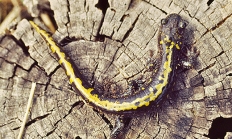
Appropriately named, adult long-toed salamanders have extremely long toes on their hind feet. Adults have black or brown skin that is smooth and moist with a yellow ragged-edged stripe running from its head to the tip of its tail. It is speckled with white or silver dots along its sides and underside. Adults may grow up to more than six inches in total length. Adult long-toed salamanders are seen infrequently, as they spend most of the year in the ground. They find cover in a variety of habitats including grasslands, dry shrub-steppe, pastures, lowland forests, high elevation lakes and ponds…
These small salamanders have solid green- brown- or gray-colored sides and backs with bright yellow or orange undersides. Adults can grow to four inches in total length. Columbia torrent salamanders spend their lives in and near cold and clear water bodies including mountain streams, springheads, waterfalls and seeps in older forests. They need loose gravel stream beds for hiding and foraging. They are highly connected to their water sources, but in times of heavy rainfall, they may venture into a nearby forest. The Columbia torrent salamander is an Oregon Conservation Strategy Species in the Coast Range and Willamette Valley ecoregions…

Adult Klamath black salamanders that live in Oregon are fully black with a smattering of bronze or green specks across the top of their heads, backs, tails and legs. The black salamander is one of the lungless salamander species and it breathes through its skin. Female black salamanders are generally larger than males and grow up to five-and-a-half inches in total length. Black salamanders live in forest, open woodland, moist talus (rock fragment piles) and streamside habitats. They use crevices in moist decaying logs or stumps, wet talus slopes or just under surface debris for cover during warm wet weather…

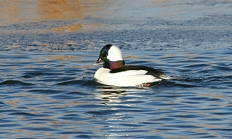
The bufflehead is North America's smallest diving duck, giving it the advantage of being able to nest in abandoned holes of northern flickers, a plentiful resource off limits to larger cavity-nesting ducks. It is a swift flyer and takes wing from water more easily and neatly than other diving ducks. Widely distributed throughout the state in winter, males attract attention with their striking white body, black back, and iridescent black head with a large notch of white; females and juveniles are dark charcoal-gray with a conspicuous white patch behind and below the eye. It is a local, uncommon breeder in…
A white form on the distant water may be the sides and breast of an adult male, whose deep green head and dark back are less visable when far away. The pearl gray bodies and white breasts of females, subadults, and eclipse males are starkly delineated from their full-crested chestnut heads. Long, slender, saw-tooth bills are held horizontally during surface swimming and grip squirming prey after an underwater chase. From coastal bays to the high Cascades, in all corners of Oregon and far beyond, common mergansers ply the rivers and peer into still waters in their efficient pursuit of fish…

This largest of the commonly encountered loons is perfectly built for underwater prey pursuit. Ungainly on land, this may be the price it pays for being a great diver. Large and blocky-headed, with a straight, robust bill, the common loon is separated from the yellow-billed by its straight bill and winter face pattern, and from smaller loons by its more angular head and often-retracted robust neck. Black head, white "necklace," incomplete black-and-white neckband, and white-checkered black back define breeding adults. Dark gray upperparts of winter adults shade to white underparts. Take-off is impossible by land and labored on water, but…

This is the world's smallest "peep" and can usually be picked out by its brownish coloration, dull yellowish legs, and hunched, creeping foraging style. Least can be found in small flocks in Oregon almost year-round. The Least sandpiper feeds on open mud with Western sandpipers but often feeds where some grass, salicornia or other cover is present, avoiding walking in the water as Western often do. It is uncommon to locally abundant statewide in migration, with most birds along the coast and at larger lakes and marshes inland. It is locally common on the coast in winter; smaller numbers winter…

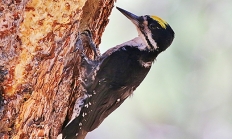
The Black-backed woodpecker can often be found in the open expanses of a recent forest fire or the twiggy closets of a bark beetle outbreak. It may be heard before seen, with its accelerating drum ringing from a prominent snag or its snarling call. Its nest is often low in a tree; both living and dead trees are used, but may require heartrot for excavation of nest cavities. Nest trees are often smaller in diameter than those used by other cavity nesters. It is a rare to locally common resident near the summit and on nearby plateaus and ridges on…
The Juniper titmouse presents the demeanor of a miniature jay with its crest jutted proudly upright. It is a pale gray bird above and underneath, with little or no brown coloration. Songs and calls are useful in locating hidden titmice. The Juniper titmouse occurs in pinyon pine-juniper woodlands in the bulk of its range. This bird is a cavity nester. The nest is often placed in a crevice of a twisted trunk of large, older junipers. It primarily forages in junipers and juniper seed are important in the winter diet. An Oregon Conservation Strategy Species in the Northern Basin and…
