
Search myodfw.com
Showing 1341 - 1360 of 1410 results
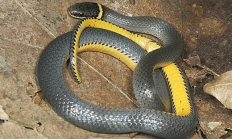
The ringneck snake requires moist micro-habitats such as downed logs, rocks, or stumps. It is found in a variety of vegetation types, but is most closely associated with pine-oak woodlands and moist canyon bottoms. It also can be abundant in Willamette Valley grasslands. These snakes feed mainly on small lizards, snakes and salamanders and also slugs, earthworms, frogs, and insects. Photo by Simon Wray, ODFW
In the Pacific Northwest, the night snake frequents arid desert scrub habitats near rocky outcrops or rimrock. It takes refuge in talus slopes or rocky crevices during the day. Night snakes tend to feed on cold-blooded prey, especially lizards and their eggs, frogs, toads, salamanders, large insects, and small snakes. These snakes are primarily nocturnal, and are more active on relatively cool nights of early summer. Photo by Ken-ichi Ueda, Flickr

This snake is most common in thick vegetation along water bodies, but ranges into farmland, chaparral, and deciduous and mixed coniferous woodlands in the Rogue and Umpqua river valleys of southwestern Oregon. Common kingsnakes usually feed on other snakes, but have been known to take small turtles, birds and their eggs, frogs, lizards, reptile eggs, and some small mammals. Photo by Alan Schmierer, Flickr
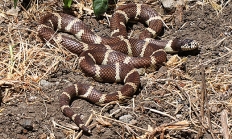
This species is found in pine forests, oak woodlands, and in chaparral of southwestern Oregon valleys. It is usually found in, under, or near rotting logs in open wooded areas near streams. The California mountain kingsnake preys upon snakes, lizards, birds and their eggs, and some small mammals. It is an Oregon Conservation Strategy Species in these ecoregions: Coast Range, Columbia Plateau, East Cascades, Klamath Mountains, and West Cascades. Photo by William Grenfell, Flickr

In the Northwest, this snake is found in grasslands, sagebrush flats, rocky stream courses, and canyon bottoms. Elsewhere it also frequents juniper and pine-oak woodlands. In southwestern Oregon, it is found in dry bushy areas close to rocks. Young striped whipsnakes feed primarily on lizards and insects. Adults also take snakes, small mammals, young birds, and insects. Photo by Bryn Hamilton, Flickr

The gopher snake occurs in a wide variety of habitats, from deserts and grasslands to woodlands and open forests. It frequents agricultural regions, especially where there is brushy cover such as fence rows. Diet varies according to size, with young eating insects, lizards, rodents, and birds and their eggs. Adults can take larger prey, occasionally as large as rabbits. Photo by Simon Wray, ODFW
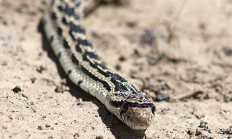
The Western ground snake is found in arid desert scrub vegetation with sandy soil, usually under surface objects or in areas with some surface moisture, such as the edges of washes. This snake feeds on small arthropods such as spiders, scorpions, centipedes, crickets, and grasshoppers. It also takes insect larvae. Photo by Peter Paplanus, Flickr

This highly aquatic snake is found in wet meadows, riparian areas, marshes, and moist forests near rivers, streams, lakes and ponds. It requires streams with thick riparian vegetation for escape and exposed boulders for basking. The Pacific coast aquatic garter snake takes aquatic prey such as small fish and fish eggs, salamanders, tadpoles, frogs, toads, earthworms, and leeches. Photo by Simon Wray, ODFW
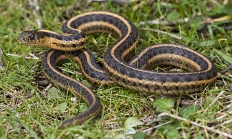
This species is found in a variety of habitats. To make matters more confusing, four subspecies are found in Oregon, each of which has somewhat different habitat preferences. All can be found in moist areas such as marshes and lake or stream margins, but two may occur some distance from water. The diet varies among subspecies; the more aquatic forms feed on fish, frogs, tadpoles, and leeches, which are eaten in the water. Terrestrial forms take frogs and toads, but also lizards, small mammals, salamanders and slugs. Photo by David Bronson, ODFW

This snake is found in meadows and at the edges of clearings in forests. It prefers areas with dense vegetation but, when basking, can be found in open areas or on talus slopes. It occurs in wooded areas on the floor of the Willamette Valley and has been found in the Rogue Valley. This garter snake is commonly found in suburban areas and city parks. The Northwestern garter snake feeds mainly on slugs and earthworms, but also takes insects, small salamanders, frogs, fish, small mammals, and possibly nestlings of ground nesting birds. Photo by J. Maughn, Flickr

Much variability in coloration exists in the common garter snake but the best identifying characteristic is a stripe down the middle of the snake's back. While the common garter snake frequents wet meadows and forest edges, it occurs in a variety of habitats far from water, including open valleys and moist coniferous forest. Smaller snakes eat earthworms, but adults feed on a variety of vertebrate prey, including frogs, toads, salamanders, birds, fish, reptiles, and small mammals. Invertebrates, including slugs and leeches, are also eaten. Photo by Dave Budeau, ODFW

Although they occur in a wide variety of habitat types, from deserts and chaparral to open forests across Oregon, Western rattlesnakes usually occur near rocks, cliffs, or downed logs. They overwinter in dens typically located on south-facing rocky hillsides exposed to sunshine. Western rattlesnakes feed mainly on small mammals, including mice, gophers, squirrels and rabbits, but will also take birds lizards, and amphibians. The Western rattlesnake is an Oregon Conservation Strategy Species in the Willamette Valley. Photo by Simon Wray, ODFW

A research study that began in 2012 confirmed Sierra Nevada red fox presence in the Oregon Cascades, specifically in the Mt. Jefferson, Mt. Washington, and Three Sisters Wilderness Areas. Confirmation was through genetic testing of hair and scat samples. Sierra Nevada red fox is a subspecies of Red fox that live in high elevations. They are slightly darker than Red fox and are highly specialized to montane (mountain) ecosystems. In the red color phase, the upper body is reddish-brown with white chin, cheeks, throat and belly. This fox ranges from silver to black in the black/silver color phase with silver…

The Sierra Nevada red fox is a montane red fox subspecies. Its presence in Oregon was confirmed in 2015, specifically in the Mt. Jefferson, Mt. Washington, and Three Sisters Wilderness Areas. The Sierra Nevada red fox is smaller than the red fox and averages about eight pounds. This fox has three color phases: silver (black), "cross" color phase and the more familiar red. The Sierra Nevada red fox is an Oregon Conservation Strategy Species in the East Cascades, Klamath Mountains and West Cascades ecoregions. Research continues on this species in the Oregon Cascades. Biologists captured and radio-collared several Sierra Nevada…
The Pacific wren makes its home in dense coniferous forests with understory thickets where it often forages for insects. This bird was considered the same species as the winter wren but is now separated as its own distinct species. The Pacific wren is rufous brown above, richly colored below, and barred with a darker brown and dusky. Young birds are distinctly less barred. It’s most easily found by its sharp kep-kep call and ringing, tinkling song. Males defend territory by singing in spring and in hopes of attracting a mate.

Adult tiger salamanders are relatively large with olive-colored blotches outlined in black. They have gray undersides and can grow to 13 inches in total length. As adults, tiger salamanders live almost entirely on land, returning to the water to breed. Terrestrial adults spend a lot of time in burrows that they or other animals have dug. Tiger salamanders are found in grassland and shrub-steppe habitats. It is unknown whether tiger salamanders occurs naturally in Oregon, or whether they were introduced by people after larval salamanders used for bait colonized fishing lakes and ponds. Photo by Matt Reinbold, Flickr

These large-bodied salamanders have solid brown skin that is smooth and moist. Adults can grow to almost 10 inches in total length. Northwestern salamanders live in moist forests or partly wooded areas. Though common in Oregon, adult salamanders are rarely seen because they live underground. Terrestrial adults require moist crevices in logs or rodent burrows in the ground for shelter from weather and predators.

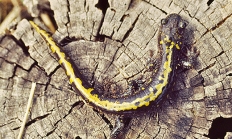
Appropriately named, adult long-toed salamanders have extremely long toes on their hind feet. Adults have black or brown skin that is smooth and moist with a yellow ragged-edged stripe running from its head to the tip of its tail. It is speckled with white or silver dots along its sides and underside. Adults may grow up to more than six inches in total length. Adult long-toed salamanders are seen infrequently, as they spend most of the year in the ground. They find cover in a variety of habitats including grasslands, dry shrub-steppe, pastures, lowland forests, high elevation lakes and ponds…
These large salamanders are marbled brown and tan in color when in their rare terrestrial (land-living) adult form. They are brown with yellowish-tan patches on These large salamanders have an aquatic adult stage that is brown with yellowish-tan patches and short gills. The rare terrestrial adult is marbled brown and tan. Larvae of Cope’s giant salamander are smaller with a more narrow head and shorter legs than the coastal giant salamander. Both terrestrial and aquatic adults can grow up to eight inches in total length. Most adult salamanders live in cold, fast-flowing, clear and permanent streams in coniferous forests. Adult…

Coastal giant salamanders are the largest salamanders in Oregon. Terrestrial adults are marbled with tan and brown and are mostly tan on their undersides. Larvae are brown with a large head, frilled gills, and a tail fin. Adults can grow to a total length of 14 inches. This species lives in dense wet forests near cold and clear streams, lakes, and ponds. Terrestrial adults are rarely seen because they spend most of their time in burrows. Occasionally, during times of heavy rain, adults are active on the forest floor. Photo by Steve Krause, NPS
