Search myodfw.com
Showing 1 - 20 of 231 results
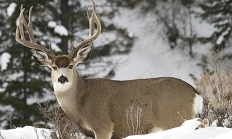
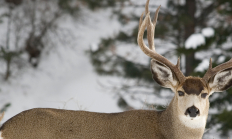
Features: Mule deer are larger and lighter in color than black-tails. Mule deer have a thinner “ropelike” tail that is white with a black tip. Their antlers are forked, as opposed to having a main beam. And as their name implies, they have large ears, like a mule, that stand at an angle. Habitat: Mule deer occupy a wide range of habitat types; some live in desert shrub-steppe, some in woodlands, and some in conifer forests. In general, however, mule deer occupy the more open, rugged areas. Although mule deer commonly are considered “browsers," they consume a wide variety of…

The mule deer is the larger member of the genus in Oregon. The ears are long, the metatarsal gland is surrounded by hairs similar in color but considerably longer than those on the remainder of the metatarsus, and the tail is short and constricted basally. Among adult males, the antlers are dichotomously branched with tines of approximately equal length. In winter, the basic pelage color is cinnamon buff. The chest is nearly black at the midline grading to grayish on the sides. The nose, sides of face, chin, and throat are whitish to pale buff. Spots of black occur immediately…
SALEM, Ore.—Oregon's Fish and Wildlife Commission today made changes to the formula used to allocate mule deer Landowner Preference (LOP) tags, which was needed due to the new harvest and population management system for mule deer approved in 2024. In a 6-0 vote (one abstention), the Commission approved shifting to…
Eastern Oregon mule deer are managed by Deer Hunt Areas, while all other big game, including Western Oregon deer hunts are managed by wildlife management units. Plan ahead by checking the boundaries of where you want to hunt. Hunters in Oregon can access millions of acres of public land open to hunting ( national forests, BLM land, state forests, wildlife areas) plus many private lands open through Oregon’s Access and Habitat program. See www.oregonhuntingmap.com to find a place to hunt.


Features: The most distinguishing feature of white-tailed deer is the tail. Whitetails have long, wide tails that can easily be seen, especially when they are startled and raise their tails. White-tailed deer antlers differ from mule and black-tailed deer in that there is one main beam with points coming off. Mule and black-tailed deer have antlers that fork on the main beam. Habitat: White-tailed deer share the same habitat as eastern Oregon’s mule deer. Deer both graze and browse. Forbs and browse (stems and leaves of woody plants) are favored forage during the growing season. Grasses are consumed during some…

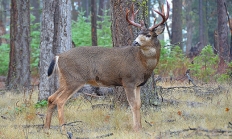
Features: Columbian black-tailed deer are smaller and darker than mule deer. As the name suggests, black-tailed deer have a wide, triangular tail with a dark brown or black top and a white underside. Habitat: Blacktails are a subspecies of mule deer found in western Oregon from the Coast Range east to the Cascade Mountains. They are edge-adapted species using the region’s dense forest cover to hide during the day and are then more open in early successional forest to feed at dawn and dusk. Places with a mix of forest age classes offer the best habitat for black-tailed deer. Techniques…

The deer mouse is a moderately small mouse-like rodent that exhibits considerable variation in color, tail length and markings. In general, the pelage of adult deer mice is buff to dark brown on the dorsum and white on the venter. The ears are moderately long, essentially naked and usually held erect and directed forward. The eyes are black and beady. The deer mouse has the broadest distribution of any species within the genus and occurs throughout Oregon. Below the treeline, it occurs as part of essentially all communities. It is active nocturnally, the time of onset of activity is cued…

Nearly a dozen subspecies of Odocoileus hemionus are recognized. Of these, two occur in Oregon - the mule deer and Columbian black-tailed deer, often just referred to as "Black-tailed deer." The mule deer is larger, lighter in color, and often associated with more open habitats, whereas the black-tailed deer is smaller and darker, and frequents dense, early seral forest communities. The most distinguishing feature of the black-tailed deer is the tail. Although not as long or wide as that of the white-tail, it is much larger than that of the mule deer. Because of the differences in size, color, marking…
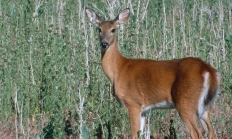
Features: Oregon’s rarest deer has a brown tail that is longer than a blacktail’s wide tail. Its antlers will branch off from a single main beam, unlike mule deer and blacktail antlers that branch twice. Habitat: The Columbian whitetail is a subspecies unique to Oregon and southwest Washington and found in just a few locations—along the lower Columbia River in Oregon and Washington, and in the Umpqua Basin near Roseburg (where it is expanding its range). Techniques: Just a few controlled hunts for this subspecies exist in the Umpqua Basin region and tags are limited; see the regulations for details.
The tail is brown dorsally with a white fringe, and white ventrally. In males, antlers with tines typically arise from a single main beam. In winter, the pelage is a dark buffy-gray and consists of relatively long, thick, and somewhat brittle hairs; in summer, the pelage is lighter with more tawny tones and is shorter and thinner. The midline of the dorsum is darker and the fade lighter; in males, the patch between the antlers is darker. Pelage markings include white on the venter, throat, muzzle and lower lip, and around the openings of the metatarsal and interdigital glands; a…

SALEM, Ore.—With the May 15 deadline approaching, ODFW is reminding hunters to apply early for 2026 controlled deer hunts and to carefully review changes to Eastern Oregon deer hunts. With the transition from Wildlife Management Units (WMUs) to Deer Hunt Areas in eastern Oregon, hunters who wait until the last…
SALEM, Ore. – Oregon's deer and elk give birth from May through July each year. It's natural for mother animals to leave their young alone for extended periods of time while they go off to feed. If you come across a fawn or calf by itself, don't assume it's orphaned…
SALEM, Ore.— Hunters are the first line of defense against Chronic Wasting Disease (CWD). By getting their animals tested, hunters can help wildlife managers detect the disease early and slow its spread in the state's deer and elk herds. OHA and ODFW are again teaming up to encourage hunters who…
SALEM, Ore.—ODFW will host a series of online public meetings in July with district wildlife biologists presenting proposed changes to next year's big game regulations and getting feedback. Each meeting will include a presentation on 2026 proposed regulations, a Q&A and opportunity for public comment. Proposed 2026 tag numbers and…