
Recreation Report
Marine Zone
Recreation Report
MARINE FISHING
October 22, 2026
Announcements
As of Jan 1, 2026, an Ocean Endorsement is needed for most recreational anglers fishing in the ocean. Check the Ocean Endorsement page for more information.
Report unusual fish and ocean conditions
Have you encountered unusual fish or ocean conditions off the Oregon Coast this year? With warm El Niño waters pushing up the coast, we're starting to see unusual tropical visitors migrating north! Report your on-the-water observations to CaCurrent.Observations@noaa.gov (more information available here). Your observations are critical to understanding how changing ocean conditions affect what we see offshore.
Saltwater News Bulletins
Be among the first to know about in-season changes! You can subscribe to receive emails and text message alerts for marine topics that interest you. It's easy to unsubscribe at any time. Your contact information will remain confidential. Three different lists of interests to ocean enthusiasts are available: bottomfish, halibut and ocean salmon.
Bottomfish
A few reminders
- Visit the sport bottomfish seasons page to see what's new for 2026.
- Retention of quillback rockfish and yelloweye rockfish remains prohibited.
- Cabezon is prohibited from Jan 1 through June 30.
Port by port reports for the week beginning Oct 12:
Last week, most of the coast experienced typical fall transition conditions, with large swell limiting the number of good days to get out on the water.
Garibaldi: Anglers landed 2.5 rockfish on average, mostly black rockfish and yellowtail rockfishes. Lingcod landings were just below 1 fish per angler.
Depoe Bay: Landings averaged 3.1 rockfish per angler, with mostly black, canary, deacon and yellowtail rockfishes landed. Lingcod catches were 1.25 fish per angler.
Newport: Anglers landed 3 rockfish per person, mostly black, deacon, and canary rockfishes were observed. Lingcod was slow.
Charleston: Anglers landed 3.5 rockfish, consisting of mainly black, canary, widow, and yellowtail rockfishes. Lingcod landings were 1.2 fish per angler.
Brookings: Anglers caught 2.6 rockfish on average; mainly black rockfish were landed. Lingcod was slow at 0.33 fish per angler.
The offshore long-leader fishery gives anglers an opportunity to catch more fish and to distribute effort away from nearshore species. Learn more about gear and the fishery.
Bottomfish fishing resources:
- What can I keep and how many? Keep up with in-season regulation changes.
- Know what you've caught with some helpful rockfish identification tips (including online quizzes and video).
- Waypoints for fathom lines and other restricted areas.
Ocean salmon
Reminder: Ocean salmon anglers are reminded that they are limited to one rod, and no more than two single point, single shank, barbless hooks (no treble hooks) and that retention of jack salmon is not allowed in the ocean.
Leadbetter Point, WA to Cape Falcon, OR
Ocean salmon fishing is closed in the recreational fishery in the area from Leadbetter Point, Washington to Cape Falcon, Oregon. Possession of salmon on board a vessel is prohibited in the Columbia River Subarea.
Cape Falcon to Humbug Mountain
Cape Falcon to Humbug Mountain remains open through October 31, 2026, for all salmon except coho, with a daily bag limit of 2 salmon. The minimum size limit for Chinook is 24".
Humbug Mountain to the OR/CA border
The area from Humbug Mountain to the Oregon/California border is closed to ocean salmon fishing for the remainder of the year.
Ocean salmon fishing resources:
- Keep track of where salmon catch and quotas are at north of Cape Falcon and south of Cape Falcon
- See the ocean salmon regulations in either a time and area graphic view or as a map
Pacific halibut
See Pacific halibut season dates or visit the sport halibut page for more information.
Port by port reports for the week beginning Oct 12:
Newport and Charleston were the only ports with halibut trips observed and the average was 0.3 and 0.1 halibut per angler, respectively.
Shore and estuary fishing
Daily bag limits, seasons and licensing requirements for shore-based anglers are the same as for boat-based anglers.
There are plenty of rocky or sandy fishing sites up and down the coast where shore anglers can drop a line for saltwater fish. Read about how and where
Lingcod and many other bottomfish species are available year-round to shore anglers fishing in rocky areas. A common setup for lingcod is a jig head with a rubber swim bait – it's simple but effective. Also pack a measuring device for lingcod: the minimum legal size is 22 inches.
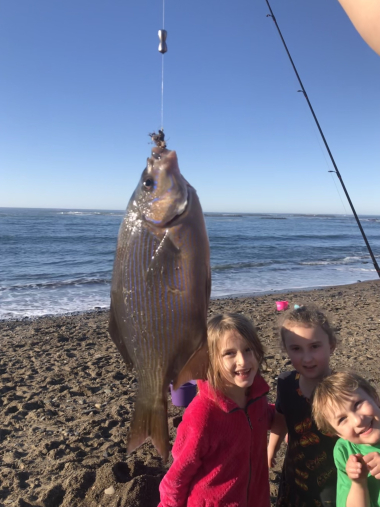
Surfperch are available in the surf year-round along sandy beaches and rocky shores, with the best fishing (and safest fishing) occurring when swells are small. Find surfperch and other learn to fish workshops and events here.
Want more opportunities that don't include a boat? Check out the crabbing and clamming recreation report for updates on crabs, clams, mussels and more!
When fishing from shore or inside estuaries and bays, it is important to check the tide. Many fish that swim into estuaries and bays, including salmon, surfperch, and Pacific herring, tend to come in with the tide. Catch of these species is more likely to occur closer to slack tide. Additionally, the accessibility of some areas can be completely dependent on the tide. Do not allow the incoming tide to become a safety issue.