Search myodfw.com
Showing 241 - 260 of 1702 results
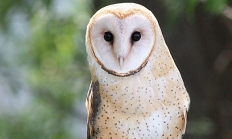
One of the most startling sounds in the black of night is the loud, harsh call of the Barn owl as it flies over field or marsh in search of small rodents. They are white to tan beneath with fine spotting ranging from almost none to fairly extensive. The face has a well-defined facial disc that acts as a parabolic dish collecting the faint sounds of its prey, allowing it to hunt successfully in total darkness. Male and female Barn owls are similar in appearance though the female is somewhat larger. The Barn owl is a fairly common permanent resident…
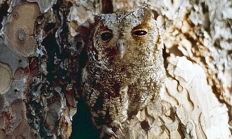
This diminutive owl is one of the smallest in North America, with a body mass of about 1.9 ounces. It has dark eyes, brown plumage with darker and reddish variegations, and small ear tufts. The Flammulated owl is unique among owls in the Pacific Northwest in that it preys almost exclusively on insects and is a neotropical migrant. Additionally, the pitch of its rather ventriloquial hoot is among the lowest of all North American owls. The Flammulated owl breeds on the eastern slope of the Cascades, in the Blue and Wallowa mountains, and in small numbers in the mountains of…
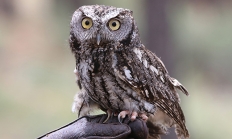
Almost strictly nocturnal, the Western screech-owl hunts discreetly at night and roosts during the day in dense woodlands, its perfectly streaked plumage allows it to pass as tree bark. These habits make it difficult to see, and it is more common than many are aware. It is a small owl with yellow eyes and feathered ear tufts. It exhibits geographic variation in plumage color and pattern: both gray morphs and brown morphs occur in the Pacific Northwest. Sexes are alike. The Western screech-owl is a fairly common year-round resident in lower-elevation woodlands throughout Oregon. It is usually found below 3,000…
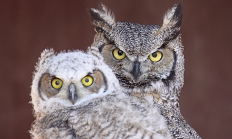
The Great horned owl is the most commonly encountered owl in Oregon. It is a large, stocky, powerful owl with large yellow eyes and distinctive feather tufts or "ears" above the eyes. Plumage color varies from dark brown in western Oregon to pale grayish brown in southeastern Oregon. The throat is white. It is a fairly common permanent resident throughout the state, but generally absent in areas above the timberline. Hear the call of the Great horned owl Photo by Charlotte Ganskopp
The Snowy owl is the largest North American owl. Its white plumage makes it uniquely adapted for life in the arctic and sub-arctic. Adult males are nearly pure white, females have black spots and some barring. Young birds can be strongly barred. Every few years, for reasons which are still not fully understood, Snowy owls move south of their normal winter range into Oregon. During these irruptive events, they can be found on coastal dunes, open high desert, agricultural areas, airport margins, and occasionally atop buildings in populated areas. Hear the call of the Snowy owl Photo by Charlotte Ganskopp

This tiny owl has a reputation as an aggressive predator on everything from mice and voles to birds and mammals over twice its size. Coloration is highly variable with brown and gray morphs. In Oregon, color varies from dark brown in coastal mountains to gray in eastern Oregon, with an intermediate pale grayish-brown form in the Cascade mountains. About the length of a White-crowned sparrow, it has striking yellow eyes, dark vertical streaks on the breast and abdomen, and dark "eyespots" on the back of the head. It is primarily diurnal and can often be approached quite closely when it…

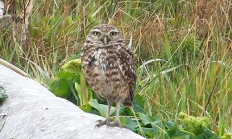
This small owl is unusual in that it nests in earthen burrows in open shrub-steppe regions and grasslands. This habit is even more curious in Oregon since most burrows used for nesting were previously excavated by badgers, a major predator of Burrowing owl eggs and young. These long-legged, short tailed owls are generally brownish buff with spots across the back and barring across the front. Males are usually lighter colored than females, possibly because they spend more time exposed to the elements. Males also average five percent larger than females, a situation rare among owls. The Burrowing owl is a…
Because of its association with old forests, this inconspicuous, dark brown owl has become one of the most controversial birds in the Pacific Northwest. The dark eyes and creamy white mottling on the breast and abdomen are distinctive, as is the lack of fear of humans. Both adults and young will typically allow humans to approach within a few feet, and it is not unusual for curious juveniles to follow hikers through the woods. The Northern spotted owl is a permanent resident in forested regions of western Oregon, from the coastal mountains to the eastern foothills of the Cascade Range…

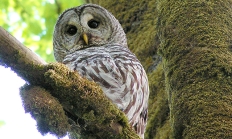
The Barred owl expanded its range from the eastern United States. It was first reported in Oregon in the early 1970s and has since spread to forested areas throughout most of the state. Sometimes confused with the closely related Northern spotted owl, the Barred owl is large with grayish-brown and white feathers and stripes on its chest and throat. It is easily distinguished from the Northern spotted owl by the pronounced horizontal barring across the throat and upper breast, and vertical brown streaks on the lower breast and abdomen. The Barred owl is now a permanent resident in forests of…
In length, the Great gray owl is Oregon's largest owl, though it weighs less than the Great horned and Snowy owls. It is sooty gray to brownish above and lacks ear tufts. The prominent facial disc, outlined in black, contains a series of fine concentric rings that surround piercing yellow eyes. Despite its large size, both feet and bill are small. Sexes are similar. It is an uncommon to rare inhabitant of forests adjacent to openings above 3,000 feet in the Cascades, Blue, and Wallowa mountains. Most observations in the Cascades are from east of the crest, though they have…

This medium-sized owl is easily recognized by its conspicuous "ear" tufts, yellow eyes set in a round facial disk, size, and mottled plumage of black, brown, gray, buff, and white. Legs and toes are densely feathered. Females are larger and darker in coloration than males. It is strictly nocturnal and secretive during nesting. The Long-eared owl is a fairly common breeder in open country east of the Cascades in wooded riparian areas and junipers. It is a common breeder on Boardman Bombing Range, Morrow County and widespread in Malheur County. It is a rare breeder in the foothills of the…

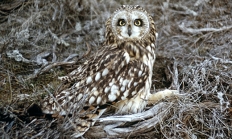
The Short-eared owl is one of our most conspicuous owls owing to its use of open country and crepuscular habits. It is often seen hunting low over the ground across marshes, fields, and other open areas on its buoyant, long wings, flying slowly and irregularly like a giant moth. This owl also differs from most other owls as it seldom vocalizes and is more often seen than heard. It was named for its inconspicuous "ear" tufts arising from the center of the forehead, though field observers rarely see these tufts. Distinguishing characteristics include a pale buff facial disk and a…
This small, brown, earless owl with a black framed, square face was long thought to be restricted to the boreal forests of Canada and Alaska but during the 1980s, it was found breeding in the Rocky Mountains of Idaho and Colorado. In Oregon, these shy owls are strictly nocturnal and live in remote mountain forests often covered by deep snows and with few passable roads. It is presumed to be a permanent resident in Oregon. It has been regularly observed about the Wenaha-Tucannon Wilderness in northeast Umatilla and northwest Wallowa counties and on the south slopes of South Sister Mountain…

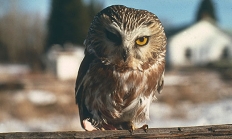
The Northern saw-whet owl is on of the most common forest owls in Oregon, but like most other owls, it is more often heard than seen. It is a small owl, approximately eight inches long, with a large head, large yellow eyes, and no ear tufts. The facial disk is reddish brown with small white streaks radiating outward from the eyes and a prominent white V above the eyes and beak. The back and wings are brown with white spots. The breast is white with rust-colored vertical streaking. This owl breeds in low to mid-elevation coniferous and mixed deciduous/coniferous forests…
With long, pointed wings, nighthawks can sometimes be seen during the day catching insects while in flight although most are active at night. Nighthawks roost by scraping the ground or roost on low branches. Nestlings can fly at 10 days old. Swifts nest on vertical walls, such as chimneys or old smoke stacks, hollow trees or rock crevices. It's fun to watch them at dusk in summer, circling their nesting site. These birds are never seen perched, but only in flight.

The Common nighthawk is a migrant to Oregon with one of the longest migration distances of any North American bird. It is also one of the last to arrive in Oregon. Long, slender wings are marked by a white patch on the "hand" visible in flight from great distances. When perched on the ground, the cryptic brown, gray, and black mottling makes the bird almost invisible. This bird breeds and migrates at all elevations through the state. Its nesting habitat is characterized by open landscapes with little ground cover and is most abundant in sagebrush and rocky scablands and rimrock…

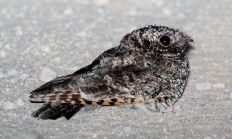
This nocturnal species is seldom-seen, sometimes known by its call on summer evenings or as a blur fluttering quickly up from secondary roads. Cryptic mottled, brownish-gray plumage helps it to blend in with dry, barren ground and to conceal it from predators. Common poorwills are smaller and shorter-tailed than other nightjars; when observed in the air, their flight resembles a moth or bat, noiseless and low over the ground. Locally common east of the Cascades, they are rare farther west in Josephine County. They are commonly found along the Snake, Wenaha and lower Grande Ronde rivers. Hear the call of…
Insects swept up in a rising air mass are favorite prey of this species nicknamed the "cloud swift." It prefers to nest near or even behind the curtain of a waterfall. This dark swift glides for long distances, often very high in the sky, with its wings held somewhat downward. It is larger and darker than the more common Vaux's swift, and has a slightly forked tail. The Black swift is a rare to uncommon spring and fall transient and summer visitant throughout the state. It's an Oregon Conservation Strategy Species in the West Cascades ecoregion. Hear the call of…

This small swift is best known for its quick flight and dazzling aerial agility, perching only when nesting or roosting. It is aerodynamically designed for fast speeds with long, pointed wings, short stout legs, and a compact body. The Vaux's swift is a transient and summer resident nesting in older forests and brick chimneys statewide except the southeast part of Oregon. Hear the call of the Vaux's swift Photo by Julio Mulero, Flickr
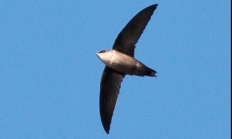
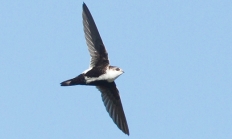
High overhead at the top of the rimrock in Oregon's desert country, the White-throated swift swoops, soars, and darts about erratically, hunting and catching insects. At great speed, it disappears into a crevice on a cliff without appearing to slow down. Its long, strong claws enable it to crawl deep inside these crevices to roosting and nesting areas, which often cannot be seen from the entrance. This bird is a locally common to abundant breeder, primarily on eastern Oregon cliffs. It is an occasional spring and sporadic fall migrant in western Oregon along the coast, in the Willamette Valley, and…