
Search myodfw.com
Showing 161 - 180 of 1702 results
Western Oregon observers enjoy these large, elegant plovers almost year-round, and as a consequence they are one of the most familiar larger shorebirds. Almost all migrants and winterers visiting Oregon inhabit mudflats and open wet dirt fields. A few can be found on sand beaches and even occasionally on rocks, but the great majority are found feeding and resting on open mud. In Oregon, it is a fairly common to common transient in western interior valleys. East of the Cascades, the Black-bellied plover is an uncommon transient in the Klamath Basin and at Malheur National Wildlife Refuge. In winter it…

These elegant shorebirds are found as often in dry or damp upland areas as they are on mudflats or beaches. The plain brown immature birds of autumn become spangled with black and gold as breeding approaches. It is an occasional to uncommon migrant in western Oregon (mainly coastal) and locally rare, irregular migrant in eastern Oregon, with most reports at Malheur National Wildlife Refuge, in the Klamath Basin (summer) and in Umatilla County. Hear the call of the American golden-plover Photo by Mark Peck, Flickr
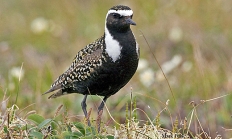
These delicate and truly golden plovers that pass through Oregon in fall are always a delight to find on an open beach or grassy coastal plain. The Pacific golden-plover feeds mainly in the open. A rare to uncommon migrant; most birds occur in fall on the outer coast. They are very rare to rare in winter on the coast and in the Willamette Valley. Hear the call of the Pacific golden-plover Photo by Dave Budeau, ODFW

This small shorebird moves along the sand by foot rather than flight. It has a distinct black cap behind a white forehead, a dark line though the eye, and an incomplete black breast band. Males have darker and more distinct breeding plumage than females; both sexes loose coloration during late summer. It is the only shorebird that regularly breeds on Oregon's beaches. East of the Cascades, the Western Snowy plover is a summer resident breeding on alkaline flats and salt pans. On the Oregon coast, this species is found year-round between Heceta Head and Cape Blanco. Western snowy plovers are…

These small, chunky plovers are uncommon to locally abundant migrants statewide, where they are among the most visible and easily identified small shorebirds. The only single-banded plover that occurs in Oregon, they can be remarkably easy to see when they are moving about on mud flats, and remarkably hard to detect when only their unmoving brown backs are visible against the mud. It is an uncommon to locally abundant migrant, with most birds at estuaries and some concentrations in spring at larger lakes of southeast Oregon. In the fall, it's rare in the Cascades; in winter, it's uncommon at larger…

With a widespread distribution and affinity for open habitats, the Killdeer is one of the most common and recognized birds through much of North America. Killdeer are large for a plover and easily distinguished from other North American plovers by their characteristic two black or brownish-black breast bands. Killdeer are well known for their loud and persistent call of "kill-dee, kill-dee," heard at all times of day or night on both the breeding and wintering grounds. Killdeer often nest close to human activities. Adults perform an elaborate and exaggerated broken-wing display to lure humans and potential predators away from their…

The Black oystercatcher is easily recognized with its black plumage, long, strait, laterally compressed, orange-red bill with a yellow tip, orange-red eye ring, yellow iris, and pale pink legs. These birds are restricted to rocky coastal shorelines where they feed in the intertidal zone. They are an uncommon to fairly common resident on rocky shores and sand/gravel beaches along the entire coast. Along the sandy central coast, they are present only as an occasional dispersing or wandering individual, typically on jetties. Black oystercatchers are Oregon Conservation Strategy Species in the Nearshore ecoregion. Hear the call of the Black oystercatcher Photo…

This fragile-looking bird with bold black-and-white plumage and exaggerated, long, reddish legs is often associated with American avocets at shallow inland ponds and lakes. Very noisy and aggressive in protection of its nest and young, using a variety of distraction displays, including an impressive broken-leg act to lure away interlopers. The Black-necked stilt is a locally uncommon to fairly common summer resident of Klamath, Lake, Harney and Malheur counties. The largest Oregon breeding colony is at summer Lake. It has become a regular spring and fall migrant through eastern Oregon and irregular spring and casual fall migrant through western Oregon…

A conspicuous wader of shallow wetland habitats with a striking appearance and graceful movements. These long-legged shorebirds have contrasting black and white upperparts and during the breeding season, the head and neck turn from gray or white to a deep rust color. One of their most notable traits is a long, slender upturned bill. It is a common breeder east of the Cascades at wetlands of south central and southeast Oregon. Distribution and number of breeding birds vary annually depending on regional and local water levels and habitat availability. Regardless, most breeders occur in the western Great Basin counties of…
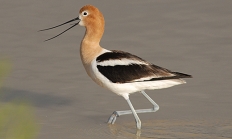
This unusual shorebird breeds along rivers, streams, and lakes in a variety of habitat types throughout the state, from sea level to near timberline. Conspicuous by its distinctive teetering behavior, boldly spotted underparts, and noisy alarm calls, it is usually the only breeding shorebird present in its preferred habitat. The appearance of a sandpiper along a tiny tributary in the upper reaches of a heavily forested watershed can be startling to one unfamiliar with the species' ubiquitous nature. The Spotted sandpiper is a widespread transient and breeder throughout the state, found in nearly every county in Oregon. Most birds depart…

The enigmatic Solitary sandpiper may be one of the least understood of Oregon's regularly occurring shorebirds. As its name implies, the species is most often found singly, and it rarely occurs in groups of more than two individuals. The Solitary sandpiper frequents habitats not often utilized by other migrant shorebirds, such as smaller and often partly wooded patches of water, and high-altitude bogs and wet meadows. It is an uncommon to rare migrant in fresh water or brackish habitats throughout Oregon; rarest along outer coast and in alkali habitats. Spring adults more common in the western interior valleys; fall juveniles…

The presence of this medium-sized shorebird often is announced by its high-pitched ringing call as it forages along rocky coastlines amid crashing waves. Unlike most shorebirds, Wandering tattler is a loner and is rarely encountered in flocks. Loose aggregations may sometimes be found together strung out along jetties in migration. The Wandering tattler is a fairly common migrant during spring and fall along the entire Oregon Coast. Hear the call of the Wandering tattler Photo by Dave Budeau, ODFW
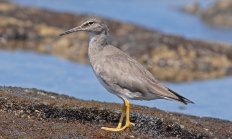
This tall, pale wader is often first detected by its ringing calls as a small flock maneuvers to land in shallow water along an estuary or lakeshore. The long, often slightly upturned bill and very long yellow legs make this one of the easier shorebirds to identify despite its subdued, speckled gray and white plumage. It is an uncommon to locally common migrant on shorelines and open wet areas statewide. It winters on the coast and locally inland. In addition to using shallow water in estuaries and along lake margins, these birds can often be found in flooded pastureland, especially…
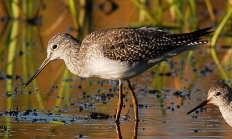
At first look, the Willet is a rather drab and nondescript medium-sized shorebird found in wetland habitats and nearby uplands. However, further observation reveals subtle patterning in its relatively uniform grayish plumage and birds in flight expose a distinct, bold white wing bar that contrasts with a black border. Sexes are similar in appearance at all times of the year. Willet are present on breeding grounds in Oregon for a short period of time during spring and summer, but displaying birds are conspicuous and emit a loud and persistent "pill-will-willet" call. These vigilant and vocal individuals often hover overhead and…

This small, remarkably delicate long-legged wader can be found in migration across most of Oregon. It is speckled gray and white with some variation by season and is typically noticed mincing about in shallow pools and in the water adjacent to mudflats or on seasonally flooded fields, as well as in small isolated ponds. It is an uncommon to common migrant, most birds in fall. In the eastern one-third of Oregon, it usually outnumbers Greater yellowlegs in fall. Hear the call of the Lesser yellowlegs Photo by Dave Budeau, ODFW

One of Oregon's rarest breeders, this distinctive "shorebird" is known for its courtship display flight and loud curlew-like call. it often perches in pine trees or on fence posts adjacent to nesting areas. A small plover-like head and short, strait bill seem out of proportion to its body, which is reminiscent of a small curlew. The Upland sandpiper is a rare breeder in large montane meadows within forests of eastern Oregon. They are almost never observed away form the breeding grounds in Oregon. The Upland sandpiper is an Oregon Conservation Strategy Species in the Blue Mountains ecoregion. Hear the call…

This large brown shorebird is the most wide-ranging of the curlew species. It is distinctive, having contrasting light-brown and dark-brown head stripes and a long decurved bill that it uses to probe for food on coastal mud flats and beaches. It is a common spring and fall migrant in coastal areas although it is also found, rarely, in small numbers inland as well. It is a rare spring migrant in the Willamette Valley with generally about one record annually, typically in late April or early May. Hear the call of the Whimbrel Photo by ©Keith Kohl, ODFW

The Long-billed curlew is the largest North American shorebird. Its most striking morphological characteristic, the long decurved bill, is an adaptation for foraging on earthworms or burrow-dwelling organisms like shrimp and crab. Body plumage is a rich buff with a tinge of cinnamon or pink. Sexes have similar plumage, but females are larger with a longer bill. It can be distinguished from other curlews in flight by its bright cinnamon underwings. When observed on the ground, the Long-billed curlew's head lacks the strongly streaked pattern of other cerlews or Whimbrel. It is a locally common breeder in open grassland areas…

A large, long-legged wader distinguished from similar species in a flight by flashing rufous underwings and dark brown primaries. Its feet extend beyond tail tip in flight. Flocks generally consist of fewer than 50 birds on the coast. Juveniles migrate south several weeks later than most adults. After mid-November, a few stragglers are seen until late December. The Marbled godwit is a regular spring and fall migrant on the Oregon coast. Spring migration commences in early April and extends through early June on the coast. Its average arrival at the Malheur National Wildlife Reserve is April 27. Hear the call…

The noisy and frenetic Ruddy turnstone is a stocky, plover-like bird who's breeding plumage is a clown like pattern of black, rust and white. Ruddy turnstones have been found foraging in the company of many other shorebird species. Found on rocky shores, jetties, open ocean beaches, mud flats, salicornia marshes, grass flats and flooded fields, the Ruddy turnstone is an opportunistic feeder. It is an uncommon to common spring and fall transient along the coast; a few birds remain to winter there each year. The largest flocks are seen during spring and fall migration at Bandon. They are an irregular…
