Search myodfw.com
Showing 121 - 140 of 1702 results
Brandt's cormorants nest colonially on offshore islands and mainland cliffs and are the most common of the cormorants on the Oregon coast in summer. In the breeding season, males are easily distinguished by their intense blue gulag pouches, displayed with a skyward pointing of the bill. They also have wispy white plumes along the side of their head and on their back, which show well against the solid black of the rest of their plumage. In bright light they have a green iridescence. During all seasons they can be distinguished from the two other Oregon species by buff-colored feathers that…

Adaptable and opportunistic, the double-crested is the most abundant and widespread of the three cormorant species found in Oregon, occurring inland and on the coast. Adults have deep, coppery feathers, bordered in black, that glisten with a green iridescent and offset a rich orange throat atop a long curved neck. The bird earns its name from plumes, ranging from white to black, that crown either side of the head during the breeding season. The double-crested cormorant is a common breeder in spring and summer at bays and estuaries, and on islands and cliffs along the coast and lower Columbia River…
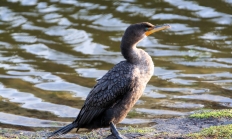
Seemingly misnamed, pelagic cormorants are rarely seen far from land. During the breeding season the distinct white flank patches contrast markedly with their black plumage. In bright light the slender neck has a purple iridescent sheen, and the back shines green accenting white filoplumes. They nest in loose colonies on ledges on vertical cliffs on rocky islands and headlands. It is common year-round along the entire coast and is not found away from salt water. Hear the call of the pelagic cormorant Photo by ©Greg Gilson

Bitterns, herons, and egrets are all long-legged wading birds with long necks and pointed bills for spearing fish or other prey.

Skulking through wetlands, the American bittern is rarely seen - it has an extremely slow and stealthy walk, and when a threat approaches it freezes and mimics marshland plants with upright posture and beak pointed skyward. These behaviors combined with its cryptic plumage effectively camouflage the bird. However, it is occasionally seen in flight, and its low, gurgling song can be heard over long distances. An uncommon to fairly common breeder east of the Cascades and a rare migrant in Malheur county it has also been noted at mountain lakes east of the Cascades in Lake County. In western Oregon…

Inconspicuous and master of stealth, the Least bittern inhabits densely vegetated deep-water marshes, making observations rare and difficult; its call is often the only way to detect this secretive species. The smallest of herons, its long neck and legs make it appear larger. The crown, back and tail of male birds is greenish black; purple-chestnut on female. Neck, flanks, and underparts are brown and white and the wings buff. It is a rare spring and summer resident in larger freshwater marshes of eastern Oregon and a very rare spring through fall visitor in the Rogue and Willamette valleys. At Upper…

This is one of the most widespread and familiar waterbirds in Oregon. It is the largest heron in North America, standing approximately four feet tall. It is slate gray with a white crown, cheeks, and throat, rusty thighs and a uniformly yellow bill. Adults develop long gray-white plumes on chest, neck, and back during breeding. Juveniles have similar plumage but may be distinguished by absence of breeding plumes, a dark crown, and dark upper bill. Great blue herons frequent many habitats from shallow areas of marshes, lakes, streams, and oceans, where they feed on fish, amphibians, and aquatic invertebrates; to…

The Great egret is much larger than Snowy or Cattle egrets, and has a unique combination of yellow bill, black legs, and a cape of feathers draping beyond the tail in the breeding season. As a breeder, the Great egret is most abundant east of the Cascades, but it is present year-round in the Klamath Basin. It is more common April through November. It is also fairly common to abundant on the south coast except during summer months. In summer, it is rare west of the Cascades, but is a regular local breeder around Coos Bay. In fall, it occurs…
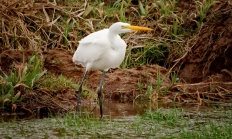
The Snowy egret is intermediate in size between Great and Cattle egrets, and much more common in Oregon than the latter. Adults have a black bill and legs and bright yellow feet; immatures show yellow on the back of their legs. In the breeding season, plumes are present on head and breast, and curve upwards on the back. The Snowy egret breeds regularly, in varying numbers, primarily in eastern Oregon. It is uncommon to fairly common spring through fall in the Klamath Basin and occasional in the northeast Malheur County. On the south coast it is rarely found in summer…
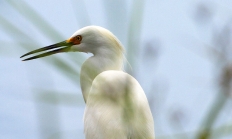
Cattle egrets are the smallest of Oregon's three egret species, with short, stout neck and legs, and white body with orange-buff plumes on the head and nape in spring and early summer. They are named for their association with livestock, consuming insects on their backs or stirred up by their hooves. In Oregon, the Cattle egret is a casual transient in spring in the Klamath Basin and rarely in the Malheur National Wildlife Refuge. The least widespread of the state's egrets during the breeding season; a rare breeder in the Great Basin and a few pairs occasionally nesting at Malheur…

Though less conspicuous than Great blue herons, Green herons are well-established residents of western Oregon. They are distinguished by small size, glossy greenish-black cap and back, yellow legs, blackish-green wings, gray underparts, and dark red neck. One of the few tool-using birds, Green herons are experts at making and using baits and lures, such as bread crusts, mayflies, earthworms, sticks, and feathers to catch fish. The Green heron is an uncommon but regular migrant and summer resident throughout west and south central Oregon. Detection of nests is difficult and breeding status uncertain in some areas due to its secretive habits…

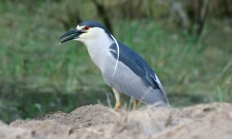
Although quite common in the U.S., the Black-crowned night-heron's nocturnal and crepuscular feeding habits can make it difficult to locate. Its habitat consists of marshes, lakes, rivers, and other wetlands, where it feeds mostly on fish. It is a thick-billed, medium-sized, stocky heron with relatively short neck and legs. Adults have a black back and cap which contrast with the pale gray or whitish underparts. Immatures have brown backs with large pale spots and heavily streaked underparts. A distinctive choking squawk call is often heard at dusk. It is a fairly common summer resident east of the Cascades where it…
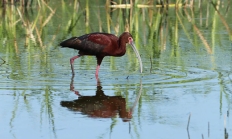
Sporting the form of a curlew, this medium-sized marsh wader is almost always found in flocks, flying in formation and quacking like ducks. Their long, down-curved bill complements their long neck and legs. Although their feathers appear black, a closer look will reveal an iridescence of bronze, purple, maroon, and green. They are named for their "white face" which appears in alternate plumage as a narrow border of white feathers along the edge of their reddish-purple facial skin, delineating a mask around the red eye. The White-faced ibis has extended its breeding grounds in Oregon to wetlands in Harney, Lake…
Oregon has a variety of raptors, from the diminutive Sharp-shinned hawk to our nation's symbol, the Bald eagle. Some of these birds of prey are migratory, while many live here year-round and can be seen hunting along rivers, roadside posts and fields.

The Turkey vulture, known locally as a "buzzard," is a common sight spring through fall throughout the state, except in the highest mountains and featureless desert expanses in summer where they are uncommon. Seeing Turkey vultures returning is a welcome sign of spring. Turkey vultures are large-winged soaring birds with overall dark plumage except for a silvery sheen on the undersides of the flight feathers. Adults have small, featherless, red heads, while juveniles have gray heads. The Turkey vulture is a common to abundant transient throughout the state and an uncommon to common summer resident except in high mountains. It…

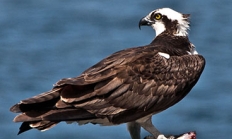
This large bird of prey has dark brown feathers above, white feathers below with a white head and prominent dark eye stripe as well as a visible dark spot at the wrist of the wing when flying. Juveniles have buffy-tipped dark feathers above. In flight, the wings have a noticeable angle or "crook." This highly migratory fish-eating species is frequently found nesting along larger rivers, lakes, and reservoirs. A large bulky nest at the very top of a live, broken top, or dead tree and more recently on utility poles, channel markers, pilings, and cell phone towers near fishable waters…
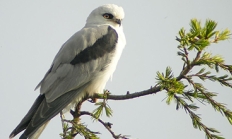
As the winter day turns to dusk, White-tailed kites drop into their roosts and Short-eared owls rise to take their place on the local hunting grounds. White-tailed kites in Oregon often roost communally in winter, but they disperse in early spring and are more difficult to find during the breeding season. By day, they are conspicuous as they hover over rural fields searching for prey, in part because of their pale appearance. The tail is entirely white, as are the head and the underparts. Dark crescents on the underwing can be seen when a bird is flying or hovering. Above…
The Bald eagle is one of eight species of sea-eagle worldwide, and the only sea-eagle found throughout North America. It is one of the most studied North American birds. Large size, wingspan of six-and-a-half to eight feet, and the contrast of white head and tail, and yellow eyes, beak, and leg, to dark brown body and wings make the adult Bald eagle one of our most distinctive raptors. Six age-related plumages have been recognized; adult plumage is acquired at four-and-a-half to five years of age. Sexes have similar plumages, but females are larger than males, and the sex of individuals…

The Northern harrier is a slender, medium-sized hawk characterized by a noticeably long tail, bold white rump patch, and owl-like face. Commonly encountered in large expanses of open country, its main hunting technique is through use of a distinctive buoyant, gliding flight low over the ground that relies heavily on visual as well as auditory cues to detect prey. The larger females have rich brown upperparts while adult males are mostly light to medium gray, sometimes appearing almost ghostly silvery-white. Males are noted for their high-spirited and acrobatic courtship displays, in particular a series of dives and barrel rolls in…
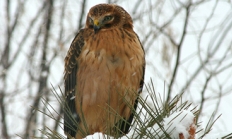
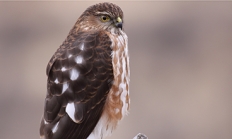
The Sharp-shinned hawk is North America's smallest and most migratory accipiter. As a hunter of songbirds (and sometimes young chickens) it historically endured harsh reproach, and was often depicted as a blood-thirsty villain, even by some ornithologists. Across the U.S., many thousands were shot in the first half of the 20th century. But prevailing attitudes have changed, and today a glimpse of this slender, secretive hawk darting through the treetops is more likely to elicit admiration than malice. Adult plumage, nearly identical to the slightly larger Cooper's hawk, consists of slate gray back and wings, breast and sides barred with…