
Search myodfw.com
Showing 241 - 260 of 509 results
Find maps, boundary descriptions and hunts available in the new Klamath Basin Hunt Area. Download printable PDF map


Features: Plankton eaters, the American shad is the biggest of the herring species and averages 3 to 5 pounds. They are silver on the sides, and green to blue on top, with green shading on their fins. Habitat: Like other anadromous fish species, they spend most of their lives at sea and return to fresh water to spawn. Females release free-floating eggs that will be fertilized by later-arriving male, called buck shad, in a spawning frenzy. Eggs hatch in eight days and fry spend four to five years in salt water before returning to spawn. Shad often survive to spawn…

If this is a new activity for you, our friends at the Audubon Society have tips on how to start birding and how to connect with other birders. This is a great resource that also includes tips on choosing binoculars, reviews and recommendations on the best birding apps and field guides, and an easy seven-point guide on how to identify birds. The Cornell Lab of Ornithology has an extensive website that includes the world's largest archive of wildlife sounds and videos, bird cams, eBird citizen science opportunities, scientific publications, bird guides, bird nesting box plans and more. ODFW's Living with…
Following droughts in the 1930s that affected most of North America, major conservation efforts, both private and governmental, were enacted to reverse trends of degrading and disappearing wetlands. During this time period there was a major creation and expansion of Federal refuges and State wildlife areas. As the concept of waterfowl flyway management was endorsed and developed, wildlife areas were acquired and managed as part of a larger plan focused on migratory waterfowl needs. Klamath Wildlife Area was one of several wetland-focused wildlife areas established in Oregon. KWA was established in 1958, with primary objectives of protecting and improving waterfowl…
The development of the WWA began in 1953 with the acquisition of five parcels of land consisting of 4,400 acres. The Department continued to purchase additional lands, acquiring 1,670 acres in 1954 and another 760 acres in 1955. From 1961 to the present the department has purchased or received another 4,219 acres. The wildlife area currently consists of 12,419 acres owned by the department. In addition, the department, through agreements with the Bureau of Land Management (BLM), manage 1,329 acres within or adjacent to the wildlife area. The WWA was established in response to continuing complaints from landowners concerned with…

The bright yellow, red, and black plumage of the male Western Tanager, so conspicuous in open situations is very obscure in forested areas where it tends to blend into the shaded foliage. The species perhaps is best known in migration when it visits city parks, orchards, and other open urban and suburban areas. It is attracted to birdbaths but seldom to bird feeders. It breeds in open coniferous forests and mixed coniferous and deciduous woodlands, primarily in mountains. They usually nest in conifers - rarely deciduous trees - at varying heights, usually well out on a branch, often at the…

Features: Columbian black-tailed deer are smaller and darker than mule deer. As the name suggests, black-tailed deer have a wide, triangular tail with a dark brown or black top and a white underside. Habitat: Blacktails are a subspecies of mule deer found in western Oregon from the Coast Range east to the Cascade Mountains. They are edge-adapted species using the region’s dense forest cover to hide during the day and are then more open in early successional forest to feed at dawn and dusk. Places with a mix of forest age classes offer the best habitat for black-tailed deer. Techniques…

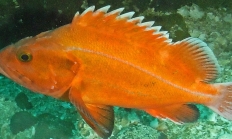
Features: They are orange red to orange yellow with a bright yellow eyes. Their fin tips may be black. On the top of their head they have a pair of rough ridges. Yelloweye, canary and vermilion rockfish can look similar. See this rockfish identification article for distinguishing features of each species Take the "Yelloweye Rockfish or Not?" quiz Habitat: Juveniles and subadults prefer shallower water than adults, and are associated with rocky reefs,and kelp canopies. Adults move into deeper water as they grow, and prefer rocky bottoms. Technique: Yelloweye rockfish are currently prohibited in the catch. Anglers are required to…
Find maps, boundary descriptions and hunts available in the new South Wallowa Hunt Area SW-02. Download printable PDF map

Find maps, boundary descriptions and hunts available in the new Devils Garden Hunt Area. Download printable PDF map
SALEM, Ore. – ODFW and the Oregon Hunters Association (OHA) will give away free wildlife forage seed to landowners at E.E. Wilson Wildlife Area near Corvallis on Saturday, May 9. The giveaway coincides with OHA's Youth Field Day (limited spots available). Seed giveaway More than 500 bags of free seed…
Features: Chukars are brown-gray with a black stripe running across the head, through the eye, and down onto the chest. Their bills and feet are red, and their sides have white and black barring. Habitat: Extensive areas in eastern Oregon provide ideal habitat for chukars. Cheatgrass, an introduced plant species, was already well established through much of eastern Oregon prior to the 1950s, and provides one of the most important year-around food resources for the chukar. Their habitat is generally steep, rocky, dry, and largely unsuitable for development, agriculture or other commercial uses except grazing. Important chukar areas in Oregon…
