Search myodfw.com
Showing 301 - 320 of 509 results
Marion Forks Hatchery began operation in 1951. The U.S. Army Corps of Engineers (COE) funds the majority of operational costs as mitigation for the development of Detroit and Big Cliff dams. The hatchery is used for egg incubation and rearing of spring Chinook.
The rock scallop ( Crassadoma gigantea) lives in the swift current shallows of Oregon's nearshore rocky reefs. Due to the coloration at its hinge, it is also known as the purple hinged scallop. These highly specialized scallops cement themselves to rocks, primarily at depths from 10 to 150 feet. They feed on microscopic plankton they filter from the water and reproduce via broadcast spawning. In order for spawning to be successful, they need to be close to one another. For this reason, it is best to harvest solitary rock scallops and minimize harvest pressure on dense aggregations which are more…
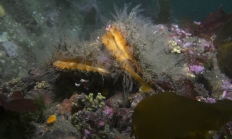
Sauvie Island Wildlife Area protects vital waterfowl habitat and provides a public hunting area while supporting a rich diversity of wildlife, including hundreds of bird, mammal, reptile, and plant species.
This medium-sized shorebird is the most common dowitcher in eastern Oregon and inland locations, where it sometimes gathers in large flocks feeding in shallow water. It is also the only dowitcher in the state that regularly winters. Although breeding plumage adults are reddish below and heavily patterned above, most birds seen in Oregon are duller postbreeding adults or browner immatures. During winter, when shorebirds are hard to find, a small flock of chattering dowitchers, even in plain gray basic plumage, often brightens a day in western Oregon. In migration, it can be found at almost any shallow water site in…

Rich, warm, unpatterned brown above and dull white below with a dusky throat and breast, the Rough-winged swallow is inconspicuous and often overlooked when flying with other, more brightly colored swallows. It is often confused with the similarly plumaged Bank and immature Tree swallows. It is most often observed flying low over rivers and lakes, rarely high overhead. It is a locally common summer resident statewide, most abundant at low to moderate elevations, usually near water. It usually nests singly, but sometimes in small loose colonies, rarely more than three pairs. Distribution is limited in many areas by lack of…

This moderately small wren maintains the frenetic energy that is so obviously typical of this family of birds. It is a summer inhabitant in many parts of Oregon, generally in open woodlands, thickets, and occasionally in residential gardens. The House wren occurs over the widest latitudinal range of any New World passerine. The House wren nests in a wide variety of native and human-influenced habitats. Nest sites are primarily located within preformed cavities in snags. It is a very uncommon to common transient and summer resident in semi-open woodland habitats throughout the state. In southwest Oregon, it is most common…

Newport, Ore. – Oregon's commercial Dungeness crab season opens Dec. 16 from Cape Falcon to the California border, the Oregon Department of Fish and Wildlife announced today. Crab will be available in time for the holiday season. Oregon will open the north coast to align with Washington once Long Beach…
Clackamas Hatchery began operation in 1979 and is used for adult collection, egg incubation and rearing of spring Chinook and winter steelhead, rearing of coho and acclimation of summer steelhead.
Cascade Hatchery was authorized under the Mitchell Act and began operating in 1959 as part of the Columbia River Fisheries Development Program – a program to enhance declining fish runs in the Columbia River Basin. The facility is used for egg incubation and rearing of coho.
Roaring River Hatchery was constructed in 1924. Many improvements have been made to the hatchery since the original construction. In 1987 and 1996 new raceway ponds were constructed to replace the original raceways. The hatchery is a mixed-stock facility, producing both anadromous fish and resident trout. The hatchery is used for rearing summer and winter steelhead from fingerling to smolt. The rainbow trout program involves broodstock maintenance, spawning, egg incubation and rearing.
SALEM, Ore. – ODFW is seeking two new members to join the Private Forest Accord (PFA) Advisory Committee. The two available positions include one member to represent the timber industry and one member to represent nongovernmental organizations promoting freshwater aquatic habitat conservation. Interested candidates are invited to submit their applications…
This is the world's smallest "peep" and can usually be picked out by its brownish coloration, dull yellowish legs, and hunched, creeping foraging style. Least can be found in small flocks in Oregon almost year-round. The Least sandpiper feeds on open mud with Western sandpipers but often feeds where some grass, salicornia or other cover is present, avoiding walking in the water as Western often do. It is uncommon to locally abundant statewide in migration, with most birds along the coast and at larger lakes and marshes inland. It is locally common on the coast in winter; smaller numbers winter…

Oregon's native turtles are in trouble. Invasive, non-native turtles such as the red-eared slider and snapping turtle compete with Oregon's turtles for food, habitat and nesting sites. Our native turtles are also preyed upon by bullfrogs and are affected by habitat loss and degradation. Check out this video to learn more about Oregon's native turtles and invasive turtles.
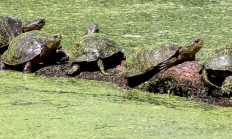

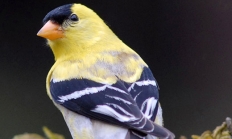
The exuberant bounding flight, musical calls, and flashy yellow and black plumage of the American goldfinch in breeding-season make them one of the most recognized and welcome of Oregon birds. Found in flocks nearly year-round, these goldfinches are a familiar site in riparian woodlands, orchards, weedy fields, and agricultural land. They are among the last of Oregon's songbirds to nest and are highly nomadic in the nonbreeding season. They may form mixed flocks with Lesser goldfinches and Pine siskins at bird feeders and weed patches throughout Oregon, as well as with Common redpolls some years in northeast Oregon. Their diet…
The eastern cottontail is the largest member of the genus in Oregon. Overall, the dorsal pelage is brownish, becoming darker (almost black) on the rump and lighter buffy brown on the flanks; the nape patch is orangy brown without black hairs, and the head is the same color as the dorsum. The hairs on the dorsum have steel gray bases followed by bands of brownish black, buff, and black. The venter hairs are white with gray bases, giving a splotched appearance when the hairs are spread, and the tail hairs are white to the base. This rabbit was introduced into…

Study ahead: Oregon Furbearer Trapping and Hunting Regulations
Seasons vary depending on species
Online Learning

NEWPORT, Ore. – New research from Oregon's south coast highlights the positive economic impact of science and tourism within Redfish Rocks Marine Reserve. The study quantifies the number of jobs supported and income generated by these activities, providing important data for the local Port Orford community, policymakers, conservation practitioners, and…