Search myodfw.com
Showing 441 - 460 of 903 results
Find maps, boundary descriptions and the percent public lands for the Desolation Unit.
Find maps, boundary descriptions and the percent public land for the Santiam Unit.
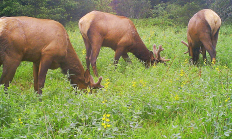
Find maps, boundary descriptions and the percent public land for the Sled Springs Unit.
Find maps, boundary descriptions and the percent public land for the Indigo Unit.
Find maps, boundary descriptions and percent public land for the Murderers Creek Unit.
Find maps, boundary information and the percent public land in the Paulina Unit.

Find maps, unit descriptions and the percent public lands in the Starkey Unit.
Find maps, boundary descriptions and the percent public land for the Fort Rock Unit.
Oregon has one species of kingfisher, the raucous Belted kingfisher and 12 woodpecker species. Six woodpeckers are Oregon Conservation Strategy Species of management concern and in need of conservation. Famous for their hammering and hole drilling, woodpeckers might decide your home looks like a good place to set up shop. Learn how to discourage this on our Living with Wildlife, Birds page.

WILLAMETTE WILDLIFE VIEWING May 21, 2026 Corvallis area EE Wilson Wildlife Area There are lots of deer, shorebirds and waterfowl to see on the wildlife area – look for goose, mallard, hooded merganser and wood duck broods. Wildlife viewing remains good for waterfowl and shorebirds. Note: Dogs are required to be on a leash inside the wildlife area boundary. Rifles and pistols are prohibited year-round. Find directions to EE Wilson Wildlife Area. A parking permit is required to park at EE Wilson Wildlife Area. Find out how to buy a parking permit. Eugene area Fern Ridge Wildlife Area Observant visitors…
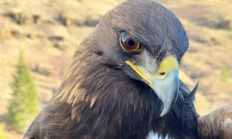
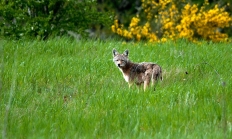
Protecting and enhancing Oregon’s fish and wildlife, and the habitats they use, for the use and enjoyment of present and future generations is at the heart of what we do.
The European starling is considered an invasive species in Oregon. It was introduced from Europe. They most closely resemble blackbirds, with which they often flock in fall and winter. While both have iridescent plumage, starlings can be told from blackbirds by their two-toned wing pattern - dark upperwing, pale underwing - and during the breeding season by the bright yellow bill. Starlings adapt readily and quickly to human habitation and are highly efficient and successful breeders. However, the abundance of the bird, the rapidity with which it has spread across North America, and its propensity to cause damage to crops…

CENTRAL POINT, Ore. – Learn how to spot and identify animal tracks, splash around in a stream to check out aquatic bugs, and play "survival of the fish-est." Join the Oregon Department of Fish and Wildlife, Jackson County Parks, and Rogue River Watershed Council for Wildlife Wisdom every Saturday from…
MARINE WILDLIFE VIEWING May 21, 2026 The Oregon coast is a great place to come and view a variety of wildlife. Enjoy the great diversity of life: from giant whales and barking sea lions to majestic bald eagles and diving pelicans, to showy Harlequin ducks and flocking shorebirds, to the tiny anemones and crabs inhabiting tidepools. There is always something new to discover. Visit our wildlife viewing map for locations to visit and view wildlife along the Oregon coast. Maximize your viewing of coastal creatures by bringing binoculars for close-up views. Beach Safety: Check conditions here Whales, orcas and porpoises…
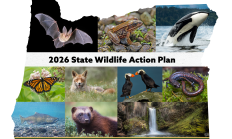
SALEM, Ore.—ODFW is excited to announce that Oregon's State Wildlife Action Plan (SWAP) has been officially approved by the U.S. Fish and Wildlife Service. This milestone marks the final step in adopting the 2026 SWAP, a science‑based roadmap to maintain healthy fish and wildlife populations, prevent further declines of at‑risk…
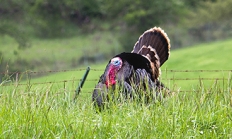
The wild turkey is the largest game bird in North American with mature males weighing upwards of 20 pounds and standing 40 inches tall. These large terrestrial birds are generally dark brown to black in appearance but iridescent color in feathers ranging from gold and copper to green and black gives a metallic appearance, particularly in full sunlight. Males and about 10 percent of females sport a unique beard of keratinous filament that protrudes from the junction of the breast and neck. Beards grow continuously but rarely exceed 10 inches in length. Females are smaller and duller in appearance. Densities…