Search myodfw.com
Showing 461 - 480 of 897 results
SALEM, Ore. – Effective June 1 through Sep. 30, minimum and maximum size limits as well as the daily and possession bag limits for rainbow trout and bass are suspended for Thief Valley Reservoir, Pilcher Creek Reservoir, and Wolf Creek Reservoir which are all located within the Southeast Zone in…
SALEM, Ore. – ODFW is seeking two new members to join the Private Forest Accord (PFA) Advisory Committee. The two available positions include one member to represent the timber industry and one member to represent nongovernmental organizations promoting freshwater aquatic habitat conservation. Interested candidates are invited to submit their applications…

The Western small-footed myotis is among the smaller bats in Oregon and is brown to pale yellow with black ears and a black mask across its eyes and nose. It lives in dry climates, especially cliffs and rocks, and forages back and forth along the face of cliffs. It hibernates in caves and mines from November through February. In Oregon, the species only occurs east of the Cascade Range. Photo by ©Michael Durham


This is the world's smallest "peep" and can usually be picked out by its brownish coloration, dull yellowish legs, and hunched, creeping foraging style. Least can be found in small flocks in Oregon almost year-round. The Least sandpiper feeds on open mud with Western sandpipers but often feeds where some grass, salicornia or other cover is present, avoiding walking in the water as Western often do. It is uncommon to locally abundant statewide in migration, with most birds along the coast and at larger lakes and marshes inland. It is locally common on the coast in winter; smaller numbers winter…

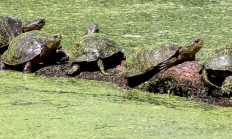
Oregon's native turtles are in trouble. Invasive, non-native turtles such as the red-eared slider and snapping turtle compete with Oregon's turtles for food, habitat and nesting sites. Our native turtles are also preyed upon by bullfrogs and are affected by habitat loss and degradation. Check out this video to learn more about Oregon's native turtles and invasive turtles.
Features: The male has a striking black head with a white crest, white breast, black back, and chestnut sides. Females and immatures are dull grayish brown except for a reddish-brown crest. Habitat: During migration hooded mergansers are widespread, though uncommon, across Oregon. They are usually in sheltered areas of lakes and ponds and less commonly on estuaries. Often seem in pairs or small groups. Techniques: Not usually targeted, they can be part of a mixed duck bag.

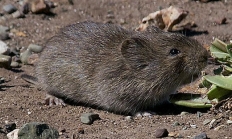
The California vole is a medium-sized vole with a cinnamon-brown to tawny-olive dorsum overlain by dark brown or black hairs. The underparts are medium gray, sometimes washed with buff; the tail is bi-colored, black above and gray below. The feet are grayish. It occurs from near Eugene south through the interior valleys of Oregon and most of California. It has been found in the drainages of the upper Willamette, Umpqua, and Rogue rivers in Lane, Douglas, Jackson, and Josephine counties. This vole spend most of the time underground in its burrows or in those of other species; it makes only…
Features: The mountain goat is stockily built with black scimitar-shaped horns, large black hooves and prominent dewclaws, and an entirely white, woolly coat. Habitat: Rocky Mountain goats are found in steep and rugged habitat in eastern Oregon, including the Wallowa, Elkhorn and Strawberry mountains, and the central Cascades near Mt Jefferson. Techniques: Rocky Mountain goat tags are “once-in-a-lifetime” and less than 25 are available each year. Be prepared to hunt their steep, rugged habitat if you are lucky enough to draw a tag.

NEWPORT, Ore. – New research from Oregon's south coast highlights the positive economic impact of science and tourism within Redfish Rocks Marine Reserve. The study quantifies the number of jobs supported and income generated by these activities, providing important data for the local Port Orford community, policymakers, conservation practitioners, and…

Study ahead: Oregon Furbearer Trapping and Hunting Regulations
2026-27 Licenses begin July 1
Online Learning

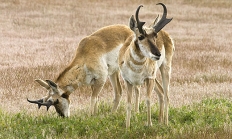
The pronghorn, often called "antelope," is deer-sized with relatively long and thin legs and feet with just two digits on each foot, a relatively small tail, and unique horns consisting of deciduous keratin sheaths set on bony cores arising from the fontal bones. Among males, the laterally flattened sheaths are long, branched and recurved, but in those females that possess horns they are short and simple. The horns and hooves are black. The front feet are larger and carry most of the weight when the pronghorn runs. The pelage is course. The dorsum is a light buff and is separated…
Smaller than a robin, this shy skulker is difficult to see, even though it is present during the nesting season in marshes throughout the state. The Sora is mostly brown with a black face and a stout yellow bill. Its chicks are small black balls of fluff with a bit of orange feathering under their chins. In the breeding season, Soras use wet meadows, including sedge, rush, and hair grass types but also wet areas with emergent vegetation, particularly cattails and tulles. They eat invertebrates, seeds, plant leaves, and stems. Hear the call of the Sora Photo by Kathy Munsel…

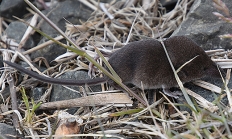
Trowbridge's shrew is a medium-sized shrew, distinguished from other Oregon shrews by its dark-brown or grayish black pelage on both dorsum and venter, and its sharply bicolored tail, white below and dark brown or grayish black above. In Oregon, its range is west and south of a line connecting Parkdale, Hood River County; Pine Grove, Wasco County; Alder Spring, Lane County; Diamond Lake, Douglas County; Gearhart Mountain, Lake County; and Lakeview, Lake County. It occurs in all stages of the coniferous forest from old growth to recent clear-cuttings. Photo by Don Henise, Flickr
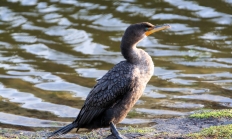
Adaptable and opportunistic, the double-crested is the most abundant and widespread of the three cormorant species found in Oregon, occurring inland and on the coast. Adults have deep, coppery feathers, bordered in black, that glisten with a green iridescent and offset a rich orange throat atop a long curved neck. The bird earns its name from plumes, ranging from white to black, that crown either side of the head during the breeding season. The double-crested cormorant is a common breeder in spring and summer at bays and estuaries, and on islands and cliffs along the coast and lower Columbia River…
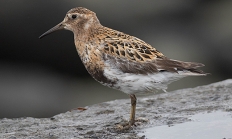
This medium sized, stocky sandpiper is rarely observed away from the rocky coastline as it forages close to the zone of salt spray. Primarily a late fall migrant with the major influx into Oregon occurring the last week in October and into early November. Generally silent during migration and on wintering grounds. Often found singly or in small groups with foraging Black turnstones and Surfbirds. Cryptic plumage makes it difficult to observe as it forages slowly over mussel and barnacle beds in typical sandpiper fashion. Roosts on rocks with Black turnstones and Surfbirds near feeding grounds, just above the spray…
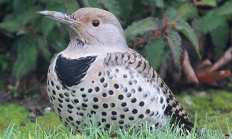
The Northern flicker is larger than most woodpeckers in Oregon. It is primarily lighter shades of brown and gray with black markings: spotted underparts, barred back, and a broad necklace. Its wing linings and undertail range from salmon to yellow, and the rump is white. Males have a red or black mustache. Northern flickers may be encountered in almost any terrestrial habitat, but are generally most abundant in open forests and forest edges adjacent to open country. They venture into nearby habitats, including towns and farms but typically avoid dense forests. It is a common resident throughout Oregon. Hear the…
The adult Lark sparrow is one of the most easily recognized passerines. The head pattern is sharp and crisp, with a chestnut crown and cheek patch surrounded by alternating white and black stripes. White underparts with a a small black central spot and a long, blackish tail with conspicuous white wing corners further aid identification. Courtship behaviors, including turkey-like strutting by males, differ markedly from that of other passerines. In Oregon, the Lark sparrow is a locally common summer resident and migrant east of the Cascades. Hear the song of the Lark sparrow Photo by Beken Bulgic Schneider, Flickr

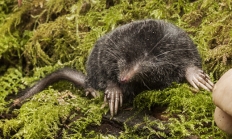
The shrew-mole is the smallest talpid in Oregon. The pelage is black; the eyes are rudimentary. The tail is about 50 percent of the length of the head and body, fat, sparsely haired, blunt ended, covered with transverse annular rows of scales and tufted. In Oregon, the species occurs as far east as Brooks Meadows, Hood River County; Indian Ford Campground, Deschutes County; and Fort Klamath, Klamath County. It is most abundant in moist sod-free ravines with deep, black-silt soils with high humus content and covered with a layer of dead leaves and twigs. Dominant vegetation in these areas is…
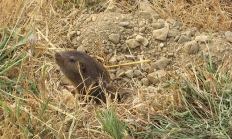
The Western pocket gopher is one of the two small pocket gophers in Oregon. Depending on the region, the pelage of this gopher ranges from pure black with purplish and greenish overtones to brown to hazel to yellowish hazel on the dorsom and from lead colored to buff to ocherous on the venter. The face is lead colored to black. The Western pocket gopher constructs burrows beneath the surface with a vertical tunnel connecting deeper burrows that include the nest. This gopher occurs from the Columbia River to the California-Oregon border in the Coast Range and along the coast. It…