
Search myodfw.com
Showing 501 - 520 of 657 results
Bobolinks summer in Oregon's eastern grasslands and meadows, singing what has been described as a bubbling delirium of ecstatic music that flows from the throat of the bird like sparkling champagne. The yellow-brown female, juvenile or non-breeding male may at first appear to be a sparrow, but the breeding male has an astonishing and diagnostic backwards tuxedo pattern of buff on the nape and white rump and scapulars on an otherwise black body. The Bobolink is a regular, locally common breeder at the Malheur National Wildlife Refuge and a few scattered pairs occur in northeast Oregon. West of the Cascades…

Features: The redstripe rockfish appears red and pink. The dorsal fin is shallowly notched and the lateral line is a distinct red stripe. It has dark lips, a protruding lower jaw, and greenish stripes radiating from the eyes. Habitat: Commonly found over high-relief, rugged bottoms from 500 feet to 900 feet below the surface. Technique: Best success will be by first locating suspended schools of redstripe rockfish in offshore areas during periods open for fishing offshore. Work rubber tail jigs or shrimp flies through the schools.

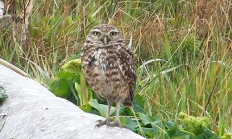
This small owl is unusual in that it nests in earthen burrows in open shrub-steppe regions and grasslands. This habit is even more curious in Oregon since most burrows used for nesting were previously excavated by badgers, a major predator of Burrowing owl eggs and young. These long-legged, short tailed owls are generally brownish buff with spots across the back and barring across the front. Males are usually lighter colored than females, possibly because they spend more time exposed to the elements. Males also average five percent larger than females, a situation rare among owls. The Burrowing owl is a…
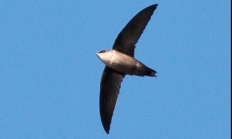
This small swift is best known for its quick flight and dazzling aerial agility, perching only when nesting or roosting. It is aerodynamically designed for fast speeds with long, pointed wings, short stout legs, and a compact body. The Vaux's swift is a transient and summer resident nesting in older forests and brick chimneys statewide except the southeast part of Oregon. Hear the call of the Vaux's swift Photo by Julio Mulero, Flickr
With its long, forked tail and long wings, it is the most graceful of all land birds and reminds one of the smaller terns not only in shape but in behavior. The Barn swallow has taken so completely to nesting on human-made structures that one forgets they were once restricted to caves and rock crevices. Almost every farm in the state has a pair or two nesting in an outbuilding, and very few bridges do not have a pair or two. It is the best known of the swallows. It is a fairly common to locally abundant summer resident and…

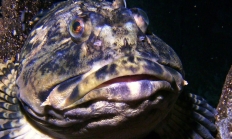
Features: Cabezon are a dark green to dark brown with mottling along their sides and with smooth, scaleless skin. The largest cabezon caught was over 20 pounds, but on average they weigh approximately 4 pounds. Habitat: Cabezon live around kelp beds and rocky headlands over hard bottoms. Technique: Cabezon are best caught using rubber tailed jigs tipped with bait. Make sure you are fishing within just a foot or two of the bottom as Cabezon like to hold tight to cover. CAUTION: While Cabezon meat can be safely consumed, its roe is poisonous to humans. Photo credit: Brandon Ford
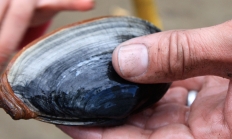
Features: Unlike gaper clams, softshell clams have no gape on their neck end. Softshell clams have a spoon like projection on the left valve, this feature is called a chondrophore. Habitat: Brackish, muddy areas all along Oregon's coastline. Find softshells 12-18" depth. Technique: Softshells can be harvested by digging with either a shovel or clam gun. As the name suggests, they have soft or thin shells which are easy to break. Although a clam with a broken shell is still good to eat, sharp edges of a broken shell can be very dangerous. Until you've refined your shoveling skills you…
SALEM, Ore. – The Private Forest Accord Mitigation Advisory Committee will hold its regularly occurring meeting, virtually on Tuesday, July 15, 2025. For a full agenda and virtual login information about the meeting, please visit: https://www.dfw.state.or.us/habitat/PFA/meetings.html The public is welcome to attend virtually. The Private Forest Accord Mitigation Fund was established…
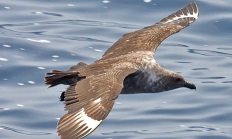
Skuas are the size of a Western gull, dark with a pale nape and large white patches on the bases of the primaries on both the upper and lower surfaces. This is a solitary bird. Its flight is low and direct with heavy flapping and little gliding. It steals food from other seabirds, and is aggressive, bordering on predatory. It may grab a shearwater's head, wing, or tail and shake and kick the bird until it regurgitates its food. Chances of detection are best around flocks of shearwaters feeding behind fishing boats. It is a rare to uncommon fall transient…
This striking songbird is best known for its habit of impaling prey on thorns and barbed wire, or wedging items in a v-shaped branch for easier handling and storage. The Loggerhead shrike breeds in open habitats east of the Cascades where they are rare but regular in the winter, especially at low-elevation sites. They are uncommon and declining in northeast Oregon. West of the Cascades, there are usually a few records each year during fall, winter, and spring in open habitats of the coast and the Willamette, Umpqua, and Rogue valleys. The Loggerhead shrike is an Oregon Conservation Strategy Species…

Brown creepers are the only North American birds that rely on both the trunk and bark of trees for both nesting and foraging. They are small birds, about five inches in length, and have a long, slender, down-curved bill used to probe for insects hidden in the furrows of tree bark. Their brown back, streaked with white, makes creepers on of the best-camouflaged girds of the forest. They most often forage upward from the base of a tree, using their long, stiff tail for support. The Brown creeper breeds and winters throughout forested areas of Oregon, from the coast to…

Features: The females are freckled all over with small reddish-brown to golden spots on gray to brownish background. Their fins are mostly yellowish-orange. The males are gray to brownish-olive, with irregular blue spots on the front of their bodies; each spot is surrounded by a ring of small reddish-brown spots. The inside of this species' mouths are yellowish. Habitat: Kelp greelings can be found to depths of 150 feet. They prefer rocky inshore areas and are common in kelp beds and on sand bottoms. Technique: It is best to target kelp greenlings by placing a line near the base of…

Features: Trout-like in appearance, the body is silvery in color with a bronze or dark back. They can be distinguished from trout by the forked tail and the small, down-turned mouth. Lengths run to 20-inches. Whitefish are often erroneously called graylings by many anglers. Habitat: Mountain whitefish inhabit many Oregon streams and lakes, thriving best in clear, cold water. Techniques: Whitefish tend to go for flashy flies, but are known for quickly spitting them out. Many sportsmen look with disfavor on the whitefish and often throw it away as undesirable. However, the flesh of the whitefish is firm and tasty…

Features: Along Oregon's coast there are two species of mussel. Bay mussels ( Mytilus edulis) are bluish-black and grow to about 3 inches in length. California surf mussels ( Mytilus californianus) are brown or black and grow to about 7 inches long. Habitat: Mussels often inhabit boulders in the upper tidal zone so it is best to go looking for them during low-tide. Technique: Wearing a glove, use a twisting motion to pull mussels off the rocks, then immediately pull the "beard" off the bottom, the hairs that previously anchored the shellfish to the rocks. Be sure to check the…

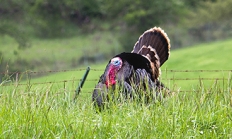
The wild turkey is the largest game bird in North American with mature males weighing upwards of 20 pounds and standing 40 inches tall. These large terrestrial birds are generally dark brown to black in appearance but iridescent color in feathers ranging from gold and copper to green and black gives a metallic appearance, particularly in full sunlight. Males and about 10 percent of females sport a unique beard of keratinous filament that protrudes from the junction of the breast and neck. Beards grow continuously but rarely exceed 10 inches in length. Females are smaller and duller in appearance. Densities…
In Oregon, fork-tailed storm-petrels breed in numbers that are only a tiny fraction of those of Leach's storm petrels. This is the larger of the two storm-petrels breeding in Oregon and is gray in color. These birds leave and return to breeding colonies only at night, when they are best detected by their distinct raspy call. At sea, they are distinguished by quick, buoyant flight with short glides interspersed with wing fluttering to maintain their position at a food source. Fewer than 20 nests have been found in Oregon, all located in the same habitat as colonies of Leach's storm…

Features: Blue grouse are large in comparison to most other grouse species. The females are mottled brown, tan, and gray. The males are similar, but with solid blue-gray on the underside and bright orange-yellow combs over the eyes. Habitat: Blue grouse occupy the coniferous forests of western Oregon, the eastern slopes of the Cascades, the Blue Mountains of northeastern Oregon, and the Klamath Basin and south Warner Mountains. Preferred habitat includes timber edges, open timbered slopes, mountain meadows adjacent to springs or other sources of water, and near berry producing areas such as chokecherry thickets. Technique: Effective hunting techniques involve…
