Search myodfw.com
Showing 541 - 560 of 1410 results
The McKenzie River originates in the Cascade Range and empties into the Willamette River near Eugene, which then flows northward into the Columbia River. McKenzie Hatchery was first constructed in 1938 and rebuilt in 1975. Today, 30 rearing ponds, a visitor's center, spawning room, egg incubation facility, office, feed storage, shop area, fish ladder and picnic area are the main components of the facility layout. McKenzie Hatchery is temporarily closed to comply with Oregon Department of Environmental Quality permit conditions. Visitors should be aware that no fish are present in the facilities' production raceways and show ponds. Fish have been…
The Winchester Dam was built in November 1890 and is in the National Register of Historical Places. Constructed from large timber cribs, the dam was originally built 4-feet high and in 1907 the dam was raised to sixteen feet. Winchester Dam provided water and electricity for the town of Roseburg until 1923. In December 1945 a more permanent fish ladder and the first fish counting station on Winchester Dam was built. Two counters working the daylight hours, counted fish that swim over a white board located about four feet below the counter. The ladder was closed when counting was no…
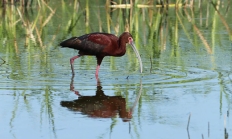
Sporting the form of a curlew, this medium-sized marsh wader is almost always found in flocks, flying in formation and quacking like ducks. Their long, down-curved bill complements their long neck and legs. Although their feathers appear black, a closer look will reveal an iridescence of bronze, purple, maroon, and green. They are named for their "white face" which appears in alternate plumage as a narrow border of white feathers along the edge of their reddish-purple facial skin, delineating a mask around the red eye. The White-faced ibis has extended its breeding grounds in Oregon to wetlands in Harney, Lake…
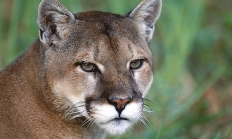
The skull of the cougar, also know as mountain lion, is massive; the canine teeth are large and slightly recurved. The heel pads of both fore and hind feet have three lobes on the posterior margin which are useful in separating the tracks of a cougar from those of other felids, such as the lynx. The dense and soft dorsal fur typically is tawny, but slate gray and reddish brown individuals are known. The venter is whitish. The back of the ears and tip of the very long tail are brownish black. The upper lip is white. Young cougars are…
CLACKAMAS, Ore.— The last day to retain a white sturgeon in the John Day Pool (mainstem Columbia River from John Day Dam upstream to McNary Dam and adjacent tributaries) is Friday, Jan. 9. Fishery managers from Oregon and Washington made the decision today after determining that the harvest guideline in…

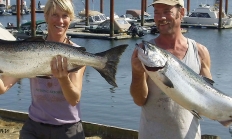
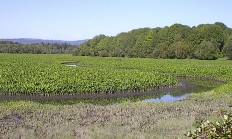
In 1925 the first fish hatchery on the South Santiam River began operations about 5 miles upstream from today’s present site, rearing annually approximately 100,000 spring Chinook in dirt ponds for release into the South Santiam River. The present site came about with the construction of Foster Dam. In 1968 the facility was dedicated for the rearing of spring Chinook and summer steelhead. This facility was built and annually funded in part by the US Army Corps of Engineers to compensate for the loss of spawning and rearing areas above the dams on the South Santiam River.
PENDLETON, Ore. – A $1 million federal investment will jump-start critical engineering and design work on fish passage and alternative solutions at McKay Creek Reservoir Dam, laying the technical groundwork to eventually reconnect more than 100 miles of historic salmon and steelhead habitat. Sens. Jeff Merkley and Ron Wyden helped…
WALDPORT, Ore. — The Oregon Department of Fish and Wildlife and First Baptist Church of Waldport will host the 27th annual family fishing event at Eckman Lake on Saturday, May 16. The event will take place from 9 a.m. to 2 p.m. for youth ages 17 and younger. Each participant…
In grass or sagebrush-dominated habitats throughout the state, the song and striking appearance of the Western meadowlark create one of the most familiar and endearing avian images in Oregon. It's one of Oregon's most recognizable birds with its bold yellow breast and belly with a distinct black V across the chest and its habit of perching on fences along roadsides. Fittingly, it was chosen as Oregon's state bird by a vote of Oregon schoolchildren ratified by the Legislature in 1927. It is one of the most widely distributed open-country species in the arid desert country of eastern Oregon. It can…

In Oregon, the nutria is considered an invasive species. The nutria is a large rat-like semiaquatic rodent. The species has a hunched body; a round, nearly hairless tail; a valvular mouth and nose; and pentadactyl feet with naked soles. The toes of the hind feet, except for the hallux, are included in a web. As an adaption to the aquatic environment, the eyes, nostrils, and small ears are set high on the sides. The pelage consists of long, course guard hairs and soft, dense underfur. Overall, the color usually ranges from dark brown to yellow-brown. The muzzle is frosted with…


This unusual shorebird breeds along rivers, streams, and lakes in a variety of habitat types throughout the state, from sea level to near timberline. Conspicuous by its distinctive teetering behavior, boldly spotted underparts, and noisy alarm calls, it is usually the only breeding shorebird present in its preferred habitat. The appearance of a sandpiper along a tiny tributary in the upper reaches of a heavily forested watershed can be startling to one unfamiliar with the species' ubiquitous nature. The Spotted sandpiper is a widespread transient and breeder throughout the state, found in nearly every county in Oregon. Most birds depart…


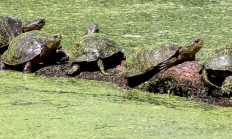
Oregon's native turtles are in trouble. Invasive, non-native turtles such as the red-eared slider and snapping turtle compete with Oregon's turtles for food, habitat and nesting sites. Our native turtles are also preyed upon by bullfrogs and are affected by habitat loss and degradation. Check out this video to learn more about Oregon's native turtles and invasive turtles.