
Search myodfw.com
Showing 561 - 580 of 1674 results
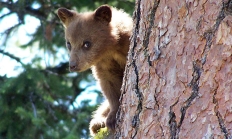
Black bears are the largest extant carnivores in Oregon. They are, however, smaller than grizzly bears, and they lack the grizzly's distinctive shoulder hump. A black bear is heavily built with stout legs and large feet. The eyes and ears are relatively small and the tail is extremely short. The claws are recurved but relatively short with those on the forefeet equal to or only slightly longer than those on the hind feet. The characteristic humped shoulders and dished face of the grizzly bear are absent. During spring-autumn seasons, black bears tend to be more active during daylight and crepuscular…
Oregon has two sea lion species and three seals. The Steller sea lion, Northern elephant seal and Pacific harbor seal are Oregon Conservation Strategy Species.

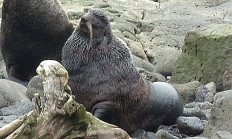
The Northern fur seal is the smallest member of the family in Oregon. The flippers are nearly twice as large as those of a comparably-sized individual of any other species of otariid. The ears are cylindrical and the auditory meatus is covered with wax to prevent entry of water. The pelage consists of coarse guard hairs and an exceedingly thick underfur that serves as waterproof insulation. Adult males are dark gray or brown dorsally and reddish brown ventrally; a grayish cape covers the neck and shoulders. Adult females are grayish brown dorsally and reddish brown ventrally. The Northern fur seal…
The Steller (or Northern) sea lion is the largest member of the family Otariidae. Among adult females and subadult males, the upper body is slim, whereas in adult males it is heavy and muscular. The head is bearlike with a moderate step between muzzle and forehead. The rear flippers are relatively small and can be turned beneath the body for travel on land. The pelage is light buff to reddish brown, slightly darker in the chest and abdomen. Overall the pelage appears darker when wet. However, beneath the water it appears white, whereas the California sea lion appears black. In…

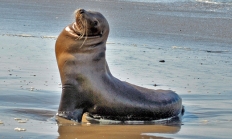
The California sea lion is the mid-sized Oregon otriid. The body is slender and tapering, the flippers are relatively small, and the rear flippers can be rotated beneath the body for moving on land. The short, course pelage lacks dense underfur; when dry, it usually is chocolate brown, but individuals with light-tan pelage are known to occur. The pelage appears black when wet. In older males, the pate is tan. The occurrence of the California sea lion along the Oregon coast is seasonal. The primary areas where it comes ashore are Cascade Head, Tillamook County; Cape Argo, Coos County; and…
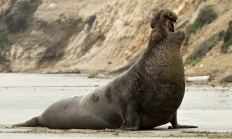
The Northern elephant seal is the largest pinniped carnivore that occurs along the North Pacific coast. The flippers are relatively small, the rear ones directed posteriorly. Its most distinctive feature is the elongated tubular proboscis with a deep transverse cleft among adult males. This proboscis can be inflated and directed into the open mouth to produce vocalizations. Also among males, the neck and chest lose most of their hair and the skin becomes rough and thickened at puberty. The adult pelage consists of course grayish or brownish hairs without any underfur. During the molt, not only is the pelage shed…
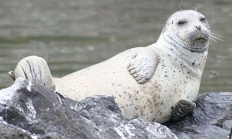
The body of the Pacific harbor seal is plump but tapers to small rear flippers permanently extended posteriorly. The head is large and rounded, the eyes are large, the limbs are short, and the nostrils sit dorsally on the muzzle. The nostrils can be closed when this seal dives. The tongue is notched at the tip. The pelage consists of long overhairs that overlay short underhairs. Markings are extremely variable, but in general the pelage is gray or brownish gray with numerous small spots of black that may coalesce to form splotches. Pacific harbor seals have been observed ashore at…
Although these species are quite different, they are both in the same family, Procyonidae.
The ringtail is shaped somewhat like a marten with an elongated body and tail of approximately equal length. The ringtail is named for its tail which has has eight dark bands alternating with seven buffy bands. The dorsum is buff overlain with blackish or dark-brownish guard hairs; the venter is whitish or light buff. The face mask is whitish, but the eyes are fringed with a narrow band of black. The toes are equipped with semi-retractile claws, and except for the pads, furred on the ventral surface. The ears are long and set wide apart on a nearly horizontal plane…

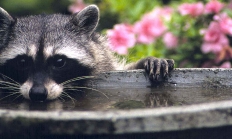
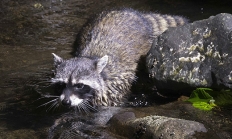
Few, if any, behavior patterns of wild mammals are more widely recognized than the so-called "food-washing" behavior of the racoon. Wild raccoons, in foraging along streams, commonly sit on their hind legs (sometimes in the water), stare vacantly into space, and search for food by "dabbling" with splayed-fingered forepaws. View more information about Living with Wildlife, Raccoons for tips on preventing conflicts at home and in the wild.
This group of mammals includes the American marten, fisher, and wolverine which are all Oregon Conservation Strategy Species.

The American marten is weasel-like with a long body and pointy face. The legs are short; the toes, including the pads, are completely furred; and the nails are semiretractile. The tail is bushy and long. The pelage in winter is luxuriant, with a dense underfur and sparse covering of guard hairs. The color varies, but usually is a golden brown shading to dark brown on the feet and tail; the head is lighter. The throat and chest are splotched with orange or yellow. A small dark stripe extends upward from the medial corner of each eye, giving the appearance of…

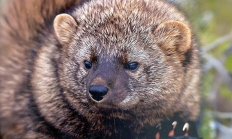
The Fisher is considerably larger than the marten and males are considerably larger than females. It is more stockily built than the weasels, but is similar in that the head is somewhat pointed, the body elongate, and the legs short. The pelage is long except on the face. The fur is dark brown grading to black on the rump and legs; the tail is black. Fishers once occurred throughout the coniferous and mixed forests of Oregon's Coast Range and Cascade Mountains. Currently, there is a native population in the Siskiyou Mountains and an introduced populations in the southern Cascades that…
The Ermine is the smallest member of the genus in Oregon. It has a long, cylindrical neck and body and short legs, but the tail is relatively short. The head is flattened and somewhat triangular, the eyes are small and slightly protruding, and the ears are rounded. The summer pelage is brown dorsally, usually white or yellowish ventrally; in some individuals the throat and belly are splotched with brown or are entirely brown. In some populations east of the Cascade Range, ermines replace brown summer pelage with a white winter pelage. The tip of the tail remains black at all…

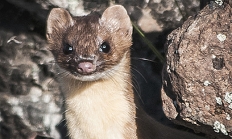
The Long-tailed weasel is the larger of the two weasels in Oregon, but smaller than the other member of the genus, the mink. Males are considerably larger than females. The head is flattened and somewhat triangular; the body and neck are elongate and almost cylindrical; the legs are short, and the tail is long. The summer pelage is brown dorsally; the venter is yellowish to orangish except for a white chin and sometimes one or more scattered brown spots. The tip of the tail is black. The pelage is molted twice annually. In the Cascade Range and eastward through the…
The Mink is a semiaquatic species. The body is elongate and cylindrical, the legs are short and stout, the tail is bushy and about half as long as the head and body. The head is flattened, the ears small and rounded, and the nose is pointed. The pelage consists of dense grayish underfur and long lustrous guard hairs. Dorsally, it is dark brown to blackish but somewhat lighter on the venter. In Oregon, the mink is found throughout the state and is associated with river, lake, pond, or marsh environments. They forage along overhanging banks, and in holes and crevices…

The Wolverine is the largest terrestrial mustelid in Oregon that, to some degree, resembles a small bear. It is powerfully built with a broad, dog-like head; short round ears; small eyes; a slightly humped back; relatively short legs and a bushy, somewhat drooping tale. The pelage consists of a dense, wooly, crimped under fur overlain by course, stiff and somewhat shaggy guard hairs. Fur on the tail is about twice as long as on the body. The base color is blackish brown with a pale brown stripe extending along the sides from the head or shoulders to the base of…

The American badger is a medium-sized, powerfully built carnivore strongly adapted for digging. The body is flattened and the legs are short but stout; the toes of the forefeet are partly webbed and equipped with long, curved claws; the hind feet are shaped like miniature shovels; and each eye is equipped with a membrane that can be extended to cover it. The ears are rounded and densely covered with fur but seem large in comparison with those of many digging mammals. The tail is short and brushlike. Dorsally, the long, shaggy pelage is mottled grayish blending on the venter to…

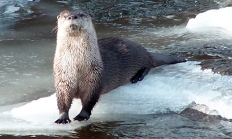
The River otter is adapted for both terrestrial and aquatic environments. The heavily muscled, somewhat cylindrical body is thickest at the thorax and tapers posteriorly to a thick, flattened tail. The body tapers to a blunt and slightly flattened head. The legs are short and powerful; and the toes are webbed. The eyes are small, forwardly directed and set high on the head. The underfur is grayish, short, and dense, and overlain by longer, stiff and shiny guard hairs. The dorsum is brown and the venter a lighter brown or tan; the lower jaw and throat are whitish. In Oregon…
The Western spotted skunk is smaller and more weasel-like than the Striped skunk. The pelage is black with a somewhat pentagonal white patch between the eyes, a round white patch on each side of the head and four or six segmented white body stripes. This skunk is endowed with a muscle-encapsulated musk gland similar to those of the Striped skunk and so similarly, can eject musk from two papillae located under the tail. The odor of the musk is considered somewhat more pungent or acrid but is less spreading than that of the Striped skunk. In Oregon, this skunk occurs…
