Search myodfw.com
Showing 561 - 580 of 903 results
The Bohemian waxwing is a nomadic species, invading locations with fruit-bearing trees or shrubs. Referred to as a "roving bands," their name reflects this view of their unpredictable and seemingly carefree lifestyle. Very sociable birds, they exhibit pronounced flocking habits in the winter, and frequently give themselves away with their constant gentle seeping or trilling voice. Their sleek profile and elegant, almost exotic coloration also distinguish these birds. Hear the song of the Bohemian waxwing Photo by Kathy Munsel, ODFW

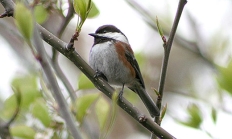
Chestnut-backed chickadees are one of the most common species of bird in conifer forests of western Oregon. They are distinguished from other chickadees by their chestnut-colored back, lack of an eye-line, and their wheezy song. Like other chickadees, they are frequently observed performing acrobatic maneuvers such as hanging from branch tips while foraging high in the canopy. They also frequent bird feeders for suet and sunflower seeds, and will nest in boxes if they are placed near groves of conifers. Hear the call of the Chestnut-backed chickadee Photo by Kathy Munsel, ODFW
This large sparrow is white below and in most plumages has at least some black around the face or throat, more in adults than younger birds. Cheeks are golden-tan in fall and winter and grayish in spring. It is streaked above. It is a winter visitor usually found with other sparrows. A very rare migrant and rare but regular visitor, you can find the Harris's sparrow statewide. Numbers vary considerably from year to year, but a few birds are typically found in the state every year. They are most regular in the Columbia Basin and in valleys within the Blue…

Gray jays are common visitors at mountainous campsites and parks and are commonly known as "camp robbers" for their habit of taking food from humans. Gray jays in the Blue Mountains have the top of their heads white, while birds in the Cascades and Coast ranges have white restricted to the forehead. Coast Range birds are decidedly browner vs grayish overall. In Oregon, the Gray jay resides in conifer forests of the Coast and Cascade ranges, the eastern slope of the Cascades at Ft. Klamath and in the southwestern part of the state. Hear the call of the Gray jay…

One of the most nondescript birds found in Oregon, this sparrow makes up for its drab appearance by its extraordinary song. It is by far the most abundant bird breeding in the vast sagebrush expanses of the Intermountain West. The Brewer's sparrow is an abundant migrant and summer resident east of the Cascades summit, particularly in the southeast quarter of the state among the vast sagebrush communities of the Great Basin Shrub-steppe. In the Columbia Plateau ecoregion, it is an Oregon Conservation Strategy Species. Hear the song of the Brewer's sparrow Photo by Dave Menke, USFWS

Features: The color of all trout varies with environment. In general, the rainbow is bluish-green on the back, silvery on the sides and belly, and has a white edge to the dorsal, anal, and pelvic fins. A generous sprinkling of black spots appear along the back, and on the dorsal, adipose and caudal fins. A pinkish band usually extends along the sides. Habitat: Rainbow trout are the most widely stocked and distributed trout in Oregon. They occur naturally in many rivers and streams, and each year ODFW stocks millions more in ponds, lakes and streams. Prime trout waters are clear…

One of Oregon's characteristic offshore seabirds, these stocky gull-like birds with steep foreheads come in a broad range of color morphs from white to slate gray, with buffy, bluish-gray, mottled and brown intermediates. The round head and pecking motion of birds feeding on the water is reminiscent of the shape and behavior of pigeons. The heavy hooked bills are divided into colorful plates of green, yellow, and orange, with large tubed nostrils atop. They are irregularly common to abundant in Oregon in winter, especially beyond five miles from shore. Hear the call of the Northern fulmar Photo by Martyne Reesman…

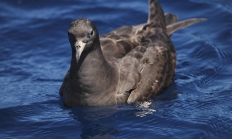
Flesh-footed shearwaters are always exciting birds to find, as they are one of the rarest of the seabirds to occur annually in Oregon. Single birds are sometimes found in flocks of other shearwaters. They are very similar to sooty shearwaters but they are larger with pink or pale whitish feet and dark-tipped pale bills. In addition, their plumage is a deep chocolate-brown, lacking the grayness of the upperpart coloration of sooty shearwaters; and the underwing does not show the sooty's white coverts. It is a rare late fall transient offshore at the western edge and slopes of the continental shelf…
This is a marine gull that breeds on both offshore islands and rocky cliffs along the Oregon Coast. It also uses structures for nesting and, occasionally, will nest on grass-covered headlands. The Western gull's food comes from the marine environment, estuaries, and the immediate shoreline. It eats small fish, clams, mussels, bird eggs, the young of other birds nesting nearby, sea urchins, starfish, squid, crustaceans, marine worms, and carrion. it will scavenge garbage or waste from fishing boats as well. It is present all year along the entire coast of Oregon. Hear the call of the Western gull Photo by…

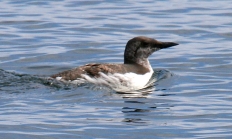
The most common seabirds breeding in Oregon, Common murres are easily recognized by their distinct black and white breeding plumage and their upright stance at colonies. Wing-beats are rapid and like all alcids they can fly underwater. They are often seen over the ocean in long lines of 10-40 or more birds. They nest on rocky islands and cliffs in colonies of tens or hundreds of thousands of birds packed together almost shoulder to shoulder. Major nesting concentrations in Oregon are on the south and north coasts reflecting the availability of suitable nesting habitat. Hear the call of the Common…
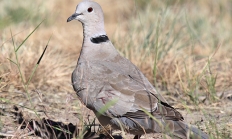
The Eurasian collared-dove is quite similar to the Ringed turtle-dove but is somewhat larger with grayer underparts and darker primaries. It is a bird of agricultural areas and readily visits bird feeding stations in urban and rural neighborhoods. During the 1600s this Indian species began to expand its range until today it occurs in all of Europe and most of Asia. After introductions in the Bahamas in 1974 and Guadeloupe in 1976 it soon expanded throughout the Caribbean and reached Florida by 1980. It is now expanding into other parts of North America, reaching Oregon in 1988. It is expected…
Familiar to anyone from the eastern United States and Canada, this sparrow is much less common in Oregon. Adults show both a white-striped and tan-striped morph, while first year birds resemble tan-striped adults but are typically more heavily streaked underneath. Even the dullest first-year birds have a distinct rectangular white throat patch, often set off with a partial black border. The White-throated sparrow is an uncommon migrant and winter visitor, mainly in western Oregon. Hear the call of the White-throated sparrow Photo by ©Keith Kohl, ODFW

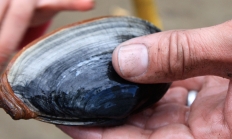
Features: Unlike gaper clams, softshell clams have no gape on their neck end. Softshell clams have a spoon like projection on the left valve, this feature is called a chondrophore. Habitat: Brackish, muddy areas all along Oregon's coastline. Find softshells 12-18" depth. Technique: Softshells can be harvested by digging with either a shovel or clam gun. As the name suggests, they have soft or thin shells which are easy to break. Although a clam with a broken shell is still good to eat, sharp edges of a broken shell can be very dangerous. Until you've refined your shoveling skills you…
Commonly found along beaches and about estuaries, this large, ponderous bird is a conspicuous member of the summer coastal community, easily recognized by its large size, massive bill, and brownish plumage. Highly gregarious, it often forms large flocks; regularly observed foraging over the ocean just offshore. Brown pelicans often join mixed flocks of birds attracted to schools of small fish. They are common spring, summer, and fall visitors along the Oregon coast. Brown pelicans are an Oregon Conservation Strategy Species in the Nearshore ecoregion. Hear the call of the brown pelican Photo by Michael Lazott

With its long, forked tail and long wings, it is the most graceful of all land birds and reminds one of the smaller terns not only in shape but in behavior. The Barn swallow has taken so completely to nesting on human-made structures that one forgets they were once restricted to caves and rock crevices. Almost every farm in the state has a pair or two nesting in an outbuilding, and very few bridges do not have a pair or two. It is the best known of the swallows. It is a fairly common to locally abundant summer resident and…

This well-known ground-dwelling bird is black above on the male and brown on the female, including the entire head and upper breast. On both sexes the upperparts are spotted with white on the wings and the long tail. It has rufous sides and a white belly. It frequents brushy areas and is common at bird feeders wherever seed is scattered on the ground, but does not feed far from cover. The varied song usually has one to three parts. The Spotted towhee breeds statewide and winters primarily west of the Cascades and in small numbers in lowland areas east of…

The song of this bird is one of the characteristic sounds of spring evenings in much of the high desert country of eastern Oregon. This temperate migrant is a ground-nesting, ground-foraging bird of most of the grassland, agricultural land, and shrubs steppe habitats of Oregon. The streaked brownish plumage of the Vesper sparrow is similar to that of several small to medium-sized sparrows, except for white outer tail feathers, shown most conspicuously in flight. The Oregon vesper sparrow is an Oregon Conservation Strategy Species in the Klamath Mountains and Willamette Valley ecoregions. Hear the song of the Vesper sparrow Photo…

Although not brilliantly plumaged, the conspicuous Song Sparrow is one of the more regularly seen birds in Oregon. Defensive and curious, when approached it readily announces its presence with loud chips and often excitedly rises to a conspicuous perch to confront the interloper. The Song sparrow is well named as both male and female have a variety of songs that may be heard at any time of year, and juvenile birds begin to sing full songs within two months of hatching. The Song sparrow is a common and widespread resident of western Oregon. Hear the song of the Song sparrow…

The noisy and frenetic Ruddy turnstone is a stocky, plover-like bird who's breeding plumage is a clown like pattern of black, rust and white. Ruddy turnstones have been found foraging in the company of many other shorebird species. Found on rocky shores, jetties, open ocean beaches, mud flats, salicornia marshes, grass flats and flooded fields, the Ruddy turnstone is an opportunistic feeder. It is an uncommon to common spring and fall transient along the coast; a few birds remain to winter there each year. The largest flocks are seen during spring and fall migration at Bandon. They are an irregular…

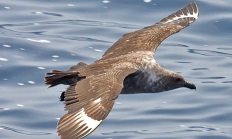
Skuas are the size of a Western gull, dark with a pale nape and large white patches on the bases of the primaries on both the upper and lower surfaces. This is a solitary bird. Its flight is low and direct with heavy flapping and little gliding. It steals food from other seabirds, and is aggressive, bordering on predatory. It may grab a shearwater's head, wing, or tail and shake and kick the bird until it regurgitates its food. Chances of detection are best around flocks of shearwaters feeding behind fishing boats. It is a rare to uncommon fall transient…