
Search myodfw.com
Showing 561 - 580 of 705 results


WALDPORT, Ore. — The Oregon Department of Fish and Wildlife and First Baptist Church of Waldport will host the 27th annual family fishing event at Eckman Lake on Saturday, May 16. The event will take place from 9 a.m. to 2 p.m. for youth ages 17 and younger. Each participant…
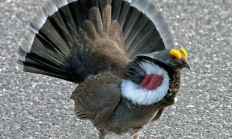
This popular upland game bird is the largest of Oregon's three forest grouse. It is well known for the distinctive hooting call emitted by courting males in the spring. This call is accompanied by an extravagant courtship display involving exposure of blood-engorged, featherless shoulder spots and eye combs, which are reddish to orange. It is a common resident in coniferous forests. Hear the call of the dusky grouse Photo by Jim Dollar, Flickr

Jewell Meadows Wildlife Area is located in the Oregon Coast Range Mountains, in the northwestern part of the state. The wildlife area was established in 1969, with an initial purchase of 183 acres. It now encompasses 1,114 acres. The wildlife area’s purpose is to protect and enhance habitat to benefit native wildlife species, to reduce wildlife damage to adjacent properties, and to provide the public with an opportunity to observe wildlife in a natural setting.

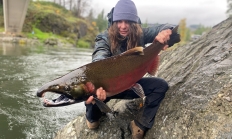
CLACKAMAS, Ore. – Angling will be closed on the lowest reach of Eagle Creek in the Clackamas basin from Sept. 27 through Oct. 31 to give coho salmon a safe resting area amid ongoing low water flows. The closure is from SE Dowty Road downstream to the Clackamas River confluence…
While there is a general, statewide season for cougars, there are quotas set by zone. Once a quota in a certain zone is met, that zone will close for cougar hunting. Below are the most recent numbers on cougar harvest by zone.

If this is a new activity for you, our friends at the Audubon Society have tips on how to start birding and how to connect with other birders. This is a great resource that also includes tips on choosing binoculars, reviews and recommendations on the best birding apps and field guides, and an easy seven-point guide on how to identify birds. The Cornell Lab of Ornithology has an extensive website that includes the world's largest archive of wildlife sounds and videos, bird cams, eBird citizen science opportunities, scientific publications, bird guides, bird nesting box plans and more. ODFW's Living with…
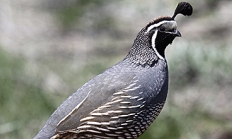
California quail are the most widely distributed upland game birds in Oregon. Most easily recognized by the comma-shaped, black, plume, or "topknot," which bends forward and is larger on the male. It has been a resident statewide since the early 1900s, except for most forests of the north Coast Range and west Cascades; it is generally absent along the coast north of Coos Bay. California quail is also absent from high-elevation areas of the east Cascade range. They are common residents in rural and even some suburban areas, particularly in eastern Oregon where many coveys gather at feeding stations during…
SALEM, Ore. – The Private Forest Accord Mitigation Advisory Committee will hold its regularly occurring meeting, virtually on Tuesday, July 15, 2025. For a full agenda and virtual login information about the meeting, please visit: https://www.dfw.state.or.us/habitat/PFA/meetings.html The public is welcome to attend virtually. The Private Forest Accord Mitigation Fund was established…
SALEM, Ore. – Last week in a Corvallis neighborhood, residents worked together to ensure a newborn fawn spotted on a grass strip between a sidewalk and road was left alone. By early evening, its mother returned for her fawn. ODFW biologists praised the residents for recognizing that does often leave…

Public comment period open; comment via online form SALEM, Ore.—Oregon's Fish and Wildlife Commission will meet Feb. 20 at the Lane County Armed Forces Readiness Center, 3106 Pierce Parkway in Springfield. The meeting starts at 8 am and will be livestreamed on the meeting agenda page and at ODFW's YouTube…
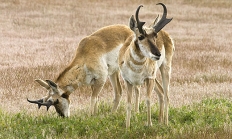
The pronghorn, often called "antelope," is deer-sized with relatively long and thin legs and feet with just two digits on each foot, a relatively small tail, and unique horns consisting of deciduous keratin sheaths set on bony cores arising from the fontal bones. Among males, the laterally flattened sheaths are long, branched and recurved, but in those females that possess horns they are short and simple. The horns and hooves are black. The front feet are larger and carry most of the weight when the pronghorn runs. The pelage is course. The dorsum is a light buff and is separated…
NW Fishing September 10, 2026 Best bets for weekend fishing: Nehalem Bay has fall Chinook in the bay and tidewater. Fishing has been fair and consistent the past couple weeks with multiple fish being caught daily. The Bag limit is one wild adult Chinook per day and five for the season (July 1 to Nov 30) as part of the overall daily bag limit. A few hatchery coho have been caught in the bay as well. Wild coho fisheries is open in Nehalem, Tillamook, and Nestucca Bays, the season runs until October 28 (Open Wednesdays, Saturdays, and Sundays only). As…