
Search myodfw.com
Showing 581 - 600 of 677 results
The elk is the largest cervid in Oregon. These heavy-bodied, deer-like mammals have narrow faces tapering to a naked nose pad; relatively small, pointed ears; a heavily maned neck; a back slightly humped at the shoulders, a contrasting rump patch; and a small tail. Pelage color is grayish brown to reddish brown, somewhat lighter among males in winter. The mane is dark brown and the rump patch and tail are cream colored. The underparts (except for a whitish patch between the hind legs) and legs are dark brown to almost blackish. Adult females, their current offspring, and their female offspring…

Big Creek Hatchery began operation in 1941. It was refurbished in 1957 under the Mitchell Act as part of the Columbia River Fisheries Development Program – a program to enhance declining fish runs in the Columbia River Basin. The facility is used for adult collection, egg incubation and rearing of winter steelhead, fall Chinook, and coho.
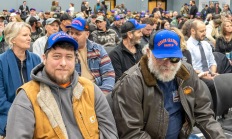
SPRINGFIELD, Ore.— The Commission voted 6-1 to deny a petition that requested crab fishery rules be modified to further reduce the risk of whale entanglement, while urging the department to continue its planned rulemaking process and engagement with NOAA fisheries to obtain ESA coverage. Whale entanglements have increased in Oregon…
Find maps, boundary information and the percent public land in the Tioga Unit.
Find maps, boundary descriptions and the percent public land for the Mt. Emily Unit.
Find maps, boundary descriptions and the percent public land for the Wenaha Unit.
Find maps, boundary descriptions and the percent public land for the Silver Lake Unit.
Find maps, boundary descriptions and the percent public land for the Siuslaw Unit.
Find maps, boundary descriptions and the percent public land for the McKenzie Unit.
Find maps, boundary descriptions and the percent public land for the Walla Walla Unit.
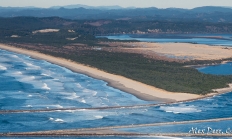
Find maps, boundary descriptions and the percent public lands for the Desolation Unit.
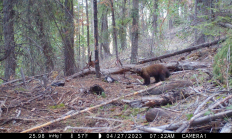
CENTRAL POINT, Ore. – The Oregon Department of Fish and Wildlife is conducting research on fisher, a forest-dwelling carnivore that once occupied forests across the Cascade and Klamath-Siskiyou regions. Today, Oregon's remaining fisher persist as a small, isolated population in the Klamath-Siskiyou Mountains. And ODFW researchers want to know how…
The goal of the Oregon Hatchery Research Center (OHRC) is to answer scientific questions related to fish recovery and hatchery programs. Information gained at the Research Center will help answer questions vital to the success of the Oregon Plan for Salmon and Watersheds and implementation of the Native Fish Conservation Policy. The Oregon Hatchery Research Center is a cooperative research project between the Oregon Department of Fish and Wildlife and the Oregon State University Department of Fisheries and Wildlife.
SALEM, Ore.—ODFW is seeking qualified applicants to fill one sport fishing position and one commercial salmon industry position on the Restoration and Enhancement (R&E) Program Board. Interested individuals must apply by Oct. 6, 2025, use this form on the R&E Board page. The ideal sport fishing candidate will be a…
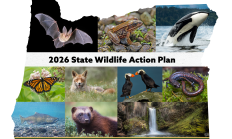
SALEM, Ore.—ODFW is excited to announce that Oregon's State Wildlife Action Plan (SWAP) has been officially approved by the U.S. Fish and Wildlife Service. This milestone marks the final step in adopting the 2026 SWAP, a science‑based roadmap to maintain healthy fish and wildlife populations, prevent further declines of at‑risk…
Find maps, boundary descriptions and the percent public land for the Keno Unit.