Search myodfw.com
Showing 61 - 80 of 897 results
SE WILDLIFE VIEWING June 25, 2026 Harney County With warmer temperatures occurring throughout Harney County various orders of birds can be viewed including but not limited to Passeriformes, Galliformes, Accipitriformes, and Anseriformes. The county experienced a mild winter this season making for low snowpack accumulation even at higher elevations, access for observation opportunities should be good even early this summer. Although, those looking to explore rural areas of the county should keep recovery items in their vehicle. Early summer rains occurring periodically may cause muddy conditions on unpaved roads. With the late spring months comes wildlife baby season. Most wildlife…
This delicate warbler rewards a diligent observer with a stunning black-and-orange vision hidden among the leaves (adult males) or a more subtle gray-and-gold (females and immatures) in riparian areas within the open forests of northeastern Oregon. A spars, unpredictable and probably declining breeder in the state, it is sometimes seen at "vagrant traps" such as desert oases and isolated coastal copses during migration. Hear the song of the American redstart Photo by Dan Pacamo, Flickr

Find maps, boundary descriptions and the percent public land for the Juniper Unit.
Find maps, boundary descriptions and the percent public land for the Wagontire Unit.
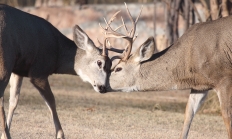
Features: Mule deer are larger and lighter in color than black-tails. Mule deer have a thinner “ropelike” tail that is white with a black tip. Their antlers are forked, as opposed to having a main beam. And as their name implies, they have large ears, like a mule, that stand at an angle. Habitat: Mule deer occupy a wide range of habitat types; some live in desert shrub-steppe, some in woodlands, and some in conifer forests. In general, however, mule deer occupy the more open, rugged areas. Although mule deer commonly are considered “browsers," they consume a wide variety of…

The Snowy owl is the largest North American owl. Its white plumage makes it uniquely adapted for life in the arctic and sub-arctic. Adult males are nearly pure white, females have black spots and some barring. Young birds can be strongly barred. Every few years, for reasons which are still not fully understood, Snowy owls move south of their normal winter range into Oregon. During these irruptive events, they can be found on coastal dunes, open high desert, agricultural areas, airport margins, and occasionally atop buildings in populated areas. Hear the call of the Snowy owl Photo by Charlotte Ganskopp

Ruffed grouse are named for a series of black iridescent feathers on the sides of the neck called the ruff, which is erected by males to form an ring around the neck during courtship displays. This forest-dwelling species, favored by upland game-bird hunters, is well known for the drumming of the males during courtship displays in the spring. It is a common resident throughout most forested regions of the state. It occupies most forests at low to moderate elevations east of the Cascade crest, primarily the east slope of the Cascades from Ft. Klamath and upper Klamath Lake and Blue…

Find maps, boundary descriptions and the percent public land for the Steens Mountain Unit.
A black bear tried its best to get into a Neskowin homeowner's bear resistant trash can. The homeowner then built a small shed to enclose the trash can. The persistent bear left its prints and claw marks on the shed but did not succeed in breaking into it. This resident…

The FRWA was created by a licensing agreement signed in 1957 and modified in 1982 and 2008, between the US Army Corps of Engineers and the Oregon Game Commission. This agreement authorized the state to develop, conserve, and manage all wildlife resources on 5,261 acres of land and water within the Fern Ridge Project. ODFW also acquired the 309 acre Coyote Creek South and 224 acre Coyote Creek Northeast units in 2013 and 2015, respectively. The wildlife area now totals 5,794 acres.

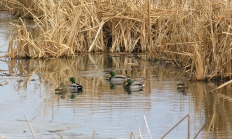
Summer Lake Wildlife Area was established in 1944, with primary objectives of protecting and improving waterfowl habitat and providing a public hunting area. It is now a popular destination for hunting, wildlife viewing and environmental education due to its geographic setting, the abundance of wildlife present and species diversity.
Canada geese, with their distinctive black neck and head and white cheek patches, need little description because they are one of Oregon's most familiar and conspicuous birds. There are 11 subspecies of the Canada goose. As a whole, the species is widely distributed throughout Oregon, with the exception of mountainous and desert areas lacking reservoirs, lakes, or large rivers. Concentrations of wintering and breeding Canada geese occur wherever agriculture and other human developments provide green forage or small grains and water bodies provide sanctuary. Hear the call of the Canada goose Photo by Leise Wease

Some of Oregon's larger mammals, such as deer and elk can easily be seen at places like Jewell Meadows Wildlife Area, Dean Creek Elk Viewing Area, and the North Bank Habitat Management Area. Black-tailed deer are frequently seen in western Oregon along roadsides. Commonly seen animals include raccoons, rabbits, squirrels, and skunks. A quiet walk in the forest or desert, a keen eye and a good pair of binoculars will reward you with glimpses of some of our more secretive animals. Some viewing tips include: keep your distance, move as silently as possible or pick a spot and remain still…
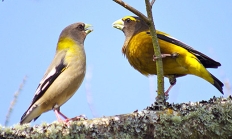
This sturdy-looking bird has a large head, short tail, and massive conical bill adapted for seed eating. The male plumage features bold patches of lemon yellow shading into olive, then brown and black, with white secondaries creating a flashy wing-patch easily seen in flight. The male's bill is chalky white in winter, but changes in early spring to a pale green that matches the new growth at the tips of spruce boughs, where they often nest. Many encounters with this species are of individuals heard flying high overhead, leaving the observer with little else to note. The Evening grosbeak is…

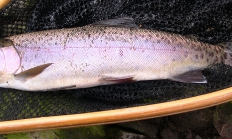
Features: As the name suggests, these fish have rosy red strip along their sides. Other identification clues include large, profuse black spots on the body and orange and yellow tints along the belly. Habitat: Redband trout are a subspecies of native rainbow trout that have adapted to the arid, desert conditions of eastern Oregon. During drought years distribution constricts as streams dry and become uninhabitable. Trout re-colonize these streams during wet cycles, expanding the distribution. Prime trout waters are clear, clean and cold. Good trout stream habitat is complex, consisting of an array of riffles and pools, submerged wood, boulders…