Search myodfw.com
Showing 601 - 620 of 1416 results
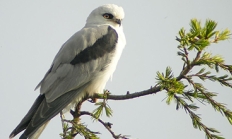
As the winter day turns to dusk, White-tailed kites drop into their roosts and Short-eared owls rise to take their place on the local hunting grounds. White-tailed kites in Oregon often roost communally in winter, but they disperse in early spring and are more difficult to find during the breeding season. By day, they are conspicuous as they hover over rural fields searching for prey, in part because of their pale appearance. The tail is entirely white, as are the head and the underparts. Dark crescents on the underwing can be seen when a bird is flying or hovering. Above…
The song of this bird is one of the characteristic sounds of spring evenings in much of the high desert country of eastern Oregon. This temperate migrant is a ground-nesting, ground-foraging bird of most of the grassland, agricultural land, and shrubs steppe habitats of Oregon. The streaked brownish plumage of the Vesper sparrow is similar to that of several small to medium-sized sparrows, except for white outer tail feathers, shown most conspicuously in flight. The Oregon vesper sparrow is an Oregon Conservation Strategy Species in the Klamath Mountains and Willamette Valley ecoregions. Hear the song of the Vesper sparrow Photo…

Noted for its familiar call, chick-a-dee-dee-dee, the Black-capped chickadee is widely heralded as one of Oregon's friendliest and cheeriest residents. Even in the midst of winter, this bird "fairly overflows with good spirits." The Black-capped chickadee is resident at low to moderate elevations in western Oregon from the Willamette Valley and coastal counties to Douglas County and in most of eastern Oregon with the exception of the southeastern corner of the state. Hear the song of the Black-capped chickadee Photo by Dave Budeau, ODFW


BAKER CITY, Ore. – ODFW along with Baker County Parks will host a Free Fishing Day event at Holcomb Park, Brownlee Reservoir, on Saturday, June 7 from 10 a.m. to 3 p.m. This event is designed to help kids and their families learn fishing basics and enjoy a day outside…
Spotted bats are rare in North America, living in dry climates and often roosting on high cliffs. They are white underneath with dark fur on their back and with large white spots. The spotted bat is found in eastern Oregon and is an Oregon Conservation Strategy Species in the Blue Mountains, Columbia Plateau, East Cascades, Klamath Mountains and Northern Basin and Range ecoregions. Photo by ©Michael Durham

This is a portly, brightly colored shorebird, typically found in coastal salt marshes, mud flats, and sandy margins of freshwater ponds. Migrant juveniles rather than adults appear in Oregon. They have a flattish, dark rufous-colored crown with fine black streaking. The crown gives the appearance of a jaunty "cap" sitting forward on the head and abruptly ending at the rear. The breast is rich orange-buff shading into the white lower breast and belly. The well-defined creamy-white supercilium broadens behind the eye and is visible at a considerable distance. This is one of the most distinctive field marks on juveniles. They…
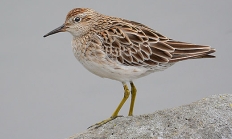
One of Oregon's rarest breeders, this distinctive "shorebird" is known for its courtship display flight and loud curlew-like call. it often perches in pine trees or on fence posts adjacent to nesting areas. A small plover-like head and short, strait bill seem out of proportion to its body, which is reminiscent of a small curlew. The Upland sandpiper is a rare breeder in large montane meadows within forests of eastern Oregon. They are almost never observed away form the breeding grounds in Oregon. The Upland sandpiper is an Oregon Conservation Strategy Species in the Blue Mountains ecoregion. Hear the call…

This salt-loving bird is possibly the most abundant grebe in the world. These grebes nest in the large, tule-fringed marshes of southeastern Oregon. They also use almost any open water for feeding after the breeding season. The eared grebe has been reported breeding in nearly every eastern Oregon county, but principal breeding areas are in Klamath, Lake, and Harney counties. It is local elsewhere east of the Cascades. Hear the call of the eared grebe Photo by Dave Budeau, ODFW

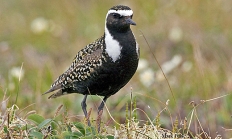
These elegant shorebirds are found as often in dry or damp upland areas as they are on mudflats or beaches. The plain brown immature birds of autumn become spangled with black and gold as breeding approaches. It is an occasional to uncommon migrant in western Oregon (mainly coastal) and locally rare, irregular migrant in eastern Oregon, with most reports at Malheur National Wildlife Refuge, in the Klamath Basin (summer) and in Umatilla County. Hear the call of the American golden-plover Photo by Mark Peck, Flickr
ASTORIA, Ore – The annual conservation closure of razor clamming on Clatsop beaches begins 12:01 a.m. July 15. The Oregon Department of Fish and Wildlife encourages clammers to take advantage of the low tide series that begins July 8. However, ODFW reminds clammers that although the low tide series goes…

The majestic trumpeter swan is the largest of our native waterfowl and one of the heaviest flying birds in the world with males sometimes exceeding 30 pounds. Historically hunted to the brink of extinction, it was recognized as an endangered species long before there was an Endangered Species Act, and its recovery is a conservation success story. The adult's snow-white plumage with contrasting black bill and feet and 8-foot wingspan define this magnificent bird. Their neck is as long as their body and is used to reach food at the marsh bottom. In spring, the trumpeter swan is a locally…

This small, remarkably delicate long-legged wader can be found in migration across most of Oregon. It is speckled gray and white with some variation by season and is typically noticed mincing about in shallow pools and in the water adjacent to mudflats or on seasonally flooded fields, as well as in small isolated ponds. It is an uncommon to common migrant, most birds in fall. In the eastern one-third of Oregon, it usually outnumbers Greater yellowlegs in fall. Hear the call of the Lesser yellowlegs Photo by Dave Budeau, ODFW

This colorful bird of coniferous forests and mixed woods is a common breeding species of eastern North America. It winters in the West Indies and Middle America and occasionally in California and the southern United States. It is a regular migrant in very small numbers in spring and irregular in summer and fall in the southwestern United States to California and Oregon and is occasionally found elsewhere in the West. The majority of Oregon records are from late April to late June, mostly from the east of the Cascades. Hear the song of the Northern parula Photo by Jeff Bryant…

The Common nighthawk is a migrant to Oregon with one of the longest migration distances of any North American bird. It is also one of the last to arrive in Oregon. Long, slender wings are marked by a white patch on the "hand" visible in flight from great distances. When perched on the ground, the cryptic brown, gray, and black mottling makes the bird almost invisible. This bird breeds and migrates at all elevations through the state. Its nesting habitat is characterized by open landscapes with little ground cover and is most abundant in sagebrush and rocky scablands and rimrock…

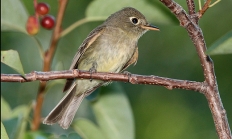
The Cordilleran flycatcher was recently designated a species distinct from the Pacific-slope flycatcher with which it was formerly lumped under the name Western flycatcher. The two species are almost identical in appearance, and the population in eastern Oregon is in some respects vocally intermediate between the Cordilleran and Pacific-slope types, so the distribution and status of the Cordilleran n Oregon is unclear. This species generally occurs in drier, higher elevation forests than the Pacific-slope flycatcher and is more closely associated with riparian zones. Hear the song of the Cordilleran flycatcher Photo by Julio Mulero, Flickr
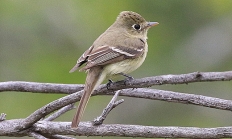
This small greenish flycatcher is easily overlooked in the moist, shady forests where it makes its summer home. It is a common to abundant breeder in forests of the Coast Range and west Cascades below about 4,000 feet and a common transient in western Oregon. The Pacific-slope flycatcher is most easily detected and identified by voice, but there is incongruence between published descriptions of vocalizations and some birds heard in the field lessens the certainty of identification to species, especially those in eastern Oregon. Hear the sounds of the Pacific-slope flycatcher Photo by Trish Gussler, Flickr
Familiar to anyone from the eastern United States and Canada, this sparrow is much less common in Oregon. Adults show both a white-striped and tan-striped morph, while first year birds resemble tan-striped adults but are typically more heavily streaked underneath. Even the dullest first-year birds have a distinct rectangular white throat patch, often set off with a partial black border. The White-throated sparrow is an uncommon migrant and winter visitor, mainly in western Oregon. Hear the call of the White-throated sparrow Photo by ©Keith Kohl, ODFW

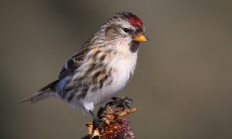
These tiny finches brighten the winter landscape of northeastern Oregon in some years. Their tan and ivory streaked with brown is plain enough, but the red forehead, black chin, and breast suffused in pink add a spot of color to snow-covered trees and shrubs. The Common redpoll is an uncommon to rare, irregular winter visitor, mainly in lowlands of the eastern Blue Mountain ecoregion. In peak years, this species can be locally common in Union, Wallowa, and Baker counties but in other years, it is essentially absent. It is an irregular visitant to Umatilla and Grant counties and in all…