Search myodfw.com
Showing 621 - 640 of 694 results
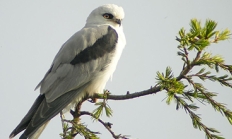
As the winter day turns to dusk, White-tailed kites drop into their roosts and Short-eared owls rise to take their place on the local hunting grounds. White-tailed kites in Oregon often roost communally in winter, but they disperse in early spring and are more difficult to find during the breeding season. By day, they are conspicuous as they hover over rural fields searching for prey, in part because of their pale appearance. The tail is entirely white, as are the head and the underparts. Dark crescents on the underwing can be seen when a bird is flying or hovering. Above…

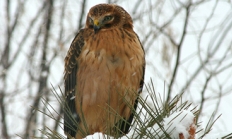
The Northern harrier is a slender, medium-sized hawk characterized by a noticeably long tail, bold white rump patch, and owl-like face. Commonly encountered in large expanses of open country, its main hunting technique is through use of a distinctive buoyant, gliding flight low over the ground that relies heavily on visual as well as auditory cues to detect prey. The larger females have rich brown upperparts while adult males are mostly light to medium gray, sometimes appearing almost ghostly silvery-white. Males are noted for their high-spirited and acrobatic courtship displays, in particular a series of dives and barrel rolls in…
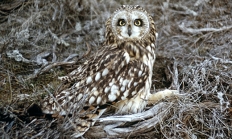
The Short-eared owl is one of our most conspicuous owls owing to its use of open country and crepuscular habits. It is often seen hunting low over the ground across marshes, fields, and other open areas on its buoyant, long wings, flying slowly and irregularly like a giant moth. This owl also differs from most other owls as it seldom vocalizes and is more often seen than heard. It was named for its inconspicuous "ear" tufts arising from the center of the forehead, though field observers rarely see these tufts. Distinguishing characteristics include a pale buff facial disk and a…



Central Fishing March 12, 2026 Best bets for weekend fishing Broodstock rainbow trout were stocked into Haystack Reservoir, Ochoco Reservoir, Pine Nursery Pond, North Twin Lake and South Twin Lakes in January and February. This is a rare and exciting opportunity to catch trophy trout from Wizard Falls Hatchery, many in the 4-8 lbs. range. As a reminder, to allow everyone a chance at catching one of these fish, only one fish over 20 inches long can be harvested each day. Anglers continue to report excellent kokanee and bull trout fishing at Lake Billy Chinook. The Metolius Arm is fishing…
SALEM, Ore. – The Fish and Wildlife Commission meets Friday, July 11 at 10 a.m., at The Dalles Civic Auditorium (323 East 4th St., The Dalles). See the agenda here. The meeting will also be livestreamed from the Commission page. At Friday's meeting, the Commission will be asked to consider…

The kit fox is the smallest canid that occurs in Oregon. It has the typical canid conformation: the body is slim, the legs are long and thin, and the ears are large and erect. The tail is about 40 percent of the total length and is tipped with black, but has no dark mane on the dorsal surface. The feet and legs are whitish interiorly, light rusty-brown posteriorly. The dorsum is grizzled brownish-gray medially blending to grizzled gray then to light buff laterally and finally to white on the chest and venter. The head and posterior surface of the ears…

The Canada lynx is only slightly larger than the bobcat. Nevertheless, long legs and long fur produce the illusion that the lynx is considerably larger than it actually is. Documented accounts of wild lynx are rare and lynx are not expected to currently reside in Oregon. However, if lynx were to be observed, it is likely to occur at higher elevations such as in the Cascade Range, Blue Mountains or Wallowa Mountains. Habitats used by lynx often are defined in terms of habitats used by their primary prey species, thus good snowshoe hare habitat usually is considered to be good…

BAKER CITY, Ore. – ODFW along with Baker County Parks will host a Free Fishing Day event at Holcomb Park, Brownlee Reservoir, on Saturday, June 7 from 10 a.m. to 3 p.m. This event is designed to help kids and their families learn fishing basics and enjoy a day outside…


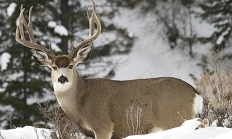
The mule deer is the larger member of the genus in Oregon. The ears are long, the metatarsal gland is surrounded by hairs similar in color but considerably longer than those on the remainder of the metatarsus, and the tail is short and constricted basally. Among adult males, the antlers are dichotomously branched with tines of approximately equal length. In winter, the basic pelage color is cinnamon buff. The chest is nearly black at the midline grading to grayish on the sides. The nose, sides of face, chin, and throat are whitish to pale buff. Spots of black occur immediately…

Wizard Falls Hatchery was constructed in 1947. Many improvements have been made to the facility since original construction. The hatchery has a rainbow trout broodstock which supply rainbow trout to the Deschutes sub-basin and southeast Oregon. The hatchery is used for incubation and rearing of kokanee salmon and rainbow trout to provide for recreational fishing program objectives, and the incubation and rearing of spring Chinook and summer steelhead as part of a reintroduction program in the upper Deschutes Basin. Brook trout and cutthroat trout fingerlings are reared for the air stocking program on odd years. Kokanee salmon are spawned remotely.
ASTORIA, Ore – The annual conservation closure of razor clamming on Clatsop beaches begins 12:01 a.m. July 15. The Oregon Department of Fish and Wildlife encourages clammers to take advantage of the low tide series that begins July 8. However, ODFW reminds clammers that although the low tide series goes…