
Search myodfw.com
Showing 641 - 660 of 897 results
Features: Drakes have a reddish head and neck; black breast, lower back and tail coverts; nearly white back, flank, and belly, and dark gray tail. The hen is grayish brown with a darker brown head, neck, breast and tail coverts. Canvasbacks are large; adults in good condition are as heavy as mallards and second in size only to the white-winged scoter among common Oregon ducks. Habitat: Brackish estuarine bays and marshes with abundant submerged aquatic vegetation and invertebrates are ideal wintering habitat for canvasbacks. Techniques: Generally part of a mixed duck bag. These ducks have a reputation as good table…

Features: Both the male and female are gray or reddish-brown on the body with dark bars and spots throughout. They have variable tail colors but always have a black band near the tip. Habitat: Ruffed grouse are most commonly found in brushy riparian areas in eastern Oregon and in early-aged mixed woodlands in western Oregon, though birds may be found in pockets of good habitat nearly anywhere. Technique: The ruffed grouse is a bird of the edge, so look in edges of meadows, clearcuts, and where brushy growth meets timber. In September, when most ruffed grouse hunting takes place in…

Ensatina salamanders are a lungless species with a short body and yellow or orange legs. There are two sub-species in Oregon: the Oregon ensatina ( E. e. oregonensis) is solid red, orange, brown or tan, while the painted ensatina ( E. e. picta) has small yellow, black or white spots on the back and tail. Ensatinas grow to just over four inches in total length. Ensatinas live in humid forests, woodlands and other areas with woody debris. They hide under logs, bark piles at the base of snags (standing dead trees), stumps and even woodpiles in residential areas for cover…

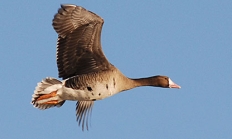
While not as abundant or conspicuous as the more familiar Canada and snow geese, the great white-fronted goose represents one of the first signs of fall. The greater white-fronted goose is gray-brown in body color and has orange feet. Adults have the namesake white forehead, pinkish-orange bill, and black speckled/barred breast and belly. Laugh-like calls from small skeins of these birds are heard high overhead in August through September in the north Willamette Valley and across the Cascades to south central Oregon and northeast California. Hear the call of the greater white-fronted goose Photo by Dave Budeau, ODFW
Inconspicuous and master of stealth, the Least bittern inhabits densely vegetated deep-water marshes, making observations rare and difficult; its call is often the only way to detect this secretive species. The smallest of herons, its long neck and legs make it appear larger. The crown, back and tail of male birds is greenish black; purple-chestnut on female. Neck, flanks, and underparts are brown and white and the wings buff. It is a rare spring and summer resident in larger freshwater marshes of eastern Oregon and a very rare spring through fall visitor in the Rogue and Willamette valleys. At Upper…

Though less conspicuous than Great blue herons, Green herons are well-established residents of western Oregon. They are distinguished by small size, glossy greenish-black cap and back, yellow legs, blackish-green wings, gray underparts, and dark red neck. One of the few tool-using birds, Green herons are experts at making and using baits and lures, such as bread crusts, mayflies, earthworms, sticks, and feathers to catch fish. The Green heron is an uncommon but regular migrant and summer resident throughout west and south central Oregon. Detection of nests is difficult and breeding status uncertain in some areas due to its secretive habits…

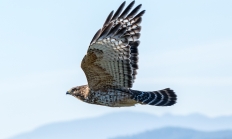
A medium-sized hawk, the Red-shouldered hawk has bold black-and-white flight feathers and rusty shoulder patches. Seen in flight from underneath, especially when lit from the sun, its wings show a translucent 'window' near the tips. It relies on perches for hunting and is closely affiliated with wooded wetlands and riparian bottomlands. In the breeding season this hawk is found in moist woodlands with at least a few deciduous trees. It prefers riparian bottoms, especially those near shallow wetlands or open meadows. In winter, it may use more open lands such as found in the Rogue and Willamette valleys, depending on…
The noisy and frenetic Ruddy turnstone is a stocky, plover-like bird who's breeding plumage is a clown like pattern of black, rust and white. Ruddy turnstones have been found foraging in the company of many other shorebird species. Found on rocky shores, jetties, open ocean beaches, mud flats, salicornia marshes, grass flats and flooded fields, the Ruddy turnstone is an opportunistic feeder. It is an uncommon to common spring and fall transient along the coast; a few birds remain to winter there each year. The largest flocks are seen during spring and fall migration at Bandon. They are an irregular…

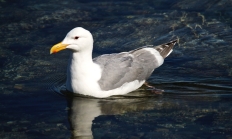
This mid-sized, pink-legged gull has caused much of the confusion in west coast gull classification and identification. Its plumage characteristics are similar to Herring, Iceland, and some Glaucous-winged hybrids, and great care is needed for correct identification. It differs from the Herring gull in having a much smaller bill, a darker eye, less black in the wing-tips and, often, a more rounded head. Opportunistic feeders, Thayer's gulls regularly concentrate about landfills, food-processing plants, and over fish runs. It is a common migrant and fairly common winter visitor along the coast. The largest wintering numbers are found in the Portland metropolitan…
This large arctic gull visits the Northwest in winter where its pale bulk often stands out in gull flocks. Finding one is a highlight of winter birding. Even at a distance the size and frosty tones of this bird can be spotted in a flock. Most Oregon birds are in the whitish first-or-second-year plumage showing a pinkish bill with sharply delineated black tip, but third-year birds and adults occur now and then, mainly on the north coast and at Sauvie Island. They are rare but regular along the coast and the Columbia River, and rare in the Willamette Valley. It…

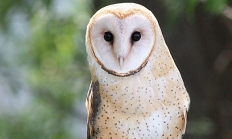
One of the most startling sounds in the black of night is the loud, harsh call of the Barn owl as it flies over field or marsh in search of small rodents. They are white to tan beneath with fine spotting ranging from almost none to fairly extensive. The face has a well-defined facial disc that acts as a parabolic dish collecting the faint sounds of its prey, allowing it to hunt successfully in total darkness. Male and female Barn owls are similar in appearance though the female is somewhat larger. The Barn owl is a fairly common permanent resident…
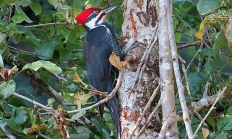
The Pileated woodpecker was the model for the cartoon character, Woody Woodpecker. It is a large black-and-white bird with a bold red feathered crest and distinctive call. You may hear its powerful drumming before you see it. In Oregon, its habitat includes older forests in the Blue Mountains, East and West Cascades, Klamath Mountains, Willamette Valley and Coast Range ecoregions. They prefer mature forests and younger forests with large snags and logs, requiring large diameter snags for nesting and foraging. Pileated woodpeckers are an Oregon Conservation Strategy Species in the Blue Mountains ecoregion. Hear the call and the drumming of…
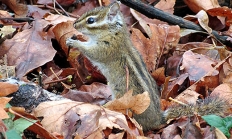
The pelage of this chipmunk is marked with five dark and four light stripes on the dorsum; the middorsal stripe is usually black and nearly always darker than the other four dark stripes. The sides of the face are marked with three brown and two light gray stripes, a patch behind the ear is light gray. The tail is blackish frosted with ochre dorsally and rusty brown ventrally. Allen's chipmunk produces a call of a rapid series of three or four to as many as 10 syllables. In Oregon, it occurs in forested areas along the eastern part of the…
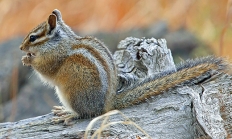
Townsend's chipmunk is the largest member of the genus in Oregon.The pelage of this chipmunk is dark and dull but as in other Oregon chipmunks, there is a dark brown to blackish middorsal stripe with alternate light and dark stripes, laterally, a total of five dark and four light stripes. Alternate dark (three) and light (two) stripes adorn the sides of the face. The throat, belly, and a patch behind the ear are white. The tail is black on the tip and the margins are frosted above with buff or white-tipped hairs. Townsend's chipmunks have been found on the west…
Features: The black back, white crescent on the side just in front of the wing, and white-ringed bill separate the drake ring-neck from the scaups. The brownish neck ring of the male in alternate plumage is not prominent. The hen is a small dark brown duck with a buff face. Drakes in courtship give a head-throw accompanied by a wow note while hens utter a growling purr. The ring-necked duck can resemble a scaup, so hunters need to know what they are shooting at. Habitat: These ducks are pretty widespread during the winter months. They generally prefer fresh water, from…

Features: Brant are a small to medium-size goose. They have smoky black backs and bellies, and dissected white collars and white around the tails provide striking contrast. The brant can live up to 20 years and are resilient enough to ride out storms on the open ocean. Habitats: Brant are primarily found in bays and estuaries, but on occasion can be found inland. They forage on eel grass and other aquatic vegetation. Most of their feeding is in shallow water or in tidal flats. They tend to feed in flocks. Techniques: As with any waterfowl hunting, location is key. Seek…

Adult tiger salamanders are relatively large with olive-colored blotches outlined in black. They have gray undersides and can grow to 13 inches in total length. As adults, tiger salamanders live almost entirely on land, returning to the water to breed. Terrestrial adults spend a lot of time in burrows that they or other animals have dug. Tiger salamanders are found in grassland and shrub-steppe habitats. It is unknown whether tiger salamanders occurs naturally in Oregon, or whether they were introduced by people after larval salamanders used for bait colonized fishing lakes and ponds. Photo by Matt Reinbold, Flickr

The Great Basin spadefoot is a species of toad. Adult spadefoots are gray with light lines along the back and light colored bellies. Their skin has abundant dark colored small bumpy spots. They have a single, black, hard spade on the heel of each hind foot. Adult females are larger than males, growing to two-and-a-half inches in length. Great Basin spadefoots live in dry sagebrush, grasslands and woodlands with sandy soils near ponds. Though they live in semi-arid habitats, they love the rain and damp weather. They spend most of the year in underground burrows that they dig quite efficiently…

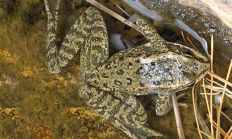
Adult Cascades frogs have tan, copper or green backs with black spots and yellow bellies. Their skin has small bumps on the back and sides. Females, which grow to three inches in length, are slightly larger than males. Cascades frogs live in a variety of moist habitats including mountain meadows, bogs, seasonally flooded forested swamps and shallow ponds, marshes and lakes. They use woody debris, mud or dense vegetation for cover from predators and spend their winters hibernating in mud. They emerge during the summer and live in wet meadows and bogs or along forested streams and pond edges. The…
Canvasbacks are large; adults in good condition are as heavy as mallards and second in size only to the white-winged scoter among common Oregon ducks. Drakes have a reddish head and neck; black breast, lower back and tail coverts; nearly white back, flank, and belly, and dark gray tail. The hen is grayish brown with a darker brown head, neck, breast and tailcoverts. It is an occasional summer resident in northeast Oregon, nesting locally only at Ladd Marsh in Union County. It is an uncommon spring and fall migrant in northeastern Oregon and regular in winter and spring on the…
