Search myodfw.com
Showing 661 - 680 of 925 results
LA GRANDE, Ore. – All northeast Oregon Access and Habitat (A&H) access areas are closed to public access due to wildfire. The A&H access areas affected are M.R King Ranches, Troy Ranches, Iron Mountain, Virtue Flat, Foster Ranch, Glass Hill, Owsley Canyon, Bear Creek, Carman Ranch, Harshfield Ranch, Divide Ridge…
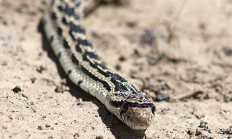
The gopher snake occurs in a wide variety of habitats, from deserts and grasslands to woodlands and open forests. It frequents agricultural regions, especially where there is brushy cover such as fence rows. Diet varies according to size, with young eating insects, lizards, rodents, and birds and their eggs. Adults can take larger prey, occasionally as large as rabbits. Photo by Simon Wray, ODFW
The red fox has a beautiful orange-red coat, black feet, and black-tipped ears. The belly is usually white or light grey, the muzzle is narrow and pointed, and the ears are pointed. It is an opportunistic carnivore, eating what is available including small mammals, birds and their eggs, reptiles, amphibians, fruit and some insects. The red fox is territorial and mates for life Red foxes occur throughout much of Oregon.

This lizard prefers humid areas, such as the edges of meadows in coniferous forests, and is also found in riparian zones. This is the only lizard found in the cool coastal forests of northern Oregon. The Northern alligator lizard eats small invertebrates (termites, beetles, ticks, spiders, millipedes, and snails), and occasionally takes small birds, mammals, and other lizards. Photo by Simon Wray

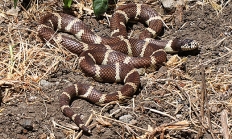
This snake is most common in thick vegetation along water bodies, but ranges into farmland, chaparral, and deciduous and mixed coniferous woodlands in the Rogue and Umpqua river valleys of southwestern Oregon. Common kingsnakes usually feed on other snakes, but have been known to take small turtles, birds and their eggs, frogs, lizards, reptile eggs, and some small mammals. Photo by Alan Schmierer, Flickr
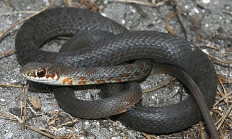
In the Northwest, this snake is found in grasslands, sagebrush flats, rocky stream courses, and canyon bottoms. Elsewhere it also frequents juniper and pine-oak woodlands. In southwestern Oregon, it is found in dry bushy areas close to rocks. Young striped whipsnakes feed primarily on lizards and insects. Adults also take snakes, small mammals, young birds, and insects. Photo by Bryn Hamilton, Flickr

The Rufous hummingbird is the most common and widespread of Oregon hummingbirds. This rusty-red and fearless nectar feeder is a popular yard bird, inspiring even the most modest of nature lovers to set up a feeder. It is a common transient and breeder throughout most of western Oregon, especially in forested regions. Hear the call of the Rufous hummingbird Photo by Charlotte Ganskopp

The racer is found in a variety of open habitats, including sagebrush flats, juniper woodlands, chaparral, and meadows. It avoids dense forests, high mountains, and very dry areas, and seeks cover under rocks, logs, or dense shrubs This species feeds on lizards, smaller snakes, frogs, toads, small mammals, birds and their eggs, and some insects. Young racers eat crickets, grasshoppers, and other insects. Photo by Simon Wray, ODFW
These delicate and truly golden plovers that pass through Oregon in fall are always a delight to find on an open beach or grassy coastal plain. The Pacific golden-plover feeds mainly in the open. A rare to uncommon migrant; most birds occur in fall on the outer coast. They are very rare to rare in winter on the coast and in the Willamette Valley. Hear the call of the Pacific golden-plover Photo by Dave Budeau, ODFW

With long, pointed wings, nighthawks can sometimes be seen during the day catching insects while in flight although most are active at night. Nighthawks roost by scraping the ground or roost on low branches. Nestlings can fly at 10 days old. Swifts nest on vertical walls, such as chimneys or old smoke stacks, hollow trees or rock crevices. It's fun to watch them at dusk in summer, circling their nesting site. These birds are never seen perched, but only in flight.

A dreary winter day can come alive with a flock of these striking birds foraging quietly in a dark green conifer. Though a common migrant and uncommon winter resident, it breeds largely to the north of Oregon. The Townsend's warbler is a common breeder in the Blue and Wallowa mountains of northeast Oregon and a local summer resident in the vicinity of Mt. Hood and in the central Cascades. Hear the song of the Townsend's warbler Photo by Doug Greenberg, Flickr

Features: These blue-green, silvery or light brown fish are a schooling fish and an important food source for larger fishes, sea birds and marine mammals. Habitat: Anchovy are frequently offshore, but can be caught inshore in harbors and large estuaries during spawning. Technique: Anchovy are usually targeted in bays with multiple-hook herring jigs.

Enterprise, Ore. – Beginning Friday, Sept. 19 through Friday, Oct. 31, harvest of wild adult Chinook salmon (non-adipose clipped, ≥ 24 inches) will be closed in the Snake River from the Oregon/Washington border upstream to Hells Canyon Dam. During this period, anglers may continue to harvest adipose-clipped (hatchery) fall Chinook…
LA GRANDE, Ore. – Effective Aug. 1 through Sep. 30, minimum and maximum size limits as well as the daily and possession bag limits for rainbow trout and bass are suspended for Thief Valley Reservoir (Southeast Zone) located in Union County. Harvest will be allowed by hand, dip net, or…
In 1925 the first fish hatchery on the South Santiam River began operations about 5 miles upstream from today’s present site, rearing annually approximately 100,000 spring Chinook in dirt ponds for release into the South Santiam River. The present site came about with the construction of Foster Dam. In 1968 the facility was dedicated for the rearing of spring Chinook and summer steelhead. This facility was built and annually funded in part by the US Army Corps of Engineers to compensate for the loss of spawning and rearing areas above the dams on the South Santiam River.
This large loon breeds in the Arctic tundra from Northwestern Russia across Siberia and Alaska through Canada to Hudson Bay. It winters in North America along the coast of South Alaska and British Columbia, and regularly in small numbers south to Baja, California. The majority of Oregon records are of transient birds found between early November and early June. Hear the call of the yellow-billed loon Photo by Mark Peck, Flickr

Horned puffins have an unmistakable black and white plumage and a large, distinct, yellow and orange bill during the breeding season. They are rare in Oregon, and most commonly encountered dead on the beach in winter or spring, or sighted more than 50 miles offshore in spring. Individual birds, or possibly pairs, occasionally stay in Oregon for the breeding season and are seen attending colonies with Tufted puffins, but there are no records of breeding in Oregon. Hear the call of the Horned puffin

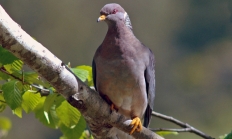
About the size of the domestic pigeon, this swift-flying species is popular among sport hunters. An arboreal bird, it is often observed perched alone on top of a tall tree or in flocks when flying about feeding areas and mineral sites. This is a common summer resident in forested areas west of the Cascade crest. It typically nests in forested mountain areas in the west Cascades. Hear the call of the Band-tailed pigeon Photo by Dave Budeau, ODFW
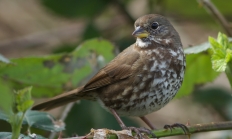
These big, medium-brown sparrows with variable grayish faces and heavily streaked or blotch undersides can be found in summer at higher elevations across much of the state except the Coast Range. Darker brown birds from more northerly breeding populations are common in western Oregon in winter, often coming to feeders, where they scratch like towhees for seed on the ground. Hear the song of the Fox sparrow Photo by Robin Horn, Flickr