Search myodfw.com
Showing 701 - 720 of 897 results
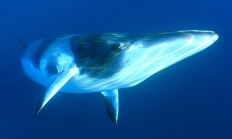
The minke whale is one of the smallest baleen whales, growing to about 35 feet. They feed along the coast in the same area as gray whales. It is close enough in size to a gray whale that you could mistake one for the other at a distance. At close range, however, the difference is apparent. Minkes have a dark black or gray, sleek body with a white underside. They are often recognized by surfacing snout first and a small, weak, but visible, bushy blow that is about six to 10 feet high. When diving, they do not display their…
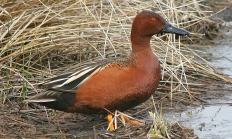
Features: Male cinnamon teal have a cinnamon-red head, neck, breast and belly. Like blue-winged teal, t hey have a bright patch of iridescent green on the rear of the wing and a bright blue patch on the front of the wing . They also have a distinctive red eye, a black bill and yellow legs and feet. Female and young male cinnamon teal are often confused with female blue-winged teal. Habitat: Prefer shallow, alkaline lakes where they dabble on aquatic plans. Techniques: Most cinnamon teal in Oregon are taken in eastern Oregon in the early season. They are not common…
The Cascade torrent salamander generally has numerous medium-sized black spots and white-gray flecking along its tan back and sides and a bright yellow belly that has fewer spots. Adults can grow to just over four inches in total length. Cascade torrent salamanders spend their lives in and near permanent, cold, fast-flowing and clear water including headwater streams, waterfall splash zones and seeps in older coniferous forests. Adults need gravel streambeds or other gravel areas with constant and shallow water flow for foraging and cover. The Cascade torrent salamander is an Oregon Conservation Strategy Species in the West Cascades and Willamette…


There is year-round salmon, steelhead, trout and smallmouth bass in the Southwest Zone. Rainbow trout are stocked in the upper Rogue River and in lakes nestled among fir forests and wind-swept dunes. Big reservoirs provide fishing for trout and for thriving populations of largemouth bass, catfish, perch and crappie. Coastal bays serve as gateways to rich offshore reef fisheries, and miles of public beach allow anglers to fish for surfperch against a backdrop of rugged capes.
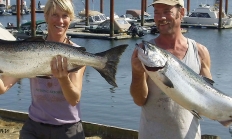
SALEM, Ore..— Everyone can fish, clam and crab for free in Oregon on Saturday and Sunday, June 6-7, 2026. No fishing/shellfish licenses or tags/validations are required on these days (meaning you do not need a Combined Angling Tag, Columbia River Basin Endorsement, Ocean Endorsement or two-rod validation where two rods…

The ring-necked duck, which would have been better named "ring-billed duck" and is called "blackjack" in the southeastern United States, frequents different habits than the scaups with which is is often confused. The black back, white crescent on the side just in front of the wing, and white-ringed bill separate the drake ring-neck from the scaups. The brownish neck ring of the male in alternate plumage is not prominent. The hen is a small dark brown duck with a buff face. Drakes in courtship give a head-throw accompanied by a wow note while hens utter a growling purr. Ring-necks are…

This restless diver of cold oceans and bays is one of the prize waterfowl to see on a coastal winter day. Although the loud, musical call of males is seldom heard in Oregon, we can still be cheered on a chilly day by this energetic visitor from the north. The winter males' body is mostly white except for a black breast and central back; the wings are dark, scapulars long and gray, and the dark central tail feathers elongate. Winter females are darker above with a light head; scapulars and tail feathers are short and dark. Dark areas mark females'…

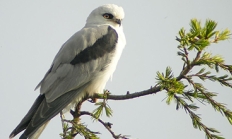
As the winter day turns to dusk, White-tailed kites drop into their roosts and Short-eared owls rise to take their place on the local hunting grounds. White-tailed kites in Oregon often roost communally in winter, but they disperse in early spring and are more difficult to find during the breeding season. By day, they are conspicuous as they hover over rural fields searching for prey, in part because of their pale appearance. The tail is entirely white, as are the head and the underparts. Dark crescents on the underwing can be seen when a bird is flying or hovering. Above…
In length, the Great gray owl is Oregon's largest owl, though it weighs less than the Great horned and Snowy owls. It is sooty gray to brownish above and lacks ear tufts. The prominent facial disc, outlined in black, contains a series of fine concentric rings that surround piercing yellow eyes. Despite its large size, both feet and bill are small. Sexes are similar. It is an uncommon to rare inhabitant of forests adjacent to openings above 3,000 feet in the Cascades, Blue, and Wallowa mountains. Most observations in the Cascades are from east of the crest, though they have…

So familiar is the American crow that it has been said if a person knows only three species of birds, one of them will be the crow. Recognized by its coal-black plumage, fan-shaped tail, and nasal caw call, it is found throughout most of North America, and its seemingly mischievous character has been immortalized in folk tales and fables. These shrewd birds possess a superior intelligence and an ability to learn and make decisions. They are also sociable, joining together in large roosts, especially in fall and winter. Able to thrive in a wide variety of environments, crows are expanding…

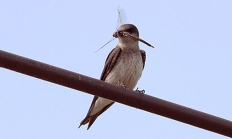
All have cause to marvel at the sight of a gorgeous male Purple martin. Adult males are entirely glossy bluish-purple, although they may look black in poor light. Females and yearling males are grayish below and darker above with a paler forehead and nape. The world's largest swallow, martins are uncommon in Oregon. They nest both solitarily and colonially in nest boxes specially put up for them, in crevices in human-made structures, and in cavities in snags and pilings. They are an uncommon local summer resident, principally inhabiting the Coast Range and Willamette Valley. They are also locally common at…
The song of the Yellow-headed blackbird, if it can be called a song as it lacks any musical quality, is a familiar sound in the marshes particularly of central and southeastern Oregon. The male, with its yellow head, neck, and breast, black body and wings, and white wig patches, is unmistakable. The female is more subtle with its dusky or sooty brown body plumage and yellow cheeks, chin, throat and chest, but is also distinctive. It is an abundant spring and summer resident in marshes of large alkaline lakes and wetlands in southeast Oregon, most notably the Klamath, Summer, Malheur…

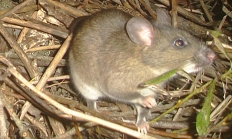
The dusky-footed woodrat is a medium-sized rat-like form with large, nearly naked ears, protruding eyes, and a long tail. The dorsal pelage consists of hairs with steel gray bases, a band of ocherous buff, and a tip of black. Hairs on the throat and belly are white. Although variably in extent, a dusky splotch occurs on the dorsal surface of the white feet. In Oregon, this woodrat occurs from the California border northward along the coast to near Bandon, northward inland through the Willamette Valley and other interior valleys to near Mollala and Monmouth, and northward to Brownsboro, Jackson County…
The Sierra Nevada red fox is a montane red fox subspecies. Its presence in Oregon was confirmed in 2015, specifically in the Mt. Jefferson, Mt. Washington, and Three Sisters Wilderness Areas. The Sierra Nevada red fox is smaller than the red fox and averages about eight pounds. This fox has three color phases: silver (black), "cross" color phase and the more familiar red. The Sierra Nevada red fox is an Oregon Conservation Strategy Species in the East Cascades, Klamath Mountains and West Cascades ecoregions. Research continues on this species in the Oregon Cascades. Biologists captured and radio-collared several Sierra Nevada…

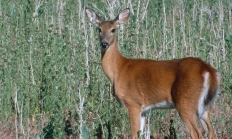
Features: Oregon’s rarest deer has a brown tail that is longer than a blacktail’s wide tail. Its antlers will branch off from a single main beam, unlike mule deer and blacktail antlers that branch twice. Habitat: The Columbian whitetail is a subspecies unique to Oregon and southwest Washington and found in just a few locations—along the lower Columbia River in Oregon and Washington, and in the Umpqua Basin near Roseburg (where it is expanding its range). Techniques: Just a few controlled hunts for this subspecies exist in the Umpqua Basin region and tags are limited; see the regulations for details.
Features: Like all cutthroat trout, this species boasts bright red streaks on either side of its “throat.” You can tell it’s a westslope cutthroat by its spot pattern – the majority of the black spots are found on the back end of the fish with rather few ahead of the dorsal fin. Habitat: While westslope cutthroat trout was once the most widely distributed cutthroat in North America, its home in Oregon has always been limited to the John Day Basin. During the cooler months of summer you can find them in places like Strawberry Creek and upper Canyon Creek. As…

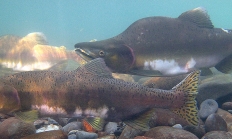
Features: These fish are silver when young, but darken and develop black spots on their tails and backs as they age. In fresh water, the males are red on their sides and develop a hump on their backs earning this species the common name humpback salmon. Females in fresh water are green on the sides with dark bars. Pink salmon are an average of 20- to 25-inches long and rarely weigh over 5 pounds. Habitat: Pink salmon spawn on odd numbered years and do so very close to saltwater, never going very far upriver. In fact, some pink salmon will…
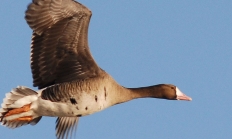
Features: The distinctive white band across the base of their bill gives this goose its name. It is medium in size with a gray and brown body. Adults have d ark brown and black spots on their chests and breasts give this goose the "specklebelly" nickname, while the young of the year birds are a nondescript gray with yellow legs and bills. Habitats: The white-fronted goose grazes on a mixture of grasses and grains. It can often be found in agricultural lands. Techniques: Hunting white-fronted geese is not for the faint-hearted. Scouting is necessary. And since they're mostly found in…