
Search myodfw.com
Showing 901 - 920 of 1410 results
The Minto Fish Facility is part of the Marion Forks/ Minto Fish Facility complex. Minto is located upstream of Packsaddle Park on the North Santiam River. The Minto facility has year round fish collection, acclimation for Chinook salmon and steelhead, a spawning facility, juvenile acclimation, short and long term holding of adult salmonids, water to water transfers for all fish, and out planting and fish recycling capabilities. Minto Dam creates an impassable barrier that encourages migrating fish into the facilities fish ladder. All fish moving upstream are counted, and disposition is determined depending on species and time of the year.
NEWPORT, Ore. – ODFW is holding a June 16 public meeting to evaluate the commercial market squid fishery. Oregon commercial squid fishers, producers and interested public are encouraged to attend. The meeting is held from 1 – 3 p.m. at Hatfield Marine Science Center in the Guin Library Seminar Room…
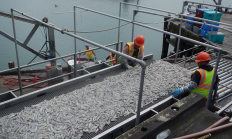
Each year ODFW assesses the freshwater escapement of Rogue River coho, fall Chinook, late run summer steelhead, and "half-pounder" steelhead by beach seining the waters near Huntley Park three times a week from Mid July thru October.
KLAMATH FALLS, Ore.—A video camera captured a Chinook salmon ascending the fish ladder at Keno Dam on the upper Klamath River this week (Sept. 24), the first picture of a salmon ascending the upper bays of the ladder since four hydroelectric dams were removed on the Klamath River last year…

Shellfish regulations only apply to Columbia River downstream of Tongue Point/Rocky Point line at the mouth of the Columbia River.


Columbia Fishing June 18, 2026 Current and upcoming fishing opportunities: Steelhead fishing is fair downstream of Rainier. Shad fishing is good for bank anglers at Bonneville Dam. Walleye fishing is good in The Dalles and John Day pools. For the latest regulations for the summer management season, see the fishing regulation update page. Announcements Columbia River sockeye season delayed until at least June 27. Read news release here. For the latest regulations, including in-season changes see the fishing regulation update page. Forecasts for 2026 Columbia River Spring Chinook, Summer Chinook and Sockeye are available here. Fish consumption advisories The Oregon…
This Eurasian diving duck regularly occurs in the Aleutian Islands and with increasing regularity in North America, especially along the West Coast. It is now reported annually in Oregon, between mid-October and early May, with most during January and February. All were from the coastal lowlands or the Willamette Valley, except for one on a small pond in Josephine County. They are closely related to the scaups and often associated with them. Hear the call of the tufted duck Photo by Tom Benson, Flickr

Greater scaup are almost the size of redheads. In hand, they are easily distinguishable from lesser scaup by size and by the white wing stripe extending beyond the secondaries into the primaries. In the field the two species are sometimes difficult to separate. Drakes are black on both ends and white in the middle. Hens are dark brown with a white mask around the base of the bill. The common vocalizations are the discordant scaup and purring pbbbrr of the female. Greater scaups form large flocks, sometimes mingling with lesser scaups in fall and winter. They are an abundant migrant…

This small, boldly-patterned duck can be found in Oregon throughout the year, either around rocky headlands on the coast or inland on mountain streams. No other breeding duck in Oregon feeds almost exclusively on benthic invertebrates, often swimming underwater and upstream against swift current in search of prey. Though males are striking in appearance, these and the drab brown females can be difficult to see when at rest on a mid-stream rock or dodging behind rocks as they evade observers. Broods have been observed or nests located on tributaries in the river basins of the west Cascades. They are found…

Although the least numerous scoter on the continent, it is the most common scoter along the Pacific coast south of Alaska and winters by the thousands off Oregon. Adult males' plumage, black except for white patches on the forehead and nape, yields attention to the bill, a swollen white, red-orange, yellow, and black wedge feathered squarely along its base. The highly visible standard advertises male's presence for up to a mile. Dark-billed adult females and subadults are dark brown above and paler brown below, with two indistinct light patches on the cheeks and sometimes on the nape. A flattened head…
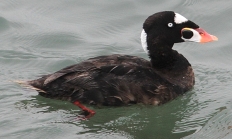
The white secondaries of the white-winged scoter in all plumages form a conspicuous square wing patch during flight but are often hidden during rest. Other than the secondaries, males' plumage is entirely black except for a small white teardrop around each eye. Females and immatures are dark brown above and pale below with diffuse white patches in front of and behind the eyes. A black knob graces the males' swollen, white-ridged, orange bills, while females' and immatures' bills are dark; the feathering of all extends almost to the nostril. Abundant along the coast from fall through spring, white-winged scoters are…
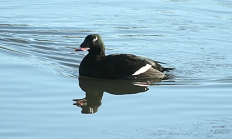
Adult male scoters of all species are black, but black scoters are the blackest; their shiny black plumage bears no white. The swollen bright orange-yellow knob on the otherwise black bill is smaller than that of other scoters. Males are distinguished in flight by the flashing silver-gray of underwing flight feathers against black wing linings and the all-black body. Females' uniform soot upperparts and dark head cap are clearly delineated from paler cheeks; their bills are usually dark. Immatures resemble females, but most males acquire some black feathering the first fall. This scoter can be uncommon to locally common along…

The common goldeneye drake is a strikingly handsome black-and-white diver about the size of a greater scaup. Goldeneyes are strong, fast flyers nicknamed "Whistlers" for the sound of their primaries as they zoom past on a still day. Drakes have a black head with a white spot below and in front of the eye, white neck, breast and flanks and a black back and tail. Hens have a brown head, light neck, breast and belly, brown backs and flanks. They are fairly silent and usually alone or in small groups. They tend to remain apart from other ducks. It is…

Medium-sized diving ducks, Barrow's goldeneyes are the expected of the two goldeneye species in Oregon in the summer, but are typically less numerous in the winter. Drakes show graceful patterns of black and white, purple glossed head, white crescent-shaped patch between the eye and bill, steep forehead, and short bill. Females and juveniles have a chocolate-brown head, slate-gray back, wings and tail; adult females have a golden bill. They are the only waterfowl species known to defend winter territories different from breeding territories. It is uncommon from the Cascades eastward in both breeding season and winter, but it may concentrate…

In quiet backwaters and wooded wetlands, these stunning ducks can occasionally be seen skulking near the shoreline as they search for fish. The male with a striking black head and extensible white crest, white breast, black back, and chestnut sides is truly a sight to behold. Females and immatures are quite plain by comparison: dull grayish-brown except for a reddish brown crest. Hooded mergansers are surprisingly secretive and local during the breeding season. They breed locally throughout the Willamette Valley west to the coast and south to Coos County. They are casual from April to early October in the Umpqua…

A white form on the distant water may be the sides and breast of an adult male, whose deep green head and dark back are less visable when far away. The pearl gray bodies and white breasts of females, subadults, and eclipse males are starkly delineated from their full-crested chestnut heads. Long, slender, saw-tooth bills are held horizontally during surface swimming and grip squirming prey after an underwater chase. From coastal bays to the high Cascades, in all corners of Oregon and far beyond, common mergansers ply the rivers and peer into still waters in their efficient pursuit of fish…
