
Search myodfw.com
Showing 961 - 980 of 1416 results
Townsend's mole is the largest talpid in Oregon. In Oregon, it is restricted to the interior valleys and coastal regions west of the foothills of the Cascade Range. It occupies pastures, prairies, and shrub habitats in lowlands and river flood plains. The highest densities were recorded in pasture areas in Tillamook County. Photo by J. Maughn, Flickr
Features: Gaper clams have large "neck" housing the two siphons that protrude above the substrate surface when feeding. Protective leathery plates are found just below the siphon tips and feel rough to the touch. Gapers are unable to retract their neck entirely into the shell, producing a "gape" in the shell. It is common for algae to grow on their necks and gaper pea crabs to dwell inside the shell with the gaper clam. Habitat: Gapers can be found in high salinity sandy and/or muddy areas in most of Oregon's larger estuaries. Tillamook, Netarts, Yaquina, and Coos are favorite bays…

The Bald eagle is one of eight species of sea-eagle worldwide, and the only sea-eagle found throughout North America. It is one of the most studied North American birds. Large size, wingspan of six-and-a-half to eight feet, and the contrast of white head and tail, and yellow eyes, beak, and leg, to dark brown body and wings make the adult Bald eagle one of our most distinctive raptors. Six age-related plumages have been recognized; adult plumage is acquired at four-and-a-half to five years of age. Sexes have similar plumages, but females are larger than males, and the sex of individuals…

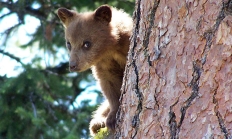
Black bears are the largest extant carnivores in Oregon. They are, however, smaller than grizzly bears, and they lack the grizzly's distinctive shoulder hump. A black bear is heavily built with stout legs and large feet. The eyes and ears are relatively small and the tail is extremely short. The claws are recurved but relatively short with those on the forefeet equal to or only slightly longer than those on the hind feet. The characteristic humped shoulders and dished face of the grizzly bear are absent. During spring-autumn seasons, black bears tend to be more active during daylight and crepuscular…
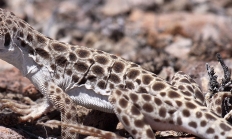
Lizards are more like ancient reptiles than either snakes or turtles. There are more than 2,500 species of lizards known in the world and they range from legless, snake-like varieties to the better known, four-legged type with five toes on each foot and scaly skin. Most lizards lay eggs but some give birth to live young. Most eat insects and small animals; some eat plants. Many lizards are very fast and most can swim. Some can even "swim" through sand, just below the surface. Lizards don't like to be caught and several species will take some pretty drastic steps to…
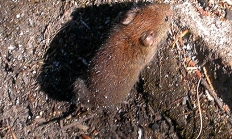
The Merriam's shrew is the smallest shrew in Oregon. This brownish shrew has a short, truncated skull and is medium dark-brown on the dorsum and pinkish white on the venter; the tail is sharply bicolored in the same tones as the body with dark and light portions about equal. In Oregon, it has been found in Grant, Harney, Lake, and Wasco counties. It occupies drier habitats and is reported to be associated with sagebrush-bunchgrass habitats.
Searching for frogs and salamanders is a great way to introduce kids to the wonders of Oregon's wildlife and the great outdoors. Learn more about their various habitat needs and you'll increase your chances of seeing one of these unique species. Remember to leave no trace to preserve their habitat. Check out our fun facts on Oregon's frogs.
The Southern red-backed vole is among the smaller voles in Oregon. The pelage is silvery on the venter and grayish with ocherous on the sides, and with a rusty or reddish stripe on the dorsum; the tail is dark brown or black above and whitish or grayish below. In Oregon it occurs in the Ochoco, Blue, and Wallowa Mountains southwestward to central Crook County and northern Harney County. Photo by D. Gordon Robertson, Wikipedia
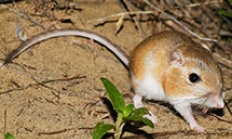
The Ord's kangaroo rat is a medium-sized kangaroo rat with awl-shaped lower incisors. It is the lightest-colored kangaroo rat in Oregon; overall the dorsum is a rich buff with gray overtones. The venter, upper lip, feet and side of the tail are white; there is a white spot above each eye and behind each ear; and a white stripe crosses each thigh. The moustache, eyelids, and ears are blackish. In Oregon, it occurs east of a line connecting The Dalles, Hood River County; Sisters, Deschutes County; and Lakeview, Lake County except in the Ochoco, Blue, and Wallowa mountains. Although occasionally…
The Rufous hummingbird is the most common and widespread of Oregon hummingbirds. This rusty-red and fearless nectar feeder is a popular yard bird, inspiring even the most modest of nature lovers to set up a feeder. It is a common transient and breeder throughout most of western Oregon, especially in forested regions. Hear the call of the Rufous hummingbird Photo by Charlotte Ganskopp

The Western small-footed myotis is among the smaller bats in Oregon and is brown to pale yellow with black ears and a black mask across its eyes and nose. It lives in dry climates, especially cliffs and rocks, and forages back and forth along the face of cliffs. It hibernates in caves and mines from November through February. In Oregon, the species only occurs east of the Cascade Range. Photo by ©Michael Durham

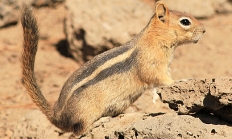
The golden-mantled ground squirrel doubtlessly is the most distinctively marked ground squirrel in Oregon; a white stripe bordered on both sides by a black stripe extends from the shoulder to the hip. From nose to nape above the eye, the head is russet. The back between the stripes is grizzled dark grayish-brown becoming less grizzled on the rump; lateral to the stripes the color grades to a light buffy-gold on the venter. The face, shoulders, front legs, and feet are a bright orangish-gold. This ground squirrel occupies the east slope of the Cascade Range and most of central Oregon, and…
Oregon has one species of kingfisher, the raucous Belted kingfisher and 12 woodpecker species. Six woodpeckers are Oregon Conservation Strategy Species of management concern and in need of conservation. Famous for their hammering and hole drilling, woodpeckers might decide your home looks like a good place to set up shop. Learn how to discourage this on our Living with Wildlife, Birds page.

A dreary winter day can come alive with a flock of these striking birds foraging quietly in a dark green conifer. Though a common migrant and uncommon winter resident, it breeds largely to the north of Oregon. The Townsend's warbler is a common breeder in the Blue and Wallowa mountains of northeast Oregon and a local summer resident in the vicinity of Mt. Hood and in the central Cascades. Hear the song of the Townsend's warbler Photo by Doug Greenberg, Flickr

SALEM, Ore. — ODFW's Fish Restoration and Enhancement Board will meet in person on Tuesday, Sept. 30 from 8:30 a.m. to 5 p.m., in Redmond at The Lodge at Eagle Crest. The meeting will occur in person and via Teams, and members of the public may attend the meeting in…
CLACKAMAS, Ore.—Fishery managers from Oregon and Washington added several days of recreational spring Chinook fishing on the mainstem Columbia River during a joint state hearing today. With these additional days, and the action taken last week, the Columbia River will be open for spring Chinook for the entire upcoming Memorial…


These large "peeps" are seen in Oregon mainly in late summer and fall, when their size, scalloped buffy plumage, and long profile help them stand out in flocks of other small sandpipers. It is an uncommon migrant statewide, with most birds southbound juveniles. It can occur in suitable habitat anywhere in Oregon, but numbers are usually very low and sizable flocks almost nonexistent. Hear the call of the Baird's sandpiper Photo by Howard Patterson, Flickr

The Costa's hummingbird is a very rare spring and summer visitant to central and southwestern Oregon. Males are sometimes present for the entire year in the Rogue Valley. Males have been observed in canopy-free riparian habitat along Bear Creek and semi-open tall white oaks at the edge of Agate Lake. Many of these birds go undetected in Oregon because of their similarity with other hummingbird species. Hear the call of the Costa's hummingbird Photo by Mick Thompson, Flickr
