
Search myodfw.com
Showing 981 - 1000 of 1416 results
Bringing its cheerful song to streamside thickets throughout the state each breeding season, the bright and active Yellow warbler seems to be the incarnation of summer. Notable for its vivid color, it has been described as a "rich yellow flame among the opening leaves." It was once the most conspicuous breeding warbler in Oregon and was formerly common in shade trees of urban areas, including western Oregon, but has declined precipitously. Hear the song of the Yellow warbler Photo by ©Keith Kohl, ODFW

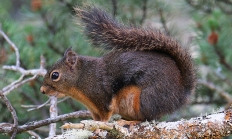
The Douglas' squirrel is one of the smaller tree squirrels in Oregon. The color and markings of this squirrel differ individually, geographically and seasonally, appearing a dusky olive to brownish gray with an indistinct band of reddish brown with a blackish band along the flanks. In Oregon, it occurs in coniferous forests from the Pacific coast to as far east as western Baker County. Douglas' squirrels are active during the daylight hours year-round, although they may remain in their nests or tree dens for a day or two during inclement weather. Photo by Kathy Munsel, ODFW
The Northern pocket gopher is the other small pocket gopher in Oregon. Its dorsal pelage ranges from a rich brown to a yellowish brown or buffy gray; the venter is lighter and usually washed with buff. This gopher builds extensive burrow systems which consist of both near-surface and deep runways connected by a vertical shaft. The nest cavity is commonly situated in the deep runway with blind tunnels radiating from near the nest that are used for food storage and as a latrine. The Northern pocket gopher occurs throughout Oregon east of the Cascade Range.

Greater sage-grouse are best known for their elaborate courtship displays that occur on traditional strutting grounds, known as leks, where males gather each spring. At all seasons, both sexes are readily identified by large size and chicken-like build. Adults are mottled dark gray, black and buff, with black bellies and pointed tails. Males have specializations used in display. Their tail feathers are long and pointed with white spots. They have yellow combs over each eye and a chest sac with two bare, yellow patches of skin which are inflated during display. The display lasts only a few seconds and is…

SALEM, Ore. – Oregon's Fish Screening Task Force will meet virtually on Thursday, April 2 at 8:30 a.m. The meeting is open to the public and will be held virtually through Teams. The meeting agenda includes updates on the Fish Screening Program, new task force members, and the development of…
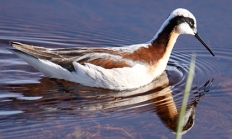
This is the largest and most terrestrial of the three species of phalaropes in Oregon. It is similar in shape to other Phalaropes, but larger size, longer bill and neck, lack of bar on the wing, and white rump distinguish it. In adaptation to a more terrestrial life than other Phalaropes, its toes are fringed, not lobed. It is a common transient and breeder east of the Cascades. The largest numbers breed on the great marshes of southeast Oregon. They are rare visitor west of the Cascades. Hear the call of the Wilson's phalarope Photo by Charlotte Ganskopp
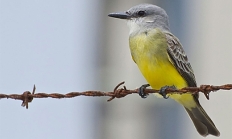
Individuals of this Mexican and South American resident regularly disperse northward in the fall. They occur in good numbers along the California coast, but become steadily scarcer northward. In Oregon, Tropical kingbirds are most often found in open situations close to the ocean, about an estuary, in pastures, in towns, sitting on a telephone wire or fence line, or on a bare tree branch. The majority of Oregon records occur from late September to late November. Hear the song of the Tropical kingbird Photo by Brian Garrett, Flickr
Southern Oregon is the northwest limit of the breeding range of Blue-gray gnatcatcher, which, as its name implies, is an active, diminutive bluish-gray. This is an energetic bird, commonly jerking its tail sharply to one side, wings held below, occasionally spreading its tail. It breeds in numerous disjunct localities and may be expanding its range in Oregon. It is an uncommon to common summer resident in the interior Rogue Valley. Hear the song of the Blue-gray gnatcatcher Photo by John Sutton, Flickr

This uncommon inhabitant of Oregon's high desert can be a challenge to find unless the observer becomes familiar with its territorial song and preferred habitat. Habitat requirements are specialized and population distribution and densities are highly variable from year to year in Oregon. The Black-throated sparrow occurs along boulder-strewn, sparsely vegetated slopes of arid deserts. They prefer warm dry sunny slopes of desert basins. Hear the song of the Black-throated sparrow Photo by Ashley Tubbs, Flickr

Merriam's ground squirrel is one of the two small gray ground squirrels in Oregon without stripes or spots. Most of the geographic range of this squirrel is in Oregon, where it occurs south and east of a line connecting Huntington, North Powder, Maupin, Warm Springs, Bend, and Fort Rock, Summer Lake, and Plush. This species does not occur south of the North Fork Owyhee River in Malheur County. These ground squirrels emerge in early March, breed, rear their young, become exceedingly fat and go into their hibernacula by early August. Photo by ©John Rakestraw

This species is found in pine forests, oak woodlands, and in chaparral of southwestern Oregon valleys. It is usually found in, under, or near rotting logs in open wooded areas near streams. The California mountain kingsnake preys upon snakes, lizards, birds and their eggs, and some small mammals. It is an Oregon Conservation Strategy Species in these ecoregions: Coast Range, Columbia Plateau, East Cascades, Klamath Mountains, and West Cascades. Photo by William Grenfell, Flickr

Although they occur in a wide variety of habitat types, from deserts and chaparral to open forests across Oregon, Western rattlesnakes usually occur near rocks, cliffs, or downed logs. They overwinter in dens typically located on south-facing rocky hillsides exposed to sunshine. Western rattlesnakes feed mainly on small mammals, including mice, gophers, squirrels and rabbits, but will also take birds lizards, and amphibians. The Western rattlesnake is an Oregon Conservation Strategy Species in the Willamette Valley. Photo by Simon Wray, ODFW

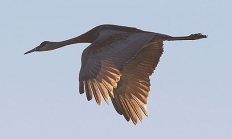
The Greater sandhill crane is Oregon's tallest bird. This large majestic crane has a guttural gurgling or bugling call, and is easily noticed in flight by its profile, with long neck and head extending straight ahead and long legs trailing behind. The Greater sandhill crane is distinguished by its red crown and white cheek patches, contrasting with with a light gray body. Fledged young resemble adults, but have a feathered forehead, a lighter tawny plumage, and lack the red crown and white cheek patches during their first fall. Fledged young have a squeaky cheap call often heard in flight during…
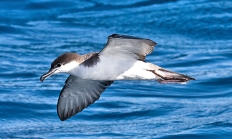
Few seabirds have been labeled "stunning;" but with their graceful flight, boldly patterned upperparts, and brilliant white underparts, these birds truly are one of the most beautiful in Oregon waters. They have a black cap, wings angled forward, long body and tail, and a unique dark 'M' pattern against light gray back and wings. Often seen in small groups mixed among other more abundant shearwaters, they sometimes form pure flocks all flying in gracefully synchronized flight. While regular in Oregon in late fall, they are still uncommon enough to excite observers when encountered at sea. Photo by Tony Morris, Flickr
Often mistaken for a duck, the American coot is actually a member of the rail family. It is a smallish, slate-gray water bird with a white bill. At home swimming in ponds and marshes, it seems to propel itself through the water by rhythmically extending its neck. During the nesting season it can be seen enthroned on a sizable nesting platform built from marsh vegetation. It has the largest Oregon breeding population of any waterfowl. Rafts of thousands of coots stage for migration in spring and fall on lakes throughout Oregon. Hear the call of the American coot Photo by…

In winter plumage, the crisp black head, white neck patch, and gray back are striking, and when combined with a pale bill this species is readily distinguished from small alcids in Oregon. Wing-propelled divers, they are nonbreeding visitors to Oregon's offshore waters. They are the only seabirds whose young are reared entirely at sea. The Ancient murrelet is an uncommon to common fall migrant and winter visitant in shelf waters near shore; rare to uncommon in spring; absent to rare in summer. Hear the call of the Ancient murrelet Photo by Patty Mcgann, Flickr

One of the most nondescript birds found in Oregon, this sparrow makes up for its drab appearance by its extraordinary song. It is by far the most abundant bird breeding in the vast sagebrush expanses of the Intermountain West. The Brewer's sparrow is an abundant migrant and summer resident east of the Cascades summit, particularly in the southeast quarter of the state among the vast sagebrush communities of the Great Basin Shrub-steppe. In the Columbia Plateau ecoregion, it is an Oregon Conservation Strategy Species. Hear the song of the Brewer's sparrow Photo by Dave Menke, USFWS

The Pacific shrew is the only shrew in Oregon without a tine on the anteromedial surface of the first upper incisor but with a posteriomedial ridge visible in anterior view through the gap between the incisors. It is a large brown shrew with the third unicuspid smaller than the fourth. The species is often found in moist wooded areas with fallen decaying logs and brushy vegetation. It is endemic to Oregon and is distributed as two disjunct populations: one in the Coast Range from Cascade Head, Tillamook County, south to Coos Bay, Coos County and eastward to Philomath, Benton County…
Trowbridge's shrew is a medium-sized shrew, distinguished from other Oregon shrews by its dark-brown or grayish black pelage on both dorsum and venter, and its sharply bicolored tail, white below and dark brown or grayish black above. In Oregon, its range is west and south of a line connecting Parkdale, Hood River County; Pine Grove, Wasco County; Alder Spring, Lane County; Diamond Lake, Douglas County; Gearhart Mountain, Lake County; and Lakeview, Lake County. It occurs in all stages of the coniferous forest from old growth to recent clear-cuttings. Photo by Don Henise, Flickr
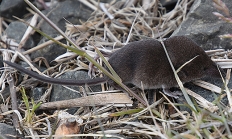
The vagrant shrew can be distinguished from all other congeners in Oregon by the combination of the upper unicuspids wider than long in ventral view. It is light medium brown on the dorsum, light pinkish-gray on the sides, and white on the venter, bases of hairs on all three areas are neutral very dark-gray. The tail is weakly bicolored (dark brown over white) in juveniles. The vagrant shrew occurs throughout the state except in the Columbia Basin. It tends to be more of a generalist than most Oregon shrews in terms of habitat affinities, nevertheless, it usually is found in…